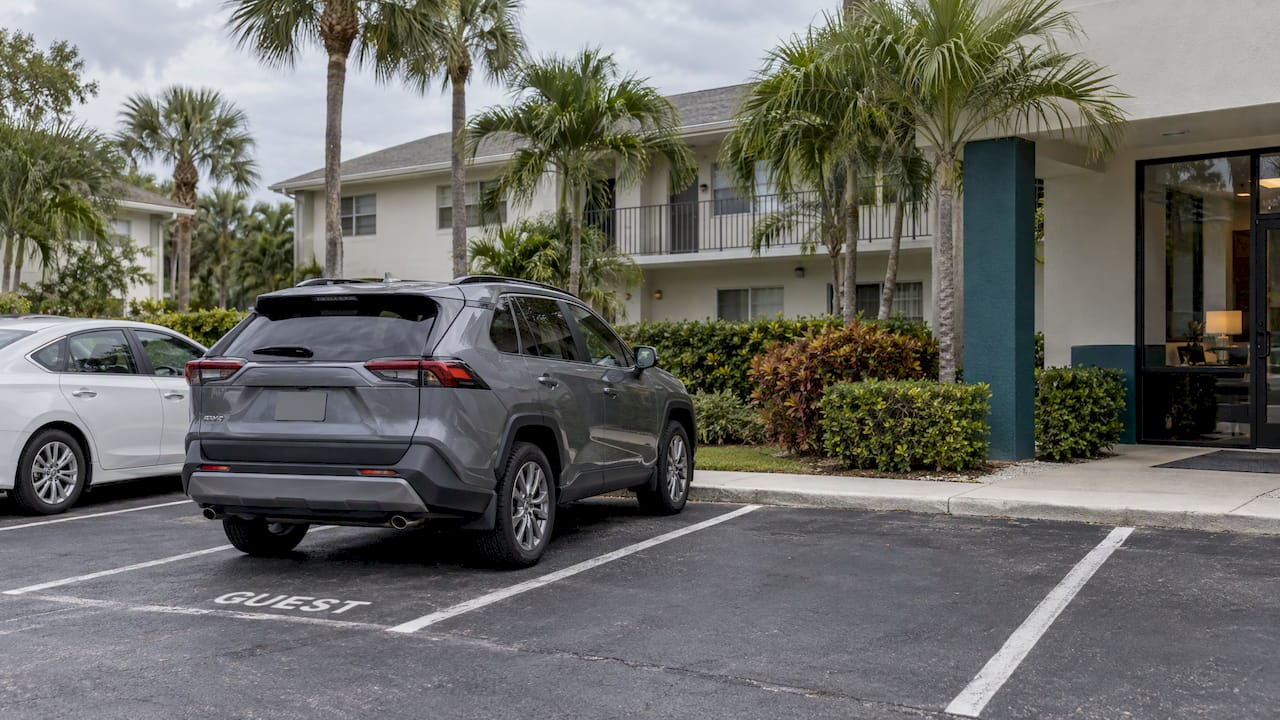
Guest parking at an apartment community is almost always a separate, limited set of spaces. Visitors usually park there on a time limit, and overnight stays often need a pass or a registration. The details live in the lease or the community rules, so read them before you sign, not after your first weekend visitor gets a warning on the windshield. This guide covers how it works, what the rules usually look like, what can cost you money, and what to ask in Boca Raton.
It is written for people renting a one-bedroom on their own: young professionals, FAU students and grad students, and cat owners who expect friends, family or a sitter to come by.
TL;DR
- Guest spaces are separate from resident parking, and a parking-management guide describes typical stays of 24 to 72 hours, with residents limited to one or two guest passes at a time.
- Overnight guests are where rules get strict. Florida communities near us require a displayed permit from midnight to 6 a.m. and cap how many nights a year a guest can stay.
- Parking in another resident’s assigned space, or overstaying, can lead to towing at the vehicle owner’s expense.
- Ask four things before you sign: where guests park, how a pass is issued, the time and night limits, and whether any guest fee applies.
- Always read the parking section of the lease addendum, not just the brochure.
Table of Contents
- How guest parking usually works
- How passes and permits work
- What the typical limits look like
- Do guests pay to park?
- What happens when a guest breaks the rules
- Checklist for Boca Raton renters
- Special cases for our readers
- Our perspective
- See our one-bedrooms for yourself
- FAQ
- Sources
How guest parking usually works
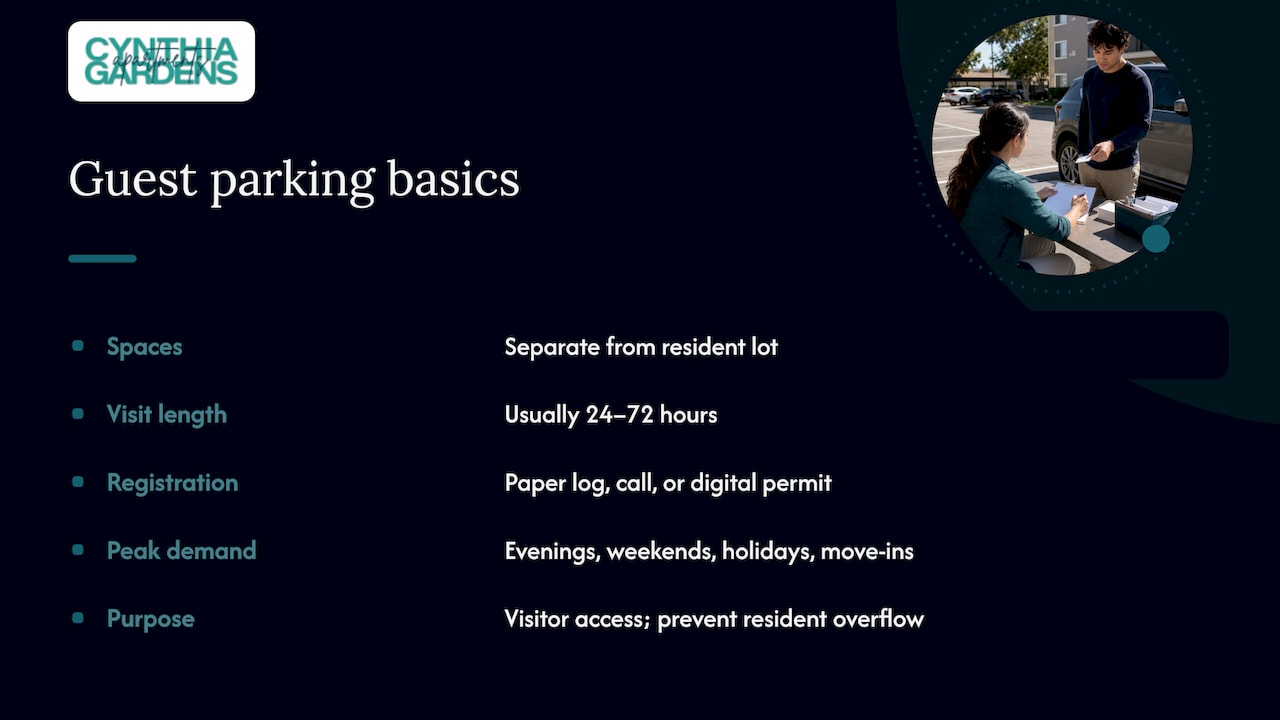
Most communities do not let visitors use resident spaces. They mark a few spaces for guests, often near the entrance or the leasing office, and the rest are for residents with a registered vehicle. According to a May 2026 apartment parking guide, guests park in designated areas separate from the resident lot, usually for 24 to 72 hours per visit. They are registered through a paper log, a phone call or a digital permit.
The same guide says demand spikes on evenings, weekends, holidays and move-in days. That matches common sense: Friday dinner, a birthday, a parent helping you move. If you host often, ask how many spaces are set aside and whether they fill up on weekends.
There is a reason communities are strict. A guide to managing guest parking frames it as two competing needs: real visitors need reliable access, while residents must not be able to use guest spaces as permanent overflow for their own extra cars. Pass limits and time caps exist to protect that balance, which also protects you when your own visitor arrives.
Day visits versus overnight stays
A daytime visit is the simplest case. In many communities you park in an open guest space and nothing else is needed. The overnight case is different, because a car sitting in a lot at 3 a.m. is hard to tell from a resident’s car or an abandoned one.
Here is how a few Florida and other US communities word it in their own published rules:
- Boca Quay requires guests and rental or loaner vehicles to display a permit on the front driver-side dashboard, filled in with time, date and unit number. Permits are required from midnight to 6 a.m., are valid for 7 days, and longer stays must be reported by email.
- Boca Terrace requires overnight guests to display a guest pass and limits overnight passes to 30 days per calendar year. Each unit is restricted to two registered vehicles.
- CitySide requires visitors to be called in through an automated phone system. Overnight passes are capped at two per unit per week, and a vehicle showing an overnight pass more than twice a week can be immobilized or towed.
These are different communities with different rules, which is the point: there is no single standard. A 7-day permit at one place and a two-nights-a-week cap at another can both be normal.
How passes and permits work
A guest pass is a short-term permission tied to a unit. It can take several forms:
- A paper hang tag or dashboard slip, filled in by hand with date, time and unit number, as at Boca Quay above.
- A phone-in or automated call, where the resident registers the visitor’s plate.
- A digital pass, where the resident enters the guest’s license plate on a website or app and picks a duration. One provider’s FAQ describes residents scanning a QR sign or opening a community link, entering the apartment passcode and the guest’s plate, and choosing the stay length.
What matters to you as a renter is how easy it is to issue a pass at 9 p.m. when your friend is already circling the lot. One parking-systems writer argues that the most common failure is registration, not enforcement: if residents have to call, email or fill in a form before a guest parks, many skip it and the guest ends up without a pass. A self-serve option that works at any hour is a real quality-of-life feature.
We cover this topic from the renter’s side in more detail in our piece on apartment parking permits going virtual.
What the typical limits look like
Limits are set by each property, but the same few numbers keep appearing. Treat these as examples of what to expect, not as a legal standard.
| Rule | Common range | Example source |
|---|---|---|
| Maximum stay per visit | 24 to 72 hours | Apartment parking guide, May 2026 |
| Concurrent guest passes per resident | One or two | Apartment parking guide, May 2026 |
| Guest-parking days per unit | Around five per month in one manager’s recommendation | Property manager guidance, 2026 |
| Overnight passes | Two per unit per week, or 30 per year | CitySide, Boca Terrace |
One more limit that surprises people: when a guest stays a lot, the community may treat them as a resident. A sample policy template uses a trigger such as ten nights in a month, after which the guest’s vehicle has to be registered like any other resident’s vehicle. If a partner stays most weeknights, ask how the property counts that.
If there is no guest lot at all
Some smaller properties have no designated visitor area. In that case the lease may limit the number of days per month a non-resident vehicle can park on site, and many leases prohibit letting a friend use your assigned spot while you are away. Lending your space feels harmless, but it is exactly the kind of thing a lease can forbid.
Do guests pay to park?
In many communities guest parking is free within the limits. Some add a charge once a free period is used up. A 2026 guide to apartment parking notes that some communities charge a guest fee beyond a standard free period. A pay-to-park guide describes a model where each unit gets a set number of free guest hours, after which the guest pays an hourly rate up to a daily cap.
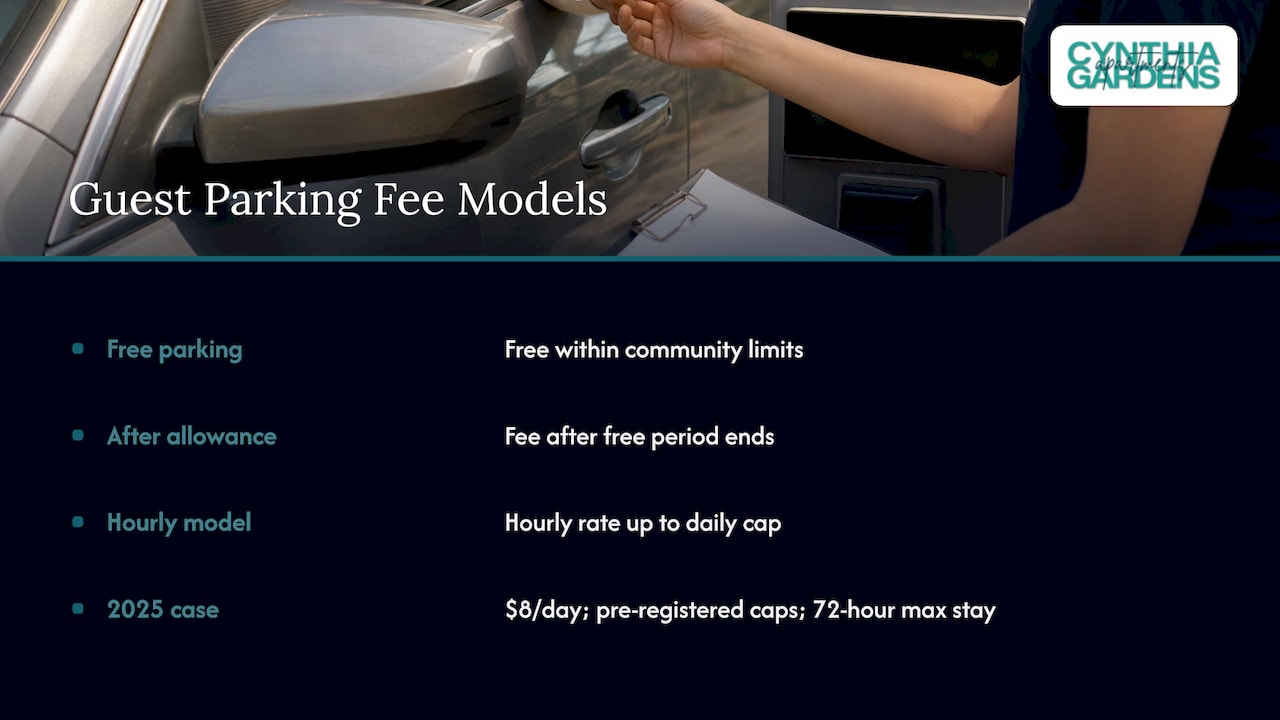
That is a model some properties use, not a rule everywhere. In one 2025 case study, higher-end communities charged visitors $8 a day, with caps on pre-registered guests and a 72-hour maximum stay. Your own community may charge nothing, or something very different, so the question to ask is simple: “Is there any fee for my guests, and when does it start?”
Parking for your own car is a different cost. If you are comparing what a Boca Raton resident pays for a space, our page on apartment parking fees in Boca Raton walks through it, and the broader trade-offs are in apartment parking: convenience, cost and lifestyle.
What happens when a guest breaks the rules
The consequences are usually spelled out in the lease or a parking addendum (a separate signed page added to the lease). Typical outcomes:
- A warning. One guide’s example sequence starts with a written windshield warning logged in the system, then a fine or formal notice for a second violation within a set window, then towing for a third.
- Towing at the vehicle owner’s expense. A California Apartment Association parking addendum says vehicles parked in unauthorized areas, including other residents’ designated spaces, may be towed at the vehicle owner’s expense. That is a California form, but the principle is the same in most leases.
- Florida law backs the property owner. Under Florida Statute 715.07, the owner of private property, or someone the owner authorizes, may have a vehicle parked there without permission removed by a towing business. The statute also sets conditions for towing, so the exact process matters.
- A digital log. One multifamily parking firm reports that a digital log makes tows easier to defend in disputes, because the record shows who was authorized.
The practical lesson: tell your visitor exactly where to park, give them the pass or registration before they arrive, and never let them take another resident’s marked space, even briefly.
Checklist for Boca Raton renters
Before signing, ask the leasing office these questions and find the answers in writing in the lease, an addendum or the community rules:
- Where do guests park? Ask to see the guest spaces, and how many there are compared with the number of units.
- How is a pass issued? Online at any hour, by phone, or in the office during business hours only?
- What are the time limits? Hours per visit, nights per week or month, and what counts as an overnight.
- Is there a guest fee? Ask whether it is free and what happens after a free period.
- What if a guest needs to stay longer? Find out who approves it and how far ahead to ask.
- What are the penalties? Warning, fine or towing, and who pays.
- Can a guest use my assigned space? Get the answer in writing if you have an assigned space.
- How many cars may I register? One resident car is simple, but a partner’s car changes the math.
If you are reading a lease for the first time, our guide to the apartment lease agreement form and our overview of apartment community rules in Boca Raton show where parking clauses tend to sit.
Special cases for our readers
Students. Roommate-free one-bedroom living still means study groups, parents visiting on move-in weekend and friends from campus. Plan for the heavy days: guest demand peaks around move-ins and weekends, so ask about the process before the busiest date of your lease, not on it.
Young professionals. If a partner or colleague stays over regularly, the overnight cap matters more than the daily limit. A cap of two overnight passes a week is a very different life from a cap of 30 nights a year.
Cat owners. Cat owners often have a friend or sitter visiting when they travel. Short visits are fine in a designated guest space, but check the rules on how many days per month a non-resident car may stay. Pet rules sit in a separate document, so also read our pieces on the apartment pet policy and the pet addendum under Florida law.
Our perspective
We think parking rules should be something you can read in two minutes before you sign, not something you discover at your first visitor’s expense.
Our community is built for people who live alone in a one-bedroom: young professionals, students and cat owners. That is why we put transparent pricing at the center of how we lease, with no hidden fees. The same habit should apply to every rule that affects your month: ask, read, and get it in writing.
Our tools are designed to make that easy. You can tour virtually, ask our AI chat or voice assistant your questions at any hour, and use the interactive property map to see the layout before you visit. Quiet, respectful community life is what our residents tell us they value, and clear rules are a part of it.
Ayman
See our one-bedrooms for yourself
Our one-bedroom apartments in Boca Raton are listed at $1,990 to $2,220 per month on our units page. Fees are published, not hidden: the application fee is $75 per applicant, the administration fee is $300, and cats carry a one-time, non-refundable pet fee of $300 to $500 per cat, with no ongoing pet rent. You can see every listed charge on our fees page.
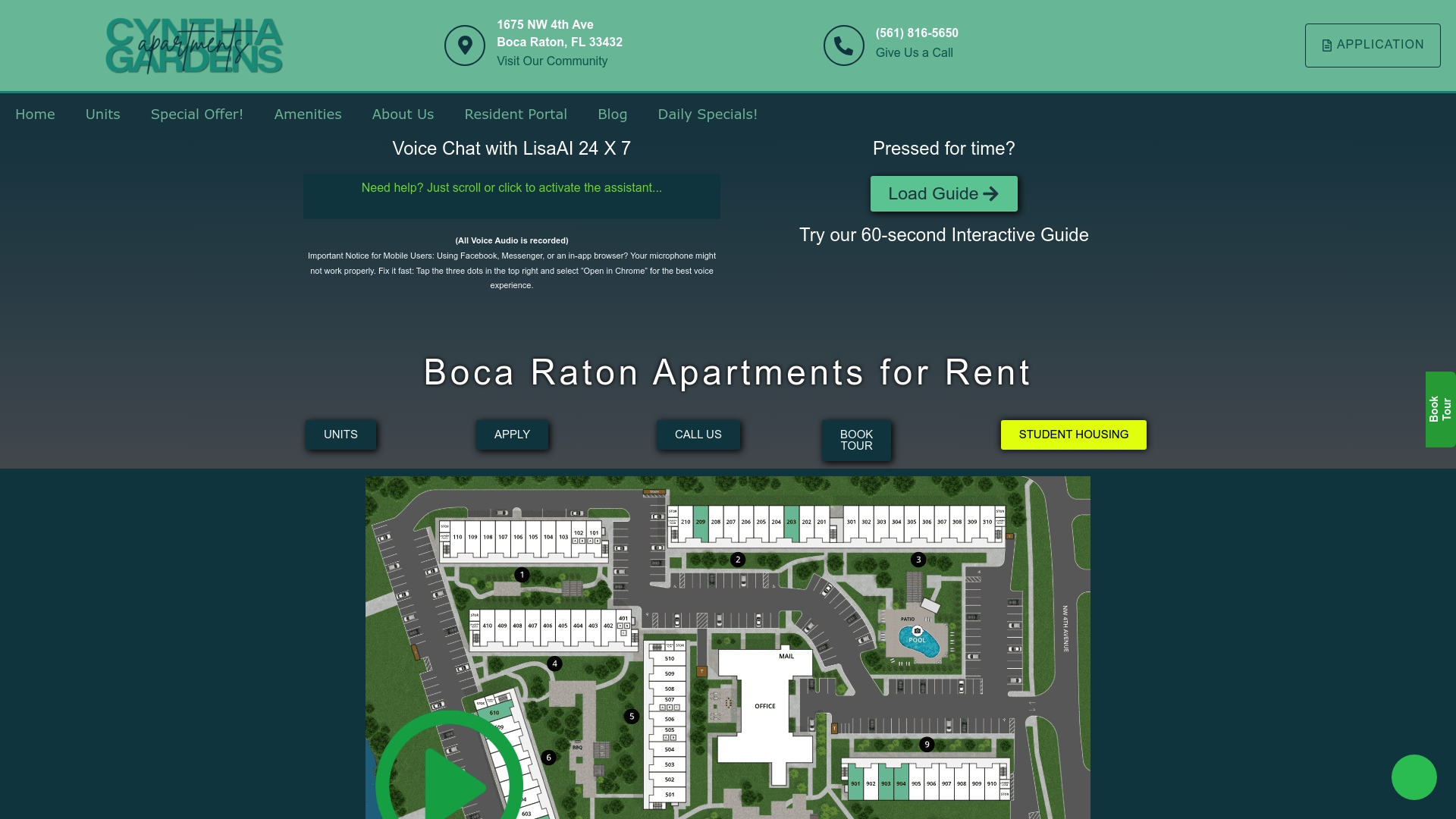
If you want to compare layouts first, take a virtual tour and use the property map to see the community from your phone. Questions about the lease or community rules can go to our AI chat or voice assistant, and you can start at cynthiagardens.com.
FAQ
Do apartment guests need a parking permit?
Often, yes, at least overnight. Boca Quay, for example, requires a displayed permit from midnight to 6 a.m., and many communities require registration for any guest vehicle. Daytime visits in marked guest spaces frequently need nothing, but check your community’s rules.
How long can a guest park at an apartment complex?
It varies by property. Typical limits are 24 to 72 hours per visit, and some communities add a monthly or yearly cap on guest nights. Your lease or parking addendum should state the exact numbers.
Can my guest park in my assigned space?
Only if your lease allows it. Many leases prohibit lending your assigned spot, and a vehicle in another resident’s designated space can be towed at the owner’s expense. Ask the office before you offer your space to a visitor.
Is guest parking free?
In many communities it is free within the limits, and some charge after a free period, at an hourly or daily rate. Ask for the fee in writing, including when it starts and any daily cap.
What if my guest stays longer than the limit?
Contact the leasing office before the limit runs out. Many communities have a process to approve longer stays, and ignoring the limit can lead to a warning, a fine or towing under your lease.
Sources
- Apartment Parking Guide: Rules, Permits and How to Manage It
- How to Manage Guest Parking: 5 Steps and Free Template
- Boca Quay lease application and parking rules
- Boca Terrace documents
- CitySide parking rules
- Guest Parking FAQ
- Guest Parking Pass System That Works
- Apartment Guest Parking Rules: A Property Manager’s Guide
- Apartment guest parking policy and lease addendum
- Apartment Parking Rules: Policies, Towing, and Rights
- How apartment pay-to-park guest parking works
- Parking automation case study
- California Apartment Association parking and garage addendum
- Apartment Guest Parking: Systems That Actually Work
- Florida Statutes, section 715.07