
Yes, a student with no job can rent an apartment in Florida, but not on a paycheck. Landlords look for another way to be confident the rent will be paid: a guarantor who signs the lease, documented financial aid or savings, or a larger upfront payment where the lease allows it. If you go in with those papers ready, “no income” stops being a dead end and becomes a paperwork problem you can solve.
This guide is for FAU students and graduate students, young professionals just starting out, and single renters, including cat owners, who are comparing one-bedroom apartments in Boca Raton. It explains what landlords ask for, how much it costs to apply, and how to build an application that gets approved.
TL;DR
- Most Florida landlords want gross monthly income of about three times the rent. A student without a job usually meets that through a guarantor, not through their own pay.
- Financial aid is not paid to the landlord. It lands in your bank account, so your award letter and bank statements are your proof of funds.
- A guarantor is legally responsible for the rent if you cannot pay, so choose someone who understands that and can qualify on their own.
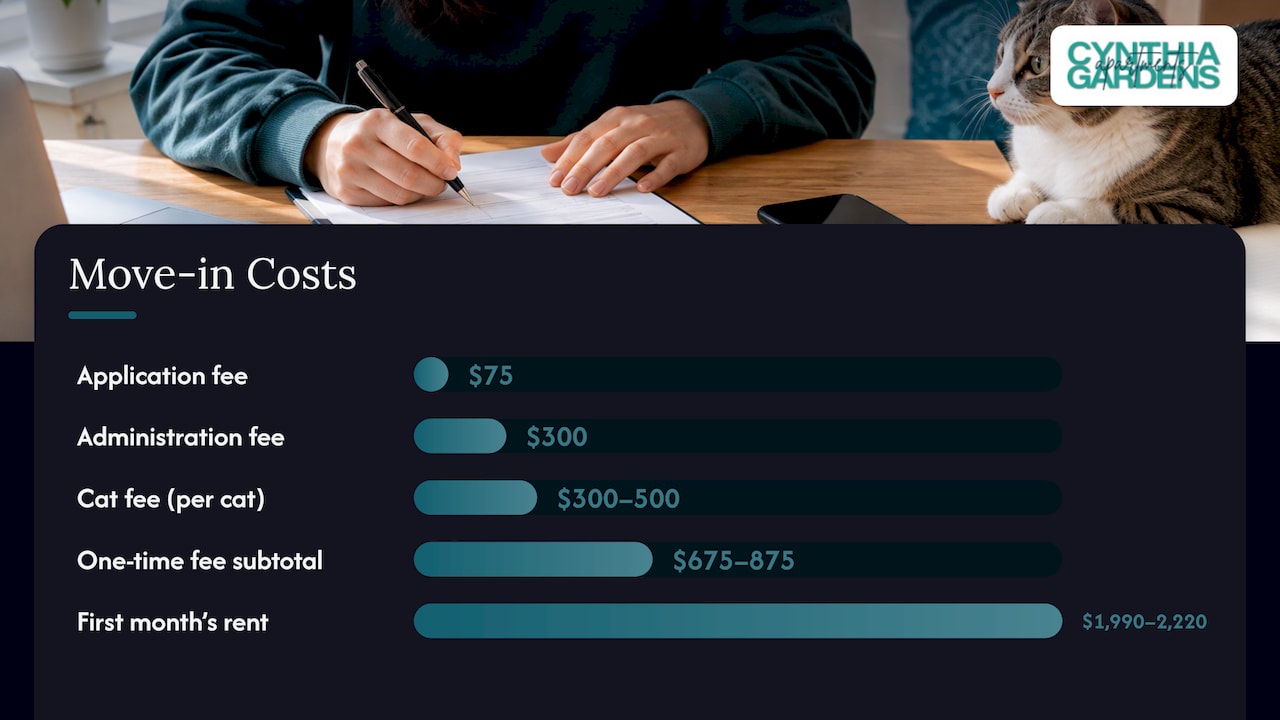
- Budget for one-time costs before move-in: at our community that means a $75 application fee per applicant and a $300 administration fee, plus $300 to $500 per cat if you have one.
- Gather your documents first. A complete application is the fastest route to a yes.
Table of Contents
- What landlords actually look for
- Ways to qualify when you have no paycheck
- Documents to have ready before you apply
- What it costs to get in the door
- Special rules for foster youth and students facing homelessness
- A step-by-step plan for your search
- Where we fit in
- Our perspective
- FAQ
- Sources
What landlords actually look for
A lease is a promise to pay for twelve months. A landlord cannot see your future, so they screen for three things: income, credit and rental history, and any record that could signal risk.
Florida State University’s rental guide says communities generally require gross monthly income of at least three times the base rent for approval without conditions. It also calls a credit score of 650 or higher generally favorable, and notes that a felony or violent-crime record could prevent approval without conditions.
Here is what the three-times rule means in dollars. Our one-bedroom apartments are listed at $1,990 to $2,220 per month. At those rents, three times the rent works out to roughly $5,970 to $6,660 of gross monthly income. Very few full-time students earn that, which is why the guarantor is so common.
Experian lists the usual red flags that push a landlord to ask for a guarantor: little or no credit history, no rental history, unstable employment and minimal income. It adds that a landlord may ask for one from a college student without a full-time job even if the student has loans or savings. A student without income is one of the most ordinary cases a leasing office sees. It is not a special exception.
Ways to qualify when you have no paycheck
There are four routes. Most students use one or combine two.
1. A guarantor or co-signer
This is the route most students take. Florida State’s housing office describes a guarantor as an adult who agrees to be financially responsible for the lease without living in the apartment. The guarantor must meet the same rental qualifications as the tenant, and is typically at least 27 years old. If the tenant defaults, the guarantor is responsible for the outstanding debt and their credit may be damaged.
The University of Central Florida’s guide adds that the guarantor signs the lease and is legally responsible for paying rent if the tenant cannot. Before you ask a parent, relative or mentor, have the honest conversation: this is a real financial obligation for them, not a formality. Our page on lease guarantor rules for Florida apartments walks through how it works in practice.
2. Proof of funds and financial aid
Income is not the only way to show you can pay. The International Student Organization’s guide says landlords commonly accept proof of funds, scholarship or assistantship documentation, a co-signer or commercial guarantor service, or prepaid rent where state law allows.
One point trips up many students. Florida State explains that financial aid does not pay rent directly to the apartment community. The refund goes to your personal bank account, and you are responsible for budgeting it to cover monthly rent for the term. So when you apply, your award letter shows the aid exists, and your bank statements show the money is there.
A worked example: if your aid refund and savings together cover twelve months at $1,990, that is $23,880 in documented funds. A leasing office can weigh that evidence, even though it is not payroll. Our page on renting with no credit history explains how newcomers to credit can get approved.
3. Paying extra up front
Some leases require extra money when you have no guarantor. UCF Student Legal Services notes that most students will need a guarantor, and that some leases require a security deposit, advance rent or a monthly guarantor waiver fee if you do not have one. The same page warns that failing to provide a guarantor does not release you from the lease once you sign. Read that clause before you sign, not after. Our overview of security deposit rules covers what a deposit can and cannot do.
4. Rental assistance, if you qualify
Students are not automatically shut out of housing assistance. Under the federal rule at 24 CFR 5.612, a student is ineligible for Section 8 only if they are enrolled in higher education, under 24, not a veteran, unmarried, without a dependent child, not a disabled person already receiving assistance as of November 30, 2005, and not individually income-eligible. Meeting any one of the exceptions, such as being 24 or older, married, a veteran, a graduate student or a vulnerable youth, keeps you eligible. Students apply through their local public housing agency, which also sets the waiting list and the income limits.
If you claim zero income on a Section 8 application, the rules are specific. A housing authority’s zero-income questionnaire lists the only things you may receive, including student financial aid and qualifying earnings of a full-time student. Waiting lists can be long, so treat assistance as a track that runs in parallel with a private lease search rather than a plan you depend on for this semester.
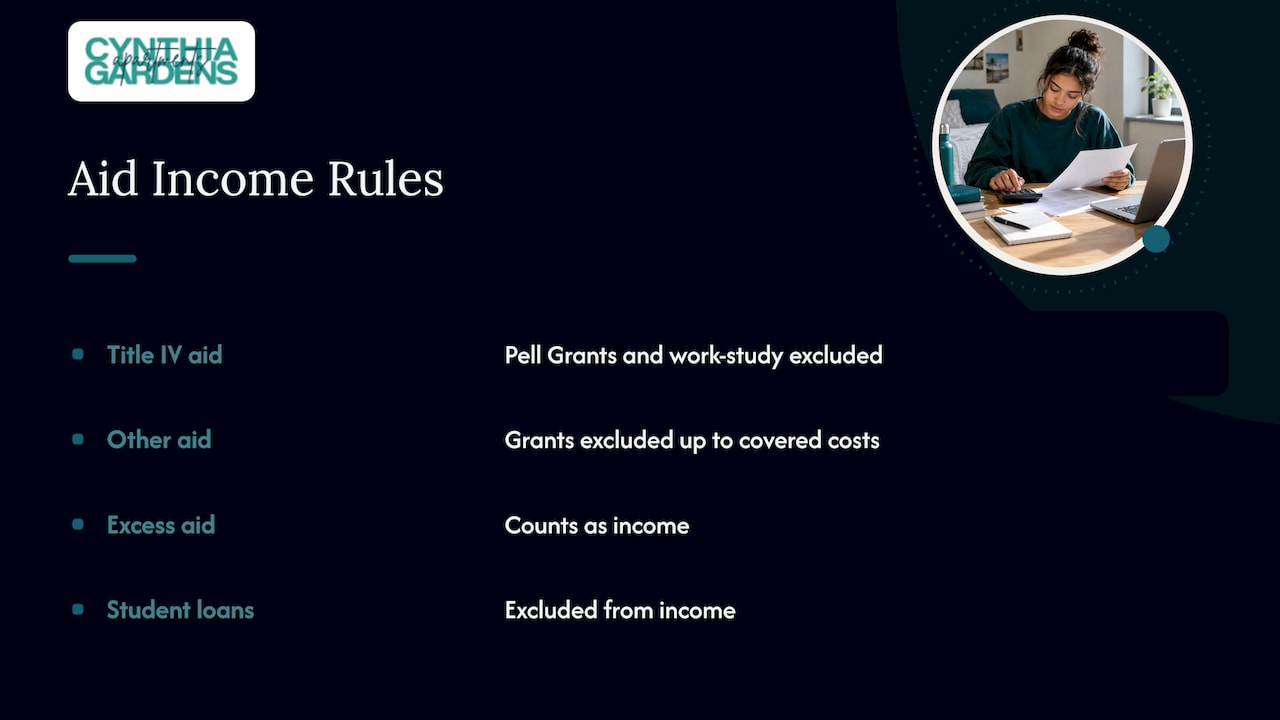
How your aid is counted also changed recently. Under the HOTMA rule, Title IV federal aid such as Pell Grants and work-study is excluded from income, and other grants and scholarships are excluded up to your actual covered costs such as tuition, fees, books and room and board. Excess aid counts as income, and student loans are excluded. That is why your financial aid award letter is a key document for assisted housing.
Documents to have ready before you apply
A complete file moves faster than a thin one. A community college basic-needs office publishes a checklist that covers the standard set. It includes a completed application and fee, a government photo ID, proof of income alternatives such as bank statements, aid or scholarship letters, and a support letter, plus credit-check consent. If you have no rental history, add character references. If you need a guarantor, add their contact information, ID and proof of income.
Put together, your folder looks like this:
| Document | What it shows |
|---|---|
| Government photo ID (passport accepted for international students) | Who you are |
| Enrollment confirmation | You are an active student |
| Financial aid or scholarship award letter | Funds are on the way |
| Bank statements | Funds are in hand |
| Support letter from a parent or sponsor | Outside financial backing |
| References from a professor, residence hall staff or past landlord | Reliability without rental history |
| Guarantor ID, contact details and proof of income | Backup if your own file falls short |
The International Student Organization’s guide lists these same items, and Wesleyan University’s international office adds that students should be ready with a Social Security number for the credit check, or ask the landlord about alternatives if they do not have one. Our lease application requirements for Boca Raton page lists what we ask for.
Protect your documents
You are handing over IDs and bank details, so make sure you are dealing with the real management company. The FTC, as cited in the International Student Organization’s guide, warns that rental scammers may request Social Security numbers, ID documents and financial information for identity theft. Provide sensitive documents only after you have verified the landlord and its application process. If an offer is far below market and asks for money before you have seen the unit, walk away. Our guide to spotting virtual tour scams covers the warning signs.
What it costs to get in the door
First-month rent is not the only bill. Florida State’s housing office tells students to expect one-time fees such as application fees (typically $40 to $60) and administrative fees (around $100), plus possible security deposits, pet fees, parking fees and monthly technology or amenity fees.
When you have no income, the surprise costs matter most, because you are budgeting from a fixed pot of aid and savings. Here are the one-time fees we publish:
| Fee | Amount |
|---|---|
| Non-refundable application fee | $75 per applicant |
| Administration fee | $300 one-off |
| Wire transfer fee | $15 one-off |
| Transfer fee | $500 one-off |
| Non-refundable pet fee | $300 to $500 per cat, one-off |
The full list is on our fees page. Everything is stated up front, so you can add up your move-in cost before you apply. If you bring a cat, the pet fee is a single payment, with no ongoing pet rent on top.
A quick budget for one applicant with one cat: $75 application, $300 administration, and $300 to $500 for the cat is $675 to $875 in one-time fees before rent. Add the first month at $1,990 to $2,220 and you can see the total you need to have documented.
Special rules for foster youth and students facing homelessness
Florida recently moved to protect its most vulnerable students. Florida College System institutions and state universities may not require a cosigner for campus housing when a student receives Road to Independence housing support or is in a continuing care program for young adults. Schools that use a housing assignment system must also give first priority to eligible homeless students and current or former foster youth, according to the Florida Senate’s analysis of SB 584. This applies to campus housing run by the institution, not to private apartment communities, so if it describes you, ask your school’s housing or financial aid office first.
A step-by-step plan for your search
- Set your ceiling. Divide your documented funds by twelve. That is your realistic monthly rent, even if the three-times rule is not met on income.
- Decide on your guarantor early. Have the conversation and collect their documents before you tour.
- Tour from your couch. Virtual tours let you narrow the list before you spend gas and time. See how virtual tours save time.
- Gather your folder. Use the table above.
- Read the lease before you sign. Check the guarantor clause, fees, renewal terms and what the lease says about leaving early.
- Plan renters insurance. Some leases require it. Our page on student renters insurance requirements explains it.
If you need flexibility on timing, our guide to student lease length in Boca Raton explains the options.
Where we fit in
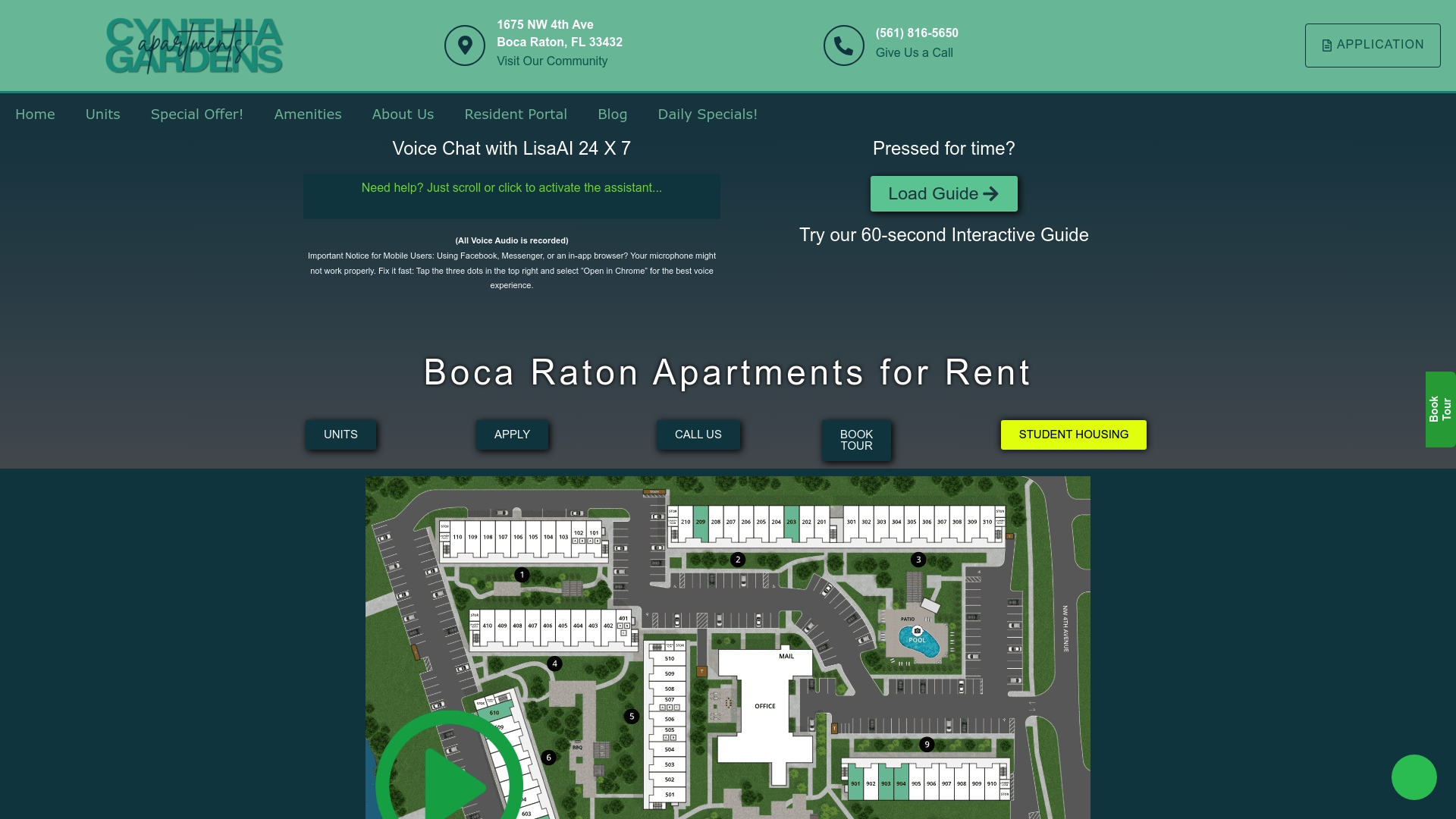
We are a one-bedroom apartment community in Boca Raton, built for young professionals, students and pet owners. Our pricing is transparent, with no hidden fees: the amounts above are the ones we publish. We offer virtual tours, an interactive property map and online leasing with AI chat and voice assistance, so you can see a unit and start your application without driving anywhere. We also offer short- or long-term furnished options, and we are cat-friendly with a one-time pet fee and no ongoing pet rent.
If you are comparing options, see our one-bedroom apartments and the cheap one-bedroom guide for Boca Raton, then start an application with your documents ready.
Our perspective
The students we hear from are rarely careless. They are organized people with real funds and no payroll. The mistake we see in that situation is applying without a plan: no guarantor lined up, no award letter, and no idea what the move-in total is.
That is why we publish our fees and rent range openly. A student on a fixed budget should be able to add up $75, $300 and the first month’s rent before ever filling out a form. Cat owners should know the pet fee is a single payment of $300 to $500, with no monthly pet rent added later.
We built our leasing process around making this easy: virtual tours, an interactive map, and AI chat and voice assistance that answer questions at any hour. Our community is quiet and respectful, and our team aims for same-day maintenance. If you are a student or a young professional starting out, bring your documents and your guarantor, and we will help you take it from there.
Ayman
FAQ
Can an 18-year-old rent an apartment in Florida?
In most cases, landlords require adult tenants, and a lease is a binding contract. An 18-year-old without income or credit history should expect to need a guarantor. Have their ID and proof of income ready alongside yours.
Can you rent a student apartment if you are not a student?
Purpose-built student housing often asks for enrollment proof, while conventional apartments do not. UCF’s guide notes that conventional apartments require proof of employment or finances to sign a lease, so a non-student with a job or savings can apply for a regular apartment such as our one-bedrooms.
Does financial aid count as income?
It depends on who is asking. Many private landlords look at your award letter and bank balance as proof of funds, since aid is paid to you and not to the landlord. For assisted housing, aid is treated under federal rules, where Title IV aid is excluded from income and excess non-Title IV aid can count.
What if I cannot find a guarantor?
You have options: proof of funds, extra deposit or prepaid rent where the lease allows, or a commercial guarantor service. Read the lease terms carefully, as some charge a monthly waiver fee. Our page on renting with bad credit in Florida has more on alternatives.
Does the three-times-rent rule apply to me?
It is the standard screening line, but your file can pass another way. A qualified guarantor’s income can meet it for you, and documented funds support your case. Ask the leasing office how it reviews students.
Sources
- FSU Rental Requirements Guide
- Experian: What Is a Guarantor for an Apartment
- FSU Off-Campus Housing FAQs
- UCF Knight’s Guide to Living Off Campus 2024
- International Student Organization: How to Rent an Apartment in the U.S.
- UCF Student Legal Services: Before Signing a Lease
- 24 CFR 5.612: Restrictions on assistance to students
- Zero Income Questionnaire
- NAHMA HOTMA 2023 Final Rule Revisions
- Apartment Application Checklist
- Wesleyan University: Apartment Hunting and Rental 101
- Florida Senate SB 584 Bill Analysis