
A nonrefundable apartment fee is money you pay a landlord that you do not get back, even if you never move in or the unit comes back spotless. A security deposit is different: it is held against damage and unpaid rent, and the unused part returns to you. The safest way to handle these fees is to get every one of them, with its amount and whether it is refundable, in writing before you apply. That is how we publish ours at Cynthia Gardens in Boca Raton: each fee is listed with its dollar amount on our fees page.
This guide is for people renting a one-bedroom on a single income: young professionals, FAU students and graduate students, and cat owners. It explains the fees you will meet, what Florida law says, and how to add up the real cost of moving in.
TL;DR
- A nonrefundable fee is gone once paid. A security deposit is held and can come back to you.
- Common nonrefundable charges are application, administration and pet fees. Each should be named, priced and labeled in writing.
- In Florida, a landlord may offer a fee instead of a deposit, and if it does, it must offer that choice to every new applicant.
- Add up every one-time fee before you apply, not after you are approved.
- At Cynthia Gardens, one-bedrooms are $1,990 to $2,220 per month, and our one-time fees are published on our site.
Table of Contents
- What “nonrefundable” actually means
- The nonrefundable fees renters meet most often
- What Florida law says
- A worked example: the real up-front cost for a cat owner
- How to check fees before you apply
- What to do if a fee looks wrong
- Why transparent fees matter more than low fees
- Our approach to fees at Cynthia Gardens
- Our view
- FAQ
- Sources
What “nonrefundable” actually means
The word has a plain meaning: if you change your mind, or the landlord has already used the money, you do not get it back. The Florida Department of Agriculture and Consumer Services notes that money paid in advance may not be refundable if the tenant later decides not to occupy the unit, and that the rental agreement should say when advance money is nonrefundable.
That last point matters most for you. A fee is only clearly nonrefundable when it is written down as such. If a charge appears on a lease or a receipt with no label, ask which category it falls into before you pay.
Fee versus deposit
The Washington State Attorney General, whose guidance is a clear general explainer, separates a fee paid to the landlord for use from a deposit that can be returned if it is not needed for damage or repair. The same logic applies in Florida:
| Nonrefundable fee | Security deposit | |
|---|---|---|
| Who keeps the money | The landlord | The landlord holds it for you |
| Do you get it back | Generally no | The unused part, yes |
| Typical purpose | Processing, administration, pet approval | Covering damage or unpaid rent |
| When you pay | Application, signing or move-in | Usually at signing or move-in |
For Florida’s deposit rules and the timelines for getting one back, see our guide to Florida security deposit law and the 15/30/15 move-out rule.
The nonrefundable fees renters meet most often
There is no single national list, and the names vary by landlord. These are the ones you will see most in Boca Raton and across Florida.
Application fee
This covers the cost of reviewing your application, such as a credit and background check. You pay it per applicant, and it is not returned whether you are approved or not. That is why it pays to narrow your list before you apply to five buildings at once. Our article on the real role of application fees goes deeper.
At Cynthia Gardens, the non-refundable application fee is $75 per applicant.
Administration fee
An administration fee is a one-time charge for preparing the lease and setting up your residency. Some communities charge it, some roll the cost into rent. The thing to confirm is the amount and whether it is due at application or at signing.
Our administration fee is $300, one time.
Pet fee
A one-time pet fee covers approving the animal and preparing the home for it. Many landlords add monthly pet rent on top, which can cost more over a year than the fee itself. Ask for both numbers, not just one.
At Cynthia Gardens, the non-refundable pet fee is $300 to $500 one time per cat, and we do not charge ongoing pet rent. If you are shopping for a cat-friendly home, our guide to pet-friendly one-bedroom apartments in Boca Raton covers the rest of the move.
Smaller and situational fees
Other charges depend on how you pay or what you change. We publish a $15 wire transfer fee and a $500 transfer fee on our fees page. Whatever the community, ask what each small fee is triggered by so you can avoid paying one by accident.
Amenity and move-in charges
Some properties add amenity, move-in or move-out fees. Florida has no state cap on amenity fees, so the amount is whatever the lease says. Read our piece on amenity fees in Florida apartments before you sign anything that includes one.
What Florida law says
Florida does not cap most of these one-time fees by statute, which makes the written disclosure the thing that protects you. The one area with specific statutory rules is the fee that replaces a deposit.
The fee in lieu of a security deposit
Under Florida Statutes section 83.491, a landlord whose rental agreement requires a security deposit may offer the tenant a fee instead. The tenant chooses between the fee and the deposit. In plain terms, you pay a smaller amount up front, often monthly, rather than a lump-sum deposit.
The statute sets out what the landlord must provide:
- written disclosures required by the law
- a signed agreement stating the fee amount and how it is collected
- the process that applies if you default
- your right to switch to a deposit
- written notice that the fee is nonrefundable, if it is
The law also says this fee is only for securing occupancy without paying a required deposit. And it does not erase your duty to pay rent or cover damage.
It is optional for landlords, but not selective
Community Legal Services of Florida explains that the option is not mandatory for landlords. If a landlord does offer it, it may not deny your application because you chose the fee, and it must offer the choice to all new applicants or to none. Keep that in mind if a leasing office tells you the option is only for certain people.
For how this compares with other ways to avoid a big up-front deposit, see our overview of alternatives to traditional security deposits.
Rules differ by place
Outside Florida, fee rules can be very different. Harvard’s Joint Center for Housing Studies reported in March 2026 that many state and local policies on up-front rental costs focus on application and screening fees, with examples including caps and bans. It cites a $10 cap in Eugene, Oregon, and a ban in Vermont. If you are moving to Boca Raton from another state, do not assume the protections you had at home apply here. Washington, for example, requires nonrefundable fees to be clearly identified as such in a written rental agreement, and Florida’s approach leans on the same idea of written disclosure.
A worked example: the real up-front cost for a cat owner
Advertised rent is only part of the move-in bill. Here is a sample using our published figures for a single renter with one cat, not counting any deposit or first month’s rent.
| Item | Low end | High end |
|---|---|---|
| Application fee (one applicant) | $75 | $75 |
| Administration fee | $300 | $300 |
| Pet fee (one cat) | $300 | $500 |
| Total nonrefundable fees | $675 | $875 |
If you pay by wire, add the $15 wire transfer fee, which brings the range to $690 to $890. Rent for our one-bedrooms runs $1,990 to $2,220 per month, so the one-time fees are roughly a third of one month’s rent.
Now compare it over a lease year for a cat owner. A landlord with a $300 pet fee plus $35 monthly pet rent would cost you $720 for the pet alone in year one. A landlord with a one-time fee and no pet rent costs only the fee. That is why the question to ask is the total, not the line item. Those figures are for illustration only.
If you are splitting costs or applying as a couple, remember the application fee is per applicant, so two applicants pay it twice.
How to check fees before you apply
A short routine saves the most money and the most stress.
- Ask for a written list of every one-time fee. You want the name, the amount and whether it is refundable. Ours are on our fees page so you can see them before you contact anyone.
- Ask when each fee is due. Application fees are due when you apply. Others come at lease signing or move-in.
- Look for the word “nonrefundable” in the lease. If a fee is not described as nonrefundable, ask what happens to it if you cancel before moving in.
- Ask about monthly add-ons. Pet rent, parking, trash and amenity charges can raise your true monthly cost above the advertised rent.
- Ask whether a fee instead of a deposit is offered. If it is, you are entitled to the written disclosures described above.
- Keep copies. Save the application receipt, the lease and any email that states a fee, so you can compare them with what you were charged.
If you are a student, the same questions apply to a roommate-split lease. Our student security deposit rules and the guide to holding deposits versus security deposits cover the paperwork you are likely to see.
What to do if a fee looks wrong
Start in writing. The Florida Department of Agriculture and Consumer Services advises tenants to give the landlord written notice of noncompliance, and it describes a seven-day period for the landlord to address the problem before a tenant may terminate in the circumstances its guidance covers.
For a fee, that means:
- State which charge you question, its amount and the date you paid it.
- Say what the lease or written disclosure says about it.
- Ask for a written answer by a specific date.
- Keep a copy of everything.
If the dispute involves a deposit rather than a fee, our guide on handling security deposit disputes lays out the steps. For a dispute that involves a lease termination or a large sum, talk to a Florida attorney or a legal aid organization, since the right move depends on your lease.
Why transparent fees matter more than low fees
A low fee hidden behind three extra charges costs more than a higher fee listed on page one. When you compare apartments, line them up on the same worksheet: monthly rent, every one-time fee, every recurring add-on, and the deposit or deposit alternative. Our guide to finding cheap one-bedroom apartments in Boca Raton shows how to do that for a single-income budget.
The building that tells you every number before you apply is usually the one that will tell you the truth when something goes wrong in month six.
Our approach to fees at Cynthia Gardens
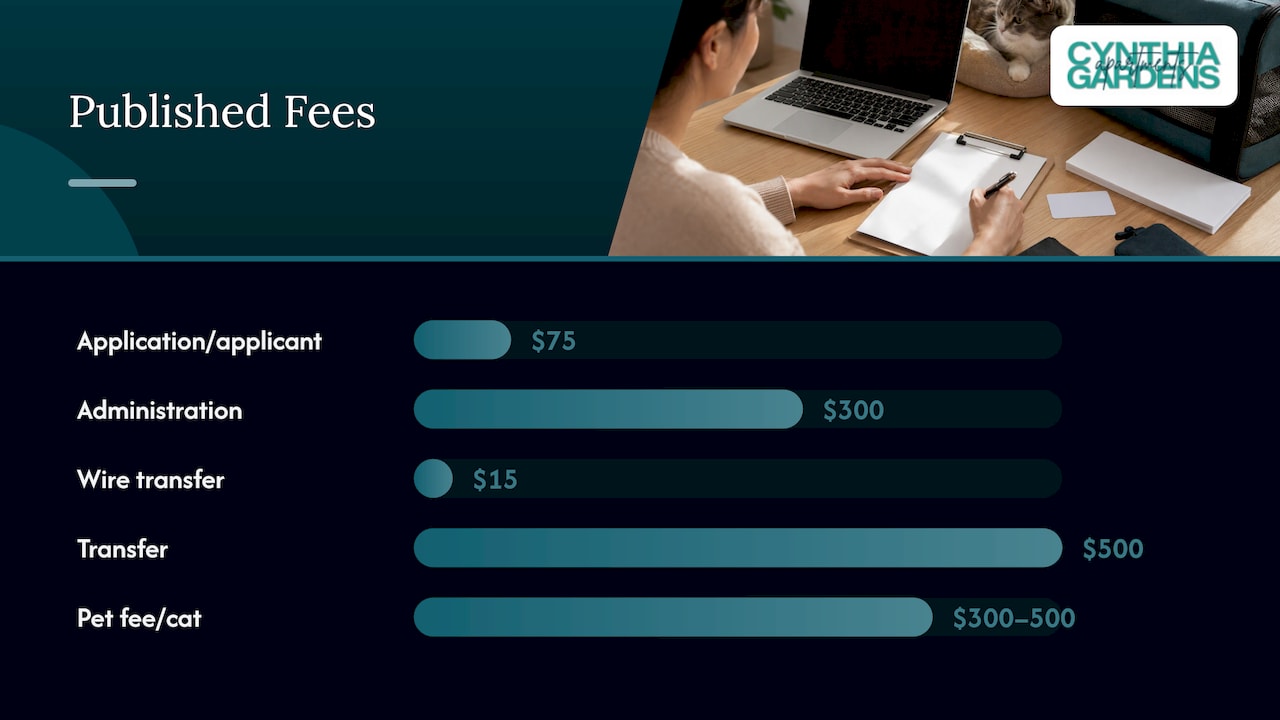
We publish our one-time charges so you can plan before you apply. Our one-bedroom apartments in Boca Raton are $1,990 to $2,220 per month. The non-refundable application fee is $75 per applicant, the administration fee is $300, the wire transfer fee is $15, the transfer fee is $500, and the non-refundable pet fee is $300 to $500 per cat. Cats do not carry ongoing pet rent here.
You can browse the floor plans on our one-bedroom apartments page, check the amounts on our fees page, and take a virtual tour before you spend anything. Our leasing is online, with AI chat and voice assistance if you want answers outside office hours.
Our view
We run a one-bedroom community for people who count every dollar: young professionals, students, and cat owners. For them, a fee is not a small thing. A $300 charge is a week of groceries.
So we believe in no hidden fees. That means each charge has a name, an amount and a place where you can read it before you apply. It means a cat owner pays a one-time pet fee and not a monthly bill that never ends.
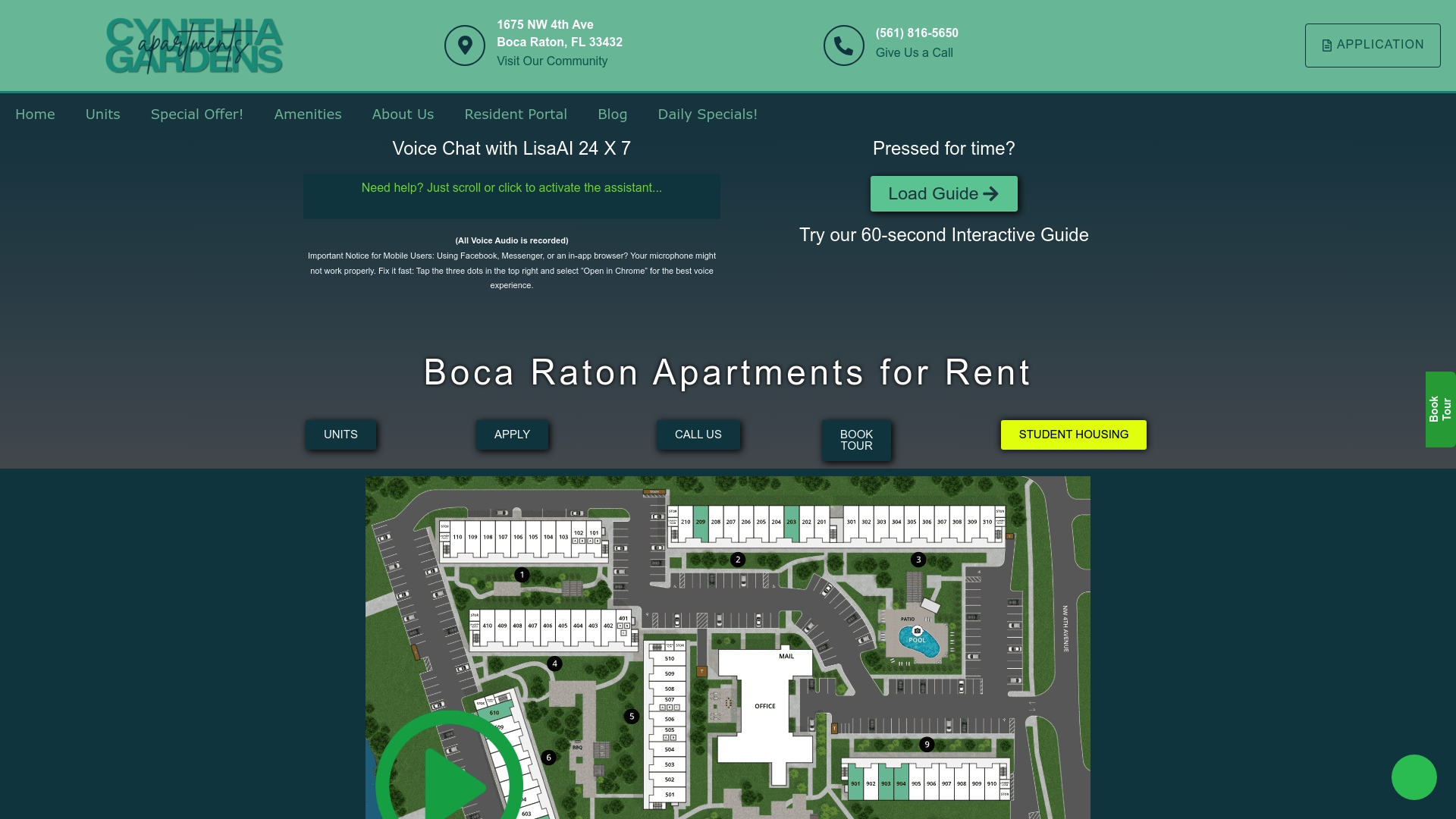
We also think leasing should be quick and clear. Online applications, virtual tours, an interactive property map and chat support are there so that you can ask your fee questions at 10 p.m. and not wait for Monday.
Renters should compare apartments on the total, not the headline rent. When you do, a transparent, well-maintained community with a quiet, respectful atmosphere is easy to pick out.
Ayman
FAQ
What does a nonrefundable fee mean?
It means the money is not returned to you once you pay it, whether or not you are approved or move in. It is different from a security deposit, which is held and can be returned if it is not used for damage or unpaid rent. Check that the lease or application labels the fee as nonrefundable.
Is the application fee refundable if I am denied?
Application fees are generally treated as nonrefundable because they pay for processing your application. Ours is a non-refundable $75 per applicant. Ask any landlord before you pay what the fee covers and how many applicants it applies to.
Can a Florida landlord offer a fee instead of a security deposit?
Yes, under Florida Statutes section 83.491, a landlord that requires a deposit may offer a fee instead, and you choose between them. The landlord must give you written disclosures and a signed agreement. If it offers the option, it must offer it to all new applicants.
Is a pet fee the same as pet rent?
No. A pet fee is a one-time charge when you bring a pet in. Pet rent is a recurring monthly charge. At Cynthia Gardens, the pet fee is $300 to $500 one time per cat, with no ongoing pet rent.
What should I do if I was charged a fee that was not disclosed?
Send your landlord a written notice that names the fee, the amount and the date, and ask for a written response. Keep copies of the lease and receipts. If it is not resolved, contact a Florida attorney or legal aid office.
Sources
- Florida Statutes section 83.491, Online Sunshine
- Landlord/Tenant Law in Florida, Florida Department of Agriculture and Consumer Services
- Fees in Lieu of Security Deposit, Community Legal Services of Florida
- Curbing Fees: How States and Cities are Addressing Up-Front Rental Costs, Harvard Joint Center for Housing Studies
- Deposits and Fees, Washington State Attorney General