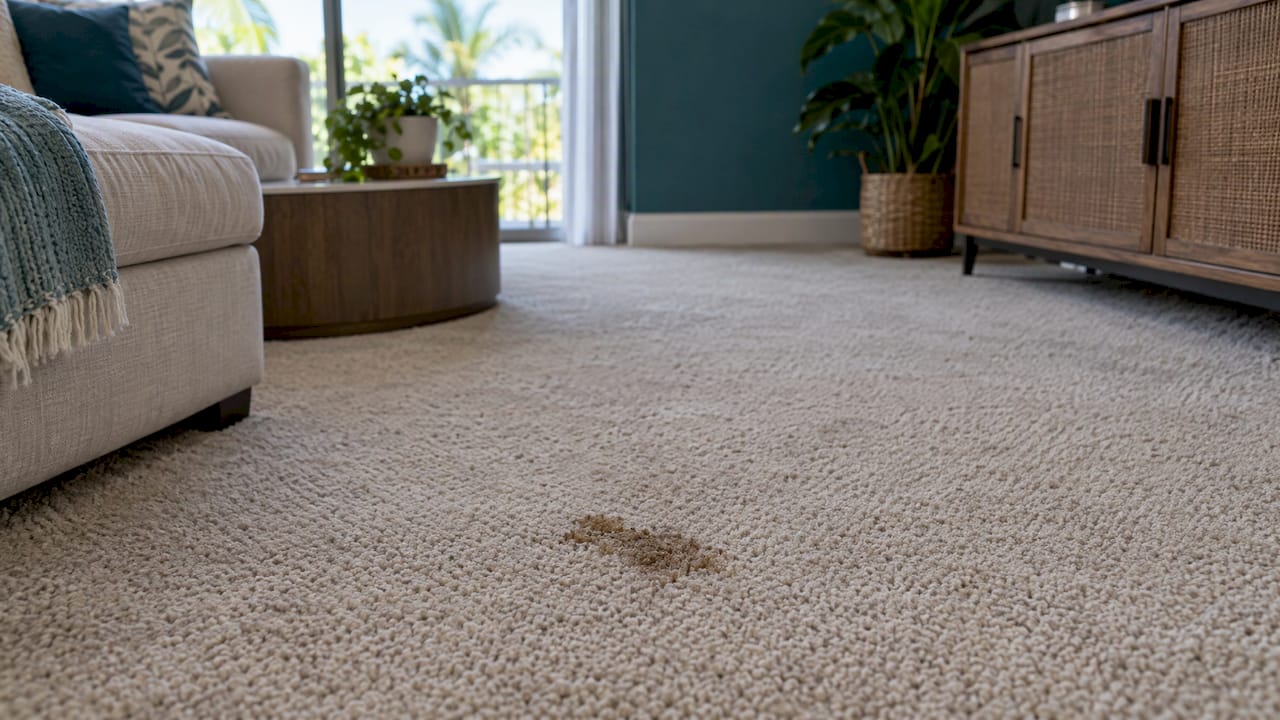
A Florida landlord can charge you for carpet damage you caused, such as large permanent stains, burns, pet urine in the pad or tears. A landlord cannot charge you for ordinary wear, and even real damage is usually billed at the carpet’s remaining value, not the price of brand-new carpet. Your best protection is paperwork: dated photos at move-in and move-out, and a written objection if the deduction looks wrong.
This guide is for renters in Boca Raton: students, young professionals, single renters and cat owners. It explains the rules in plain terms, shows the math on a worked example, and lists what to do before and after you move out.
TL;DR
- Ordinary wear (traffic patterns, light fading, minor matting) is the landlord’s cost. Large stains, burns, pet-urine damage and tears are chargeable.
- A fair charge reflects the carpet’s age and remaining life. Carpet that has reached the end of its life supports little or no replacement charge.
- In Florida, a landlord has 30 days after you move out to send written notice of a deposit claim. You then have 15 days to object in writing.
- Photos or video at move-in and again before move-out are the strongest evidence you can have.
- Cat owners at Cynthia Gardens pay a one-time pet fee of $300-$500 per cat and no ongoing pet rent, so the pet cost is known upfront.
Table of Contents
- What counts as damage and what counts as wear
- Why age matters: the charge is not the replacement invoice
- What a landlord should show you
- Florida deadlines you need to know
- How to dispute a carpet charge
- Protect your deposit before you ever move out
- Cat owners: keep pet charges predictable
- Looking for an apartment with clear pricing?
- FAQ
- Sources
What counts as damage and what counts as wear
The line between the two decides almost every carpet dispute. Florida’s consumer agency says a landlord may deduct for carpet damage beyond ordinary wear, but not for ordinary aging such as traffic-pattern wear, minor matting or slight fading. It also lists the kinds of damage that are deductible: large or permanent stains, burns, pet-urine damage and torn carpet, per the Florida Department of Agriculture and Consumer Services (FDACS) landlord-tenant guide.
Here is how that sorts out in daily life.
| Situation | Usually treated as |
|---|---|
| Flattened or thinned carpet along the hallway and in front of the sofa | Normal wear |
| Light sun fading near a window | Normal wear |
| Small dents where furniture sat | Normal wear |
| A coffee ring or spill that comes out with professional cleaning | Cleaning charge, if the lease allows it |
| Cigarette or iron burn | Damage |
| Bleach spots or dye stains | Damage |
| Pet urine that soaked into the pad | Damage |
| Carpet torn or ripped by misuse | Damage |
The same line is drawn by a collections firm that handles these disputes: slight thinning, light fading and furniture indentations are wear, while severe pet stains that reach the pad, large burns or tears are chargeable. A burn the size of a coin and a burn the size of a dinner plate can be treated differently, so photograph the size of any mark with something for scale.
Cleaning versus replacement
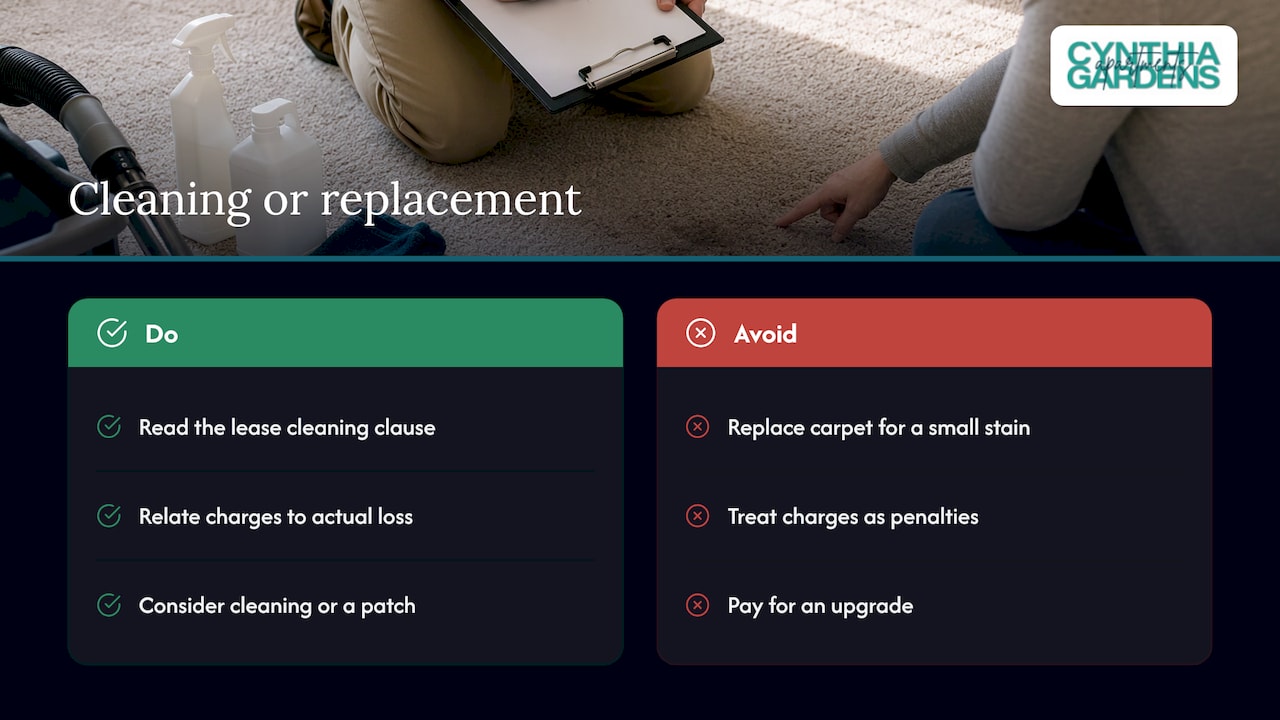
A stain that comes out with a professional cleaning is a cleaning cost, not a replacement cost. One industry guide puts typical cleaning at about $40 to $80 per room, and whether you can be billed for it depends on your lease and Florida law. Replacing a whole carpet for one small, localized stain is hard to justify when cleaning or a patch would fix it. A charge should relate to the actual loss, and it should not work as a penalty or pay for an upgrade.
Read your lease for any carpet-cleaning clause before you sign. Florida’s consumer agency advises renters to understand the lease terms before signing, and that includes anything about cleaning at move-out.
Why age matters: the charge is not the replacement invoice
Most renters are surprised by this part. Carpet wears out whether or not anyone lives on it. If a landlord billed you the full price of new carpet for an old one, you would be paying for an upgrade. A 2026 summary of Florida deposit law says a carpet replacement claim should reflect the carpet’s remaining depreciated value.
The usual formula is:
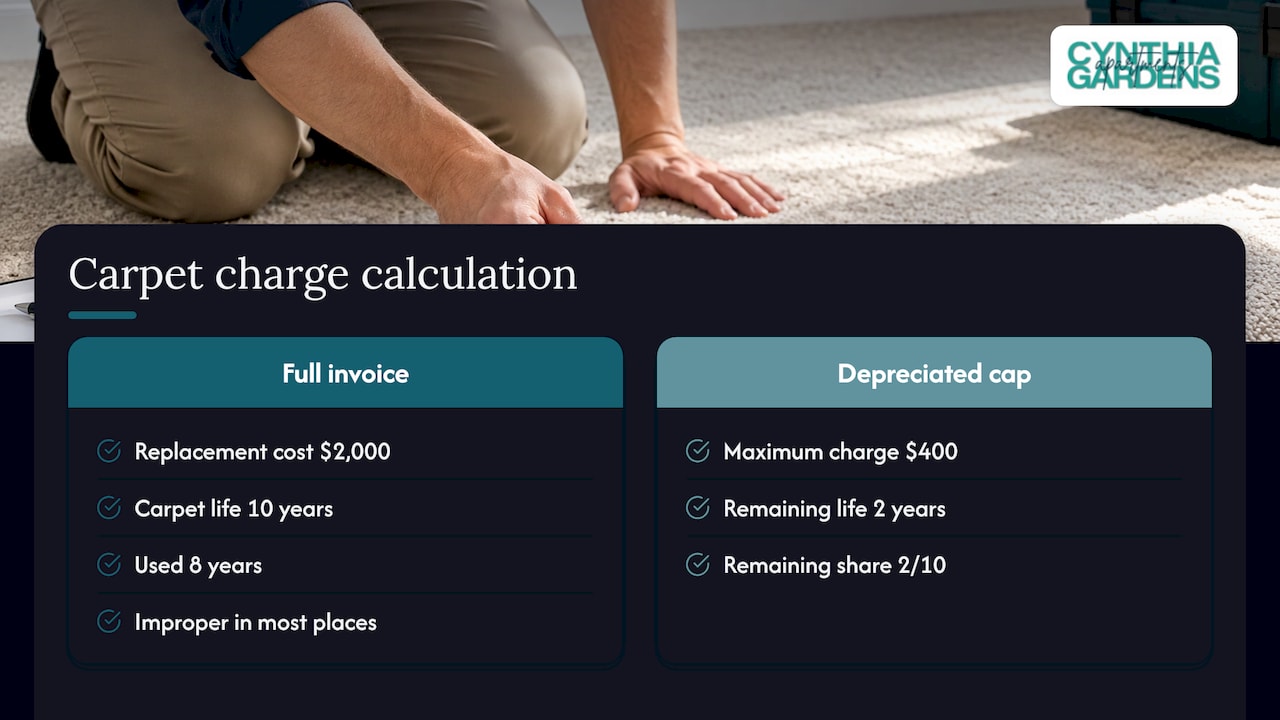
Tenant charge = replacement cost × (remaining useful life ÷ total useful life)
A published example: a $2,000 carpet with a 10-year useful life that was installed 8 years before move-in leaves a maximum charge of $2,000 × (2/10) = $400. Charging the full $2,000 would be improper in most places.
A worked example for a cat owner
Say a cat urinates on the bedroom carpet and the stain reaches the pad. The carpet was three years old, it has a five-year expected life, and a flooring company quotes $1,400 to replace it.
- Is it damage rather than wear? Yes, pet urine in the pad is damage.
- What is the depreciated value? Two of five years remain, so 40%.
- The carpet charge is $1,400 × 40% = $560.
That is the same arithmetic used in a landlord guide to pet damage. The same guide says services that undo a specific harm, like odor treatment or sealing the subfloor, are generally chargeable in full, while the carpet itself is charged only at its depreciated value. So the bill can still include more than the $560, but each extra line should be an actual service with an invoice.
A five-year or ten-year life is a common assumption, not a Florida statute. The principle is what matters: a guide built on federal housing guidance for HUD-assisted properties shows a carpet with a five-year life expectancy destroyed after three years supports a charge of at most 2/5 of new-carpet cost, and carpet in service five or more years supports none. Ask your landlord when the carpet was installed. If it was already old when you moved in, that belongs in your objection.
What a landlord should show you
A charge you can trust arrives with its reasons. A landlord who deducts for carpet should be able to give you:
- Move-in and move-out photos of the same areas from similar angles
- The carpet’s approximate installation date and its condition before your tenancy
- Cleaning or replacement estimates and the final invoices
- The lease, the inspection checklist and the deposit statement
- An explanation of why the work was necessary and how the amount was calculated
That list comes from a legal guide on landlord duties for carpet replacement. A line reading only “carpet, $900” does not explain much. If you receive one, you have every reason to ask for the supporting pieces in writing.
The burden of proof matters too. Any deduction should survive three questions in order: is it damage rather than wear, what is the depreciated value, and can the landlord prove the carpet was undamaged at move-in. That third question is why your own move-in record is so useful.

Florida deadlines you need to know
Florida’s deposit timeline is short, and it works in your favor if you follow it.
| Step | Deadline |
|---|---|
| Landlord makes no claim | Returns your deposit within 15 days after the tenancy ends |
| Landlord wants to keep part of it | Written notice within 30 days after you move out, stating how much and why |
| You disagree | Object in writing within 15 days after you receive the claim notice |
All three come from the FDACS guide. FDACS also says a landlord who misses the 30-day notice deadline forfeits the right to impose a claim on the deposit. A June 2026 summary reports these core timelines still stand, and that email notice is allowed when both sides signed the required addendum. Confirm the current statute if your notice came by email.
Give your forwarding address in writing when you leave. FDACS advises renters to tell the landlord about an address change, because the claim notice goes to the address on file.
For a longer walk through the timeline, see our guide to Florida move-out charges and the 15/30/15 rule and our overview of Florida security deposit law.
How to dispute a carpet charge
- Read the notice closely. Check that it arrived within 30 days, states an amount, and says why.
- Send a written objection within 15 days. Keep a copy and note how you sent it. Per the Chapter 83 text reproduced by a Florida law firm, missing the 15 days does not waive your right to seek damages in a separate action, but do not rely on that. Object on time.
- Challenge the math. Ask for the carpet’s installation date, the invoice, and the calculation. Apply the formula above and state your own figure.
- Separate wear from damage. Point to your photos showing traffic patterns, fading or matting that was already there.
- Escalate if needed. FDACS says a renter may file a complaint with the agency or bring a court action. Under Florida Statutes section 83.49(3)©, the prevailing party in a court action over the deposit can recover court costs and a reasonable attorney fee.
For a deeper walkthrough, see our guide on handling security deposit disputes. If a dispute reaches a legal question, such as whether you can recover fees, a Florida attorney or your local legal aid office is the right person to ask.
Protect your deposit before you ever move out
Most carpet disputes are decided by evidence from the first week and the last week of a lease.
At move-in
- Walk through every room before you settle in. Florida’s 2026 renters resource guide recommends a move-in walk-through, a written record of imperfections, and photos or video.
- Photograph stains, burns, worn paths and seams, with a wide shot and a close-up of each. Include a coin or tape measure for scale.
- Share the list with your landlord and keep your own copy. FDACS recommends recording damaged items before signing, sharing the record and keeping a copy.
- Ask when the carpet was installed and write the answer down.
Our pages on what a move-in inspection is and a move-in inspection checklist cover this step in more detail.
During your lease
- Blot spills right away and ask about the right cleaner for the stain rather than scrubbing it into the fibers.
- Use furniture pads and a chair mat under a desk chair. Rolling chairs are a common source of crushed or torn carpet.
- Report leaks or spills from plumbing in writing, with a photo.
- Students sharing a unit should agree on who handles a spill before it sets.
At move-out
- Repeat your photo record shortly before you leave, matching the move-in angles. The same 2026 guide recommends repeating the documentation shortly before moving out and keeping a copy.
- Do a final walk-through with the landlord if possible, since FDACS recommends documenting damages then.
- Keep every email and text about the unit’s condition.
- Provide your forwarding address in writing.
Cat owners: keep pet charges predictable
Pet urine in the pad is the single most common reason a carpet moves from wear to chargeable damage, so a litter box setup matters. Put the box on a hard surface or a waterproof mat, keep it away from carpet edges, and clean accidents quickly. An enzyme cleaner breaks down the odor that draws a cat back to the same spot. Take photos of the clean carpet before your cat settles in, so the move-in record shows the condition you started with.
At Cynthia Gardens, the pet cost is set out in advance: a one-time, non-refundable pet fee of $300 to $500 per cat and no ongoing pet rent. Our guide to pet-friendly one-bedroom apartments in Boca Raton explains what to expect as a cat owner.
Our view on carpet charges
A carpet dispute is almost never about malice. It starts when nobody wrote down what the floor looked like on day one, or when the numbers on a deductions list are not explained.
We believe renting should be clear from the first conversation. That is why we publish our fees openly, and why we think a renter should see the full cost of a one-bedroom before applying: rent from $1,990 to $2,220 a month, a $75 application fee per applicant, a $300 administration fee, and for a cat a one-time fee with no pet rent after that.
The same clarity should apply at the end of a lease. Dated photos, a clear carpet age and a written explanation of any charge protect the resident and the community alike. Our community is built for students, young professionals and cat owners who want to know where they stand.
Ayman
Looking for an apartment with clear pricing?
If you are searching for a one-bedroom in Boca Raton, we publish our monthly rent and our one-time fees up front. One-bedroom apartments at Cynthia Gardens are listed at $1,990 to $2,220 per month, and you can see the full list of fees on our fees page. You can tour virtually and use our interactive property map before you decide. Browse the available one-bedroom apartments to see what fits your budget.

FAQ
Is replacing carpet considered normal wear and tear?
Usually not by the tenant’s account. Replacement at the end of a carpet’s useful life is a landlord expense. A landlord can charge only for damage beyond ordinary wear, and then generally only the carpet’s remaining value, per Florida’s consumer agency and a 2026 deposit law summary.
Can a landlord charge for the whole carpet if only one room is damaged?
The charge should relate to the actual loss. Replacing an entire carpet for a small, localized stain is hard to justify when cleaning or a partial repair would restore it, and the landlord should explain why the work was necessary and how the amount was calculated.
How long does a landlord have to tell me about carpet charges in Florida?
Thirty days after you move out, in writing, stating how much of the deposit will be kept and why. If the landlord misses that deadline, FDACS says the right to make a claim on the deposit is forfeited. You then have 15 days from receiving a claim to object in writing.
What can I do if I think the charge is too high?
Object in writing within 15 days, ask for the carpet’s age, invoices and calculation, and attach your move-in and move-out photos. FDACS says you can also file a complaint with the agency or bring a court action.
Sources
- Landlord/Tenant Law in Florida, FDACS
- Renters Resource Guide, English, 2026
- Chapter 83, Florida landlord and tenant statutes
- Florida Security Deposit Law: Deadlines and Forfeiture (2026)
- Carpet replacement dispute guide
- Useful life of rental property items
- Normal wear and tear vs damage, item by item
- Pet damage in a rental: what you can charge for
- Tenant rights and landlord duties for carpet replacement