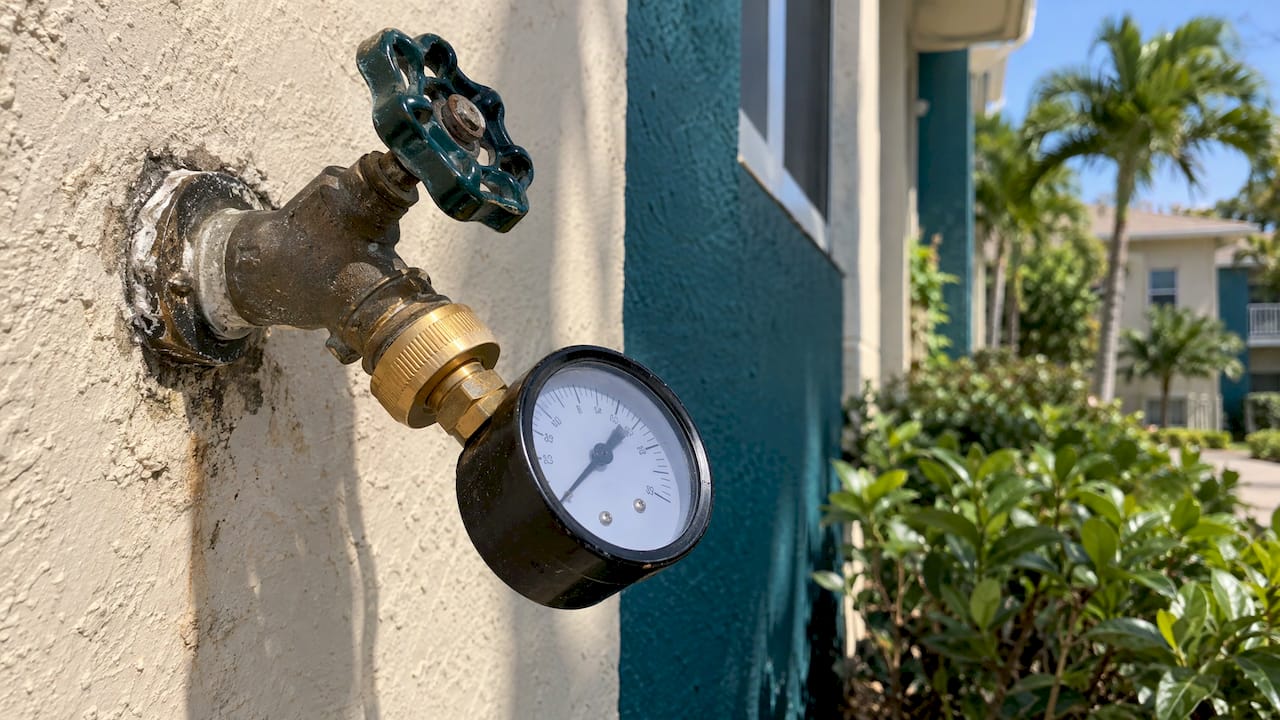
You can test your apartment’s water pressure in about ten minutes with a hose-thread pressure gauge, usually under $15 at a hardware store. Screw it onto a hose bibb (the outdoor spigot) or the washing machine connection, turn off every other water use, open the tap fully and read the dial. The U.S. EPA says fixtures work best between 45 and 60 psi. Under about 40 psi, showers feel weak. Above 80 psi, pipes and appliances take a beating. Below, you’ll find how to run the test, what the number means, what to do with low pressure, and how to keep Boca Raton humidity in check.
TL;DR
- Buy a water pressure gauge with a female hose thread, attach it to a hose bibb or laundry connection, shut off all other water use, and read the psi.
- Aim for roughly 45 to 60 psi. Readings under 40 suggest a weak supply or a restriction. Readings over 80 call for a professional to adjust the regulator.
- If only one faucet is weak, it’s usually a clogged aerator. If every fixture is weak, report it to management in writing.
- In South Florida, keep indoor humidity under 60%, and ideally near 50%. Your air conditioner does most of the work, and a small dehumidifier can help.
- Run both checks in your first week in a new apartment, and document the results with dates.
Table of Contents
- What you need for a water pressure test
- How to test water pressure, step by step
- What your psi reading means
- Low water pressure in an apartment: find out where the problem is
- How to report it so it gets fixed
- Do the pressure test as part of your move-in routine
- Humidity in a Boca Raton apartment: the other number to watch
- Looking for a one-bedroom in Boca Raton?
- FAQ
- Sources
What you need for a water pressure test
The kit is simple. One plumbing company’s guide lists a gauge with a hose bib fitting (under $15 at most hardware stores), an adjustable wrench, a phone or notepad for readings and a towel for drips.
Two details are worth getting right:
- Gauge range. Pick a dial that reads at least 0 to 100 psi with a clear face. A South Florida plumbing guide also recommends a red maximum-pressure indicator, which catches spikes you would otherwise miss.
- A second “max” needle. A gauge with a second needle that stays at the highest reading is ideal. Leave it on overnight, and the gap between the two needles in the morning reveals pressure surges.
No gauge yet? Skip any urge to guess by feel. A shower that feels weak can be a clogged showerhead, not low pressure. The gauge settles it with a number you can show management.
How to test water pressure, step by step
- Find a connection. The best spots are an outdoor hose bibb or the cold-water washing machine hookup. If your apartment has neither, a threaded utility sink faucet works. Ask management where the nearest hose connection is if you can’t find one.
- Turn everything else off. No running faucets, no dishwasher, no washing machine, no ice maker refilling, no one showering. A reading taken while something else runs is a flow reading, not a static one.
- Attach the gauge. Screw it on hand-tight, then snug it a quarter turn with the wrench. Put the towel underneath.
- Open the tap fully. Watch the needle settle. That steady number is your static pressure.
- Record it. Write down the psi, the date, the time and the location. Take a second reading from another connection if you can.
- Repeat at a different time. One plumbing company suggests testing early in the morning or late at night, when utility pressure often runs higher. Testing again during the evening rush shows how much the number drops when your neighbors shower.
One catch: building code lets the line to an outdoor spigot stay unregulated, so an outside bibb may read the street pressure rather than what your kitchen and bathroom fixtures see. If the outdoor reading is high but your shower is weak, test the laundry connection inside as well.
What your psi reading means
| Reading | What it usually means | What to do |
|---|---|---|
| Under 30 psi | A clear problem | Retest, then report to management in writing |
| 30 to 40 psi | Low. Showers and upstairs fixtures feel weak | Check aerators, compare fixtures, report if it persists |
| 45 to 60 psi | The range the EPA says fixtures work best in | Nothing to fix |
| 60 to 80 psi | Acceptable for most plumbing | Fine, but watch for noise |
| Over 80 psi | Strains pipes, fixtures and appliances | Report it. The regulator needs a professional |
For context, Inspectapedia notes that building pressure on a municipal supply is typically 30 to 60 psi, depending on the regulator setting. Sources differ a little at the edges. The EPA’s 45 to 60 psi is the safest target to use when you write to management.
High pressure deserves the same attention as low. The EPA says much higher pressure may warrant a professional adjusting or installing a pressure-regulating valve. That is a building-side repair, so don’t touch the regulator yourself. Sudden banging in the walls or a faucet that sprays harder than it should are the clues that send you to the gauge.

Low water pressure in an apartment: find out where the problem is
Before you blame the building, work out the scope. The question that matters is whether the problem is one fixture or the whole unit.
Only one faucet or shower is weak
This points to the fixture. Unscrew the aerator (the small screen at the tip of the faucet) and rinse out the grit. Do the same with the showerhead screen. Portland’s water bureau advises exactly this when some faucets run normally and others don’t, along with checking that the valves under the sink are fully open.
Only the hot water is weak
If cold runs normally and hot doesn’t, the same city guide points to the water heater and to the hot-side faucet screens. In an apartment, the water heater is usually management’s equipment. Report it rather than opening it.
Everything is weak, including the outdoor spigot
This is the pattern that calls for management. Portland’s guide says that when flow is reduced at all faucets, including outside hose spigots, report it to the property manager in an apartment or condo building. A plumbing company’s tenant guide adds that reduced flow across multiple floors or the whole building calls for a property-level investigation.
Common building-side causes include pumps that can’t keep up, aging pipes, leaks and a pressure-reducing valve set too low. In taller buildings, water is pumped up to rooftop or intermediate tanks, and higher floors need more pressure to get consistent flow. A low reading at peak hours but a normal one at night often means demand, not a broken part.
What not to touch
Leave shared valves, pumps, tanks and controls alone. A wrong adjustment can affect other residents or create a safety problem. Your job is to gather evidence and hand it to the people who maintain the building.
How to report it so it gets fixed
A vague “my water is weak” gets a vague response. A short written note gets action. Include:
- the psi readings, with dates, times and where you measured
- which fixtures are affected, and whether hot, cold or both
- when it started, and whether it was sudden or gradual
- whether neighbors on your floor or in other buildings have noticed it
- any visible signs, such as damp spots, stains or noisy pipes
These are the same details that a tenant-focused plumbing guide suggests sending. Keep a copy. If you also want a refresher on how to log repair requests, our guide to apartment maintenance steps for renters walks through it, and our piece on spotting hidden maintenance issues covers the slow leaks that can quietly sap pressure.
If you’re a cat owner, maintenance in cat-friendly apartments is worth a read before you schedule a repair visit.
Do the pressure test as part of your move-in routine
The best time to measure is in your first days, before any dispute about who caused what. Put the gauge reading next to the other items on your move-in inspection checklist: run every tap, flush the toilet, check under sinks for drips and note the hot water arrival time. A dated baseline protects you later if pressure changes.
If you’re still hunting for a place, our apartment viewing checklist covers what to look at during a tour. Running the taps in the kitchen and bathroom takes thirty seconds and tells you a lot.
Humidity in a Boca Raton apartment: the other number to watch
Most renters who search for water pressure in Florida are also fighting damp air. Florida’s average relative humidity is about 74.5%, and at night it can reach 80 to 100%, especially after storms or when windows are open, according to University of Florida extension specialists. Indoors, the target is much lower.
What indoor level to aim for
Official and academic sources agree on the direction, with small differences in the exact band:
- The Florida Department of Health says keeping humidity below 60% and venting shower and cooking moisture outside are key to preventing mold. Below 50% is best for controlling both mold and dust mites.
- The Florida Solar Energy Center at the University of Central Florida puts the best target at 45% to 55%, and says relative humidity above 60% for several hours in a conditioned home means air quality control could be improved.
A simple plan: aim for the 45% to 55% band and treat anything that stays above 60% as a problem to fix.
Measure it first
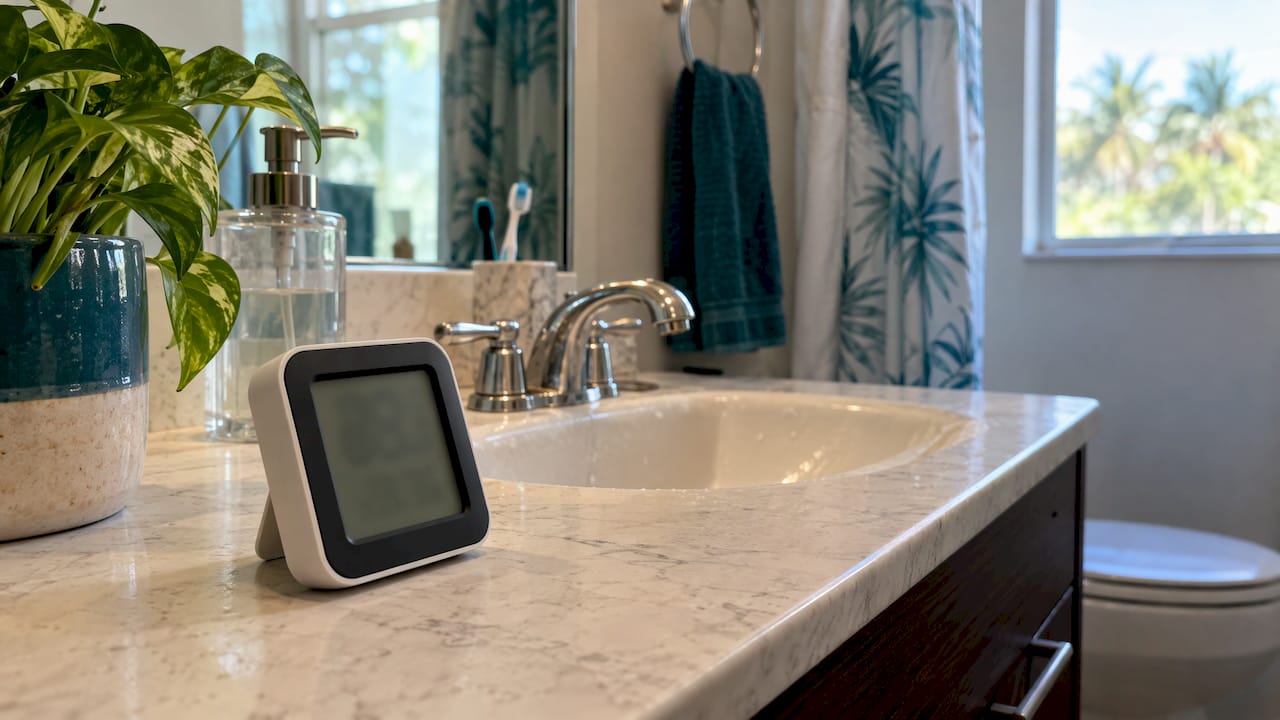
A small hygrometer costs little and shows the real number. Put it in the bedroom and the bathroom area, and check it morning and evening for a week. Humidity is relative, so it swings. The FSEC explains that air at 75°F and 60% relative humidity would reach about 70% if cooled to 70°F, even though its moisture content hadn’t changed. This is why an over-chilled apartment can feel clammy.
Let the air conditioner work first
The air conditioner is your main dehumidifier. The Florida Department of Health advises using an air conditioner or dehumidifier to bring indoor humidity under 60%, and says that if central air needs a dehumidifier to get there, the system should be examined. The EPA likewise recommends air conditioners and dehumidifiers, especially in hot, humid climates.
Practical habits that help:
- Run the bathroom exhaust fan during and after showers, and the kitchen hood while cooking.
- Keep windows closed on humid days and nights.
- Avoid setting the thermostat so high that the system barely runs. Short cycles remove less moisture.
- Don’t dry laundry on racks indoors if you can avoid it.
If the air conditioner is not keeping up, report it to maintenance. Equipment belongs to the building.
Choosing a dehumidifier for a one-bedroom
A dehumidifier is useful when the AC runs but humidity still sits above 55% to 60%, such as in a closet-heavy bedroom or in cooler months. Consumer Reports says spaces under 600 square feet typically call for small-capacity models under 30 pints per day. It also says to consider noise and tank size, to use a hose to a floor drain or a pump if you need to drain upward, and to clean the tank and filter regularly.
For a one-bedroom, that means:
- A compact unit in the 20 to 30 pint range is usually enough.
- Put it in the room that gets damp, with space around it for airflow, and keep doors closed.
- Empty the tank daily, or use a hose to a sink or tub if the layout allows.
- Mind the noise if it sits near the bedroom.
If humidity or visible mold keeps coming back despite consistent use, tell management in writing, with your hygrometer readings and photos. Persistent moisture often has a building source, such as a window seal or an exhaust fan, that a portable unit can’t solve.
For tenants who are new to the area, our Boca Raton water service guide and apartment utility billing explainer are useful for planning monthly costs, including the electricity a dehumidifier will add.
What we tell residents
A gauge reading and a hygrometer reading are the two most useful things a renter can hand to management, because they turn “it feels off” into numbers that can be acted on. We built our community around transparent pricing and attentive same-day maintenance, and a dated, written report is the fastest way for a maintenance team to see where to look first.
Our residents are mostly young professionals, students and cat owners who want one-bedroom living without surprises. Whatever the building, we’d say the same thing: test early, write it down, and keep copies. If your apartment is the right fit on the day you move in, a dated baseline keeps it that way.
Ayman
Looking for a one-bedroom in Boca Raton?
If you’re comparing places, we offer one-bedroom apartments in Boca Raton at $1,990 to $2,220 per month, with pet-friendly policies, transparent pricing with no hidden fees and virtual tours so you can narrow your search from home. Our cat-friendly policy has no ongoing pet rent, just a one-time fee, and we publish our application, administration and other fees on our fees page. See the available one-bedroom apartments and pick the layout that fits.
Prefer to look first? Our guide to why tour apartments virtually explains how a digital tour works.
FAQ
What is a good water pressure for an apartment?
The EPA says fixtures work best between 45 and 60 psi. Some plumbing sources treat 40 to 80 psi as an acceptable working range. Under 40 psi usually feels weak, and over 80 psi can damage fixtures and appliances.
Can I test water pressure without a gauge?
You can compare fixtures and time how long a bucket takes to fill, but neither gives a psi number. A hose-thread gauge is cheap and gives you something to show management. It also helps you tell low pressure from low flow caused by a clogged aerator.
Is low water pressure my responsibility to fix as a renter?
You can clean aerators and showerhead screens yourself. Anything that touches the building’s plumbing, such as the regulator, shared valves, pumps or the water heater, is for management to handle. Report it in writing with your readings.
What humidity should I keep in a Florida apartment?
The Florida Department of Health says to keep it below 60%, with below 50% best for mold and dust mites. FSEC suggests 45% to 55% as the best target. A hygrometer tells you where you stand.
Do I need a dehumidifier in Boca Raton?
Not always. Run the air conditioner and exhaust fans first. If the readings stay above about 55% to 60%, a small dehumidifier of under 30 pints per day is typically enough for a one-bedroom, according to Consumer Reports. If humidity keeps returning, tell management.
Sources
- Home Maintenance, US EPA
- How To Test Your Water Pressure At Home
- How to Test Water Pressure in Your South Florida Home
- How to check water pressure, Plumbdeck
- Water Pressure Problems in SWFL
- Water pressure measurement procedure, Inspectapedia
- Troubleshooting water pressure and flow, Portland.gov
- Causes of Low Water Pressure in an Apartment Building
- How to Deal With Low Water Pressure in a High-Rise
- Check indoor humidity, UF/IFAS
- Mold, Florida Department of Health
- Humidity, FSEC
- Main ways to control moisture in your home, US EPA
- Dehumidifier Buying Guide, Consumer Reports