You can keep an indoor cat happy in a one-bedroom apartment with five things: places to climb and look out, daily play with prey-like toys, food that takes effort to get, scratching surfaces in more than one spot, and a calm routine. None of it needs a big budget or a big floor plan. This guide covers each of those, the DIY versions you can build from recycling, and how to introduce a cat to a new apartment so the first week goes smoothly.
TL;DR
- Use height and windows first: a cat tree, wall shelves or a window perch give a small apartment more usable space from a cat’s point of view.
- Plan for about 15 to 20 minutes of interactive play a day, and rotate toys every few days so they stay interesting.
- Cardboard tubes, boxes, egg cartons and paper bags make good puzzle feeders and hideouts for almost no money.
- When you move in, start your cat in one quiet room with food, water, litter and hiding places, then open the rest of the apartment one room at a time.
- Call your veterinarian if hiding, withdrawal, lethargy or litter-box changes continue, because pain and illness can look like stress.
Table of Contents
- What enrichment means for an apartment cat
- Use vertical space and windows first
- Play, hunting and food puzzles
- DIY cat enrichment for almost nothing
- Scratching posts and litter boxes in a small floor plan
- How to introduce your cat to a new apartment
- Signs your cat is stressed by the move
- Our perspective
- Find a one-bedroom that works for you and your cat
- FAQ
- Sources
What enrichment means for an apartment cat
Enrichment is anything that lets a cat do what cats are built to do. VCA describes it as support for hunting, play, exploration, exercise, mental stimulation and social interaction, and notes that every cat has its own preferences. A cat that never stalks, climbs or scratches still has those urges. They just come out on your curtains, your ankles or at 3 a.m.
The foundation is not a toy. A peer-reviewed review of environmental enrichment for indoor cats says it starts with a predictable, consistent environment that minimizes fear and gives the cat some control over its daily routine. The AAFP and ISFM environmental needs guidelines link a cat’s environment to physical health, emotional wellbeing, behavior and stress. So the order is: a stable base, then the fun.
Apartments have an advantage here. A smaller space is easier to make predictable, and you are home in the same rooms every day. The challenge is floor area, which is why most good apartment ideas go up the walls and into the window.
Use vertical space and windows first
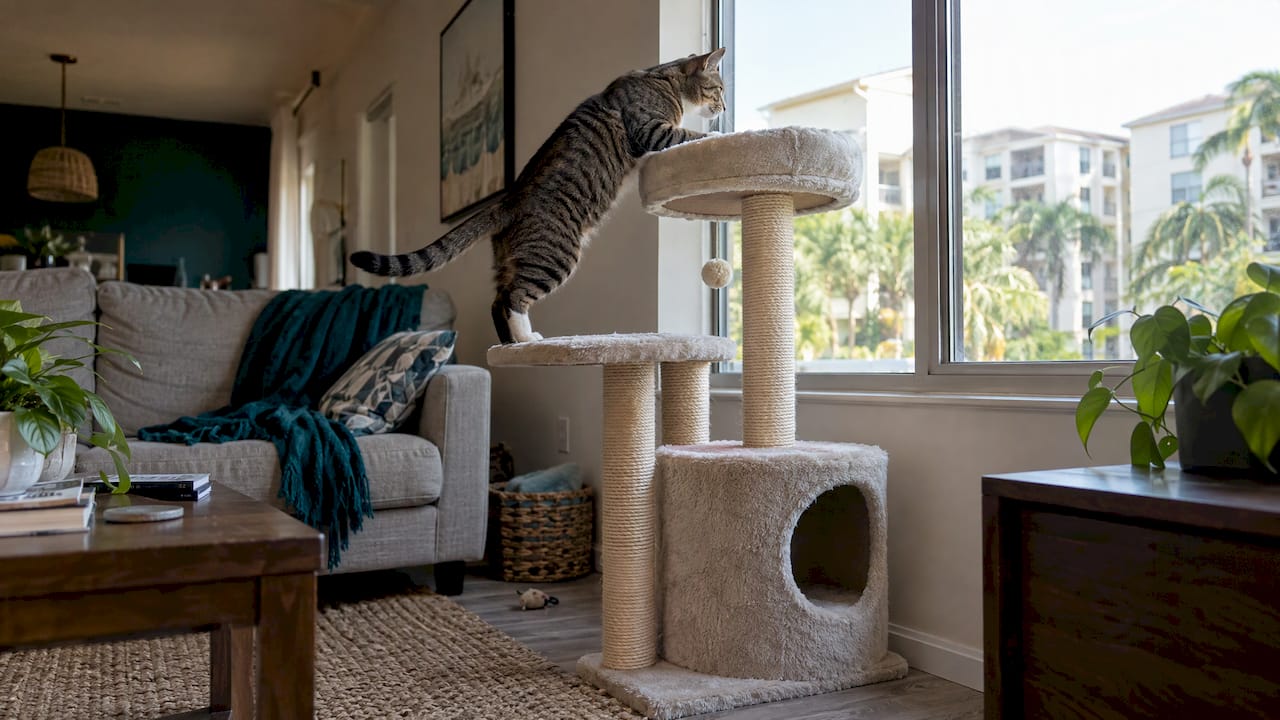
If you do only one thing, add height. AAHA’s guidance for indoor cats recommends vertical space such as cat trees or shelves, interactive toys and a secure window view. VCA points to cat trees and elevated resting places as spots for climbing, hiding, playing and safe observation.
Cat trees and shelves
Pick a tall, stable tree and put it where you spend time, such as beside the sofa or near the desk. VCA recommends climbing structures in areas where people are, because cats like to watch and be near their household. If you rent and do not want to drill, a tall freestanding tree does the job. If your lease allows wall mounting, ask first and follow the rules in your lease about repairs.
On a budget, ASPCA Pet Health Insurance suggests building vertical space by tying plastic milk cartons securely together or buying a cat tree. ASPCApro also mentions cheap plastic milk crates as a kitty jungle gym. Whatever you build, make sure it cannot tip, and test it with your own weight on the base before the cat climbs it.
One popular guide argues that vertical space effectively increases a home’s usable area for a cat, so a 600-square-foot apartment with shelves, a tall tree and window perches feels significantly larger to a cat than the same rooms with furniture alone. That is a useful way to think about a one-bedroom: count surfaces, not square feet.
The window perch
A window seat is the cheapest entertainment you can give a cat. The Ohio State University Indoor Pet Initiative lists window perches alongside scratching posts, daily play, toy rotation and hidden treats. ASPCA Pet Health Insurance suggests a windowsill seat for watching birds, and a bird feeder outside the window if your building allows it, with the window kept securely closed.
Safety note: check screens and latches before you open a window near a perch. A screen that holds against a breeze may not hold against a cat launching at a bird. In a high-rise or upper-floor unit, keep windows shut or use a screen made for pets.
Play, hunting and food puzzles
Daily interactive play
AAHA suggests about 15 to 20 minutes of interactive play every day, using prey-like toys such as feather wands or toy mice. The peer-reviewed review recommends wand toys, self-propelled prey-like toys, balls in a box or bathtub, catnip toys, and pointer games that finish with a treat or toy. That last detail matters: a hunt that never ends in a catch can frustrate a cat.
A simple routine for a one-bedroom:
- Play in two or three short bursts, such as after you get home and before bed.
- Move the wand like prey: away from the cat, behind furniture, then a pause.
- End with a treat, a small meal or a toy the cat can grab and carry.
- Put the wand away afterward. Strings should not be left out, as covered below.
Rotate toys
A toy basket that is always open stops being interesting. Both the Ohio State initiative and the peer-reviewed review recommend rotating toys every few days. Keep four or five out, store the rest in a closet, and swap them on a schedule you will remember, like laundry day.
Food puzzles and scatter feeding
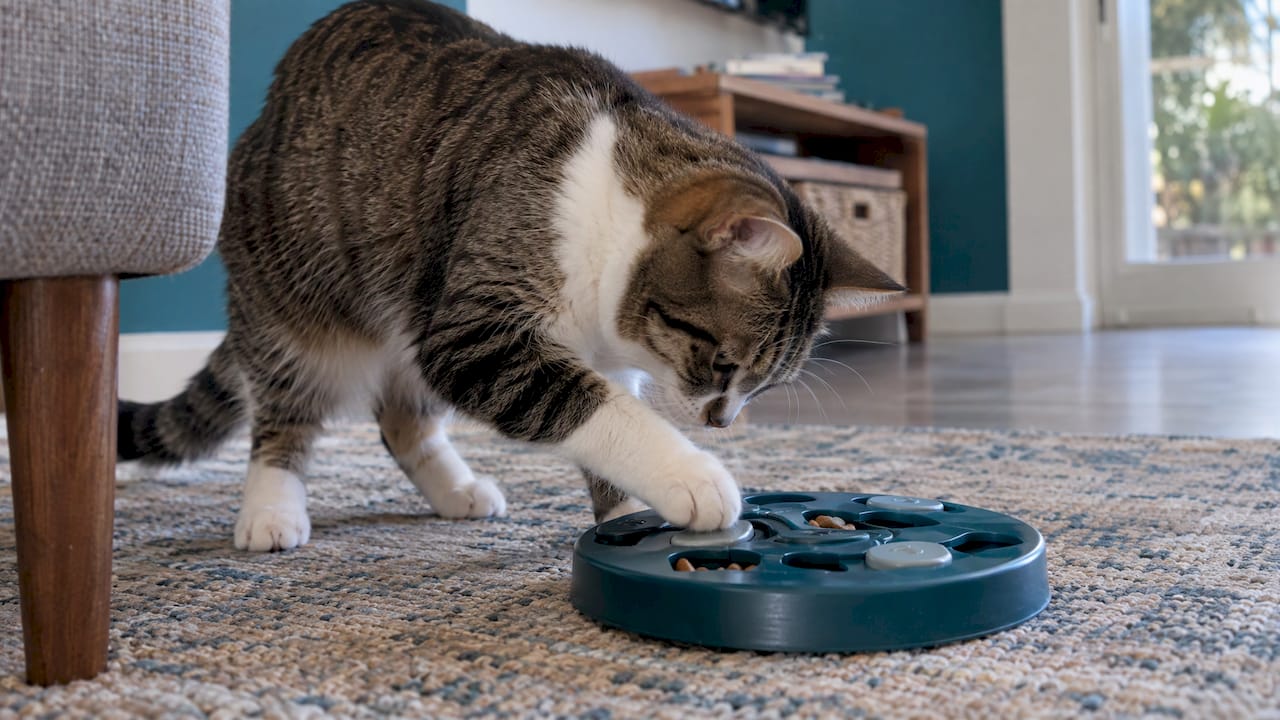
VCA recommends hiding toys or part of the daily food ration and using puzzle toys. Best Friends Animal Society describes scatter feeding: tossing kibble on the floor or hiding small piles around the house. In a small apartment, hiding food on the cat tree, behind a chair leg and on a low shelf turns a bowl into a mini hunt.
DIY cat enrichment for almost nothing
You do not need to buy much. The ideas below come from veterinary and animal welfare groups, and most use things already in your recycling bin.
| Idea | What you need | How it works | Source |
|---|---|---|---|
| Toilet paper roll puzzle | Empty roll, treats | Fold the ends closed, cut a few small holes in the sides, add treats, and let the cat bat it to release them | AAHA |
| Reach feeder | 3 to 4 tube rolls, shoe box with lid, pencil, sharp knife | Trace the roll ends on the lid, cut holes, slide rolls in, fill with kibble or treats | ASPCA |
| Cardboard tube challenge | Tubes, small box | Stand tubes upright in the box and drop treats inside | AAHA |
| Egg carton puzzle | Egg carton, scrunched paper | Put treats in the compartments and cover with paper | AAHA |
| Pizza box puzzle | Empty pizza box | Cut holes in the lid and insert treats | ASPCApro |
| Cardboard box castle | Several boxes, tape | Cut holes, stack and tape the boxes into a hideout | AAHA |
| Sock and string toy | Sock, soft stuffing, optional catnip, string | Stuff, tie off, and attach string or ribbon | AAHA |
Best Friends Animal Society adds that low-cost or no-cost items are often a cat’s favorites, including wadded-up paper, cardboard boxes, ping pong balls and plastic rings from milk jugs. It specifically says to skip aluminum foil, which cats tend to dislike. The Ohio State initiative also lists cardboard boxes and paper bags as hiding places, which suit a small apartment because they are cheap, replaceable and fold flat.
Start with one puzzle at an easy level. If your cat gives up, make the holes bigger or let treats fall out sooner. The goal is a small win, not a test.
Keep toys safe
VCA warns that wand toys and strings should not be left unattended because ingestion can be dangerous, and that toys should not be small enough to swallow. Before you hand over a homemade toy, check for loose ribbon, staples, tape adhesive, or anything the cat could chew off. If you think your cat has swallowed string, call your veterinarian or an emergency clinic right away rather than pulling on it.

Scratching posts and litter boxes in a small floor plan
Scratching is a need, not a bad habit. The Ohio State initiative recommends scratching posts in several locations. In a one-bedroom, that usually means one tall post by the main seating area, one by the bedroom door and a cardboard scratcher near the cat’s favorite nap spot. Cats often scratch after waking and near the spots they use for sleep, so place them there.
Litter boxes are part of enrichment too. The peer-reviewed review says boxes belong in quiet, safe locations away from food and water, and that in multicat homes you should provide one box per cat plus one extra, out of one another’s sight. In a small apartment, avoid putting the box next to the washer or in a spot where the cat feels cornered. A bathroom corner with the door propped open often works.
If you are still choosing a place to live, our guides on cat-proofing an apartment and pet-proofing for cat owners walk through renter-friendly changes that do not touch the walls.
How to introduce your cat to a new apartment
For an indoor cat, the home is the whole world, so a move is a big deal. The Ohio State initiative says that any sudden change may be upsetting, and that a consistent refuge the cat can come and go from helps during transitions. That is the idea behind every step below.
Before moving day
- Bring boxes in early. The ASPCA suggests introducing moving boxes early and packing the cat’s familiar room last, then keeping the cat in a quiet room with the door shut on moving day.
- Give the cat a refuge. The Ohio State initiative recommends a refuge before packing begins, with a radio or TV playing nearby as white noise to muffle confusing sounds.
- Keep routines steady. Preventive Vet recommends a quiet safe zone with familiar bedding, a hiding place, elevated space if possible, food, water and litter, and maintaining feeding, play, bonding and litter-cleaning routines.
- Update the microchip. VCA also recommends transporting your cat in a secure carrier and updating microchip information.
For the logistics of the move itself, a moving day plan for cats can help you sequence the carrier, the cat room and the movers so your cat is never in a doorway with the door open.
The home-base room
When you arrive, set up one room first. VCA says to leave the cat in a secure room with familiar items, food, water, litter and an open carrier, visit often, keep the cat there for several days while you unpack, and check doors and windows before it explores. The Humane Society of Sonoma County adds that it is normal for a cat not to eat, drink or play much in the first few days, and that hiding spots such as cardboard boxes or cave-style beds should be offered.
In a one-bedroom, the bathroom or bedroom usually works best. Put in:
- A litter box away from food and water
- Food and water bowls, kept apart from each other
- A bed or blanket that smells like the old home
- A box or cave to hide in
- A scratcher and one or two safe toys
- A high spot, even a sturdy low shelf or the top of a box
Opening up the apartment
Cats Protection’s guide recommends letting a new cat explore its room first, approaching quietly at floor level and never forcing it out of hiding. If the cat will not come out, move food closer to the hiding place. Eating and using the litter box are reassuring signs.
The ASPCA suggests gradually introducing other rooms while keeping some doors shut, and moving the litter box one foot forward each day if it needs to end up elsewhere. San Diego Humane Society similarly advises opening additional rooms one at a time as the cat becomes comfortable.
A realistic timeline for a small apartment:
| Stage | What to do |
|---|---|
| Day 1 | Home-base room only. Quiet visits, no pressure to come out |
| Days 2 to 4 | Short sessions of calm play or treats in the room. Keep other rooms closed |
| Days 4 to 7 | Open one more room when the cat eats, uses the litter box and walks around the base room confidently |
| Week 2 | Set up the cat tree, window perch and puzzle feeders in the main living area |
Cats vary, so treat these days as a guide and follow your cat’s pace.
Signs your cat is stressed by the move
AAHA lists possible signs of anxiety: increased hiding, litter-box accidents, constipation, diarrhea, vomiting, changes in eating or sleeping, excessive grooming, new scratching or spraying, excessive vocalization, withdrawal and lethargy. A move, new people or pets, routine changes, rearranged furniture and food or litter changes can all contribute.
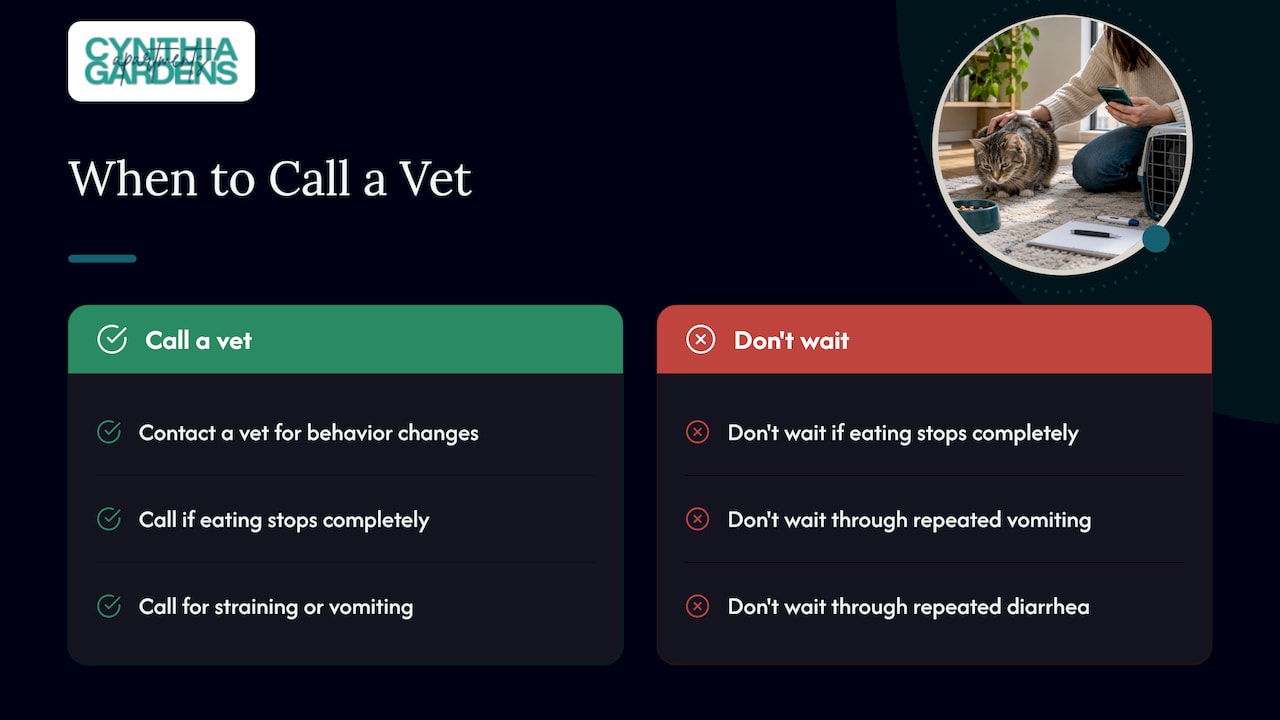
San Diego Humane Society notes that cats may hide, seem nervous or eat less for several days after a move. That alone is common. What is not something to wait out: AAHA advises contacting a veterinarian about behavior changes, withdrawal or lethargy, because medical conditions and pain can cause anxiety too. If your cat stops eating completely, strains in the litter box or has repeated vomiting or diarrhea, call your veterinarian rather than waiting for it to pass.
VCA suggests adding boxes with hidden toys or treats and window perches while keeping familiar beds, toys, litter boxes and scratching posts. This is where enrichment and settling in meet: puzzles and perches give a nervous cat something to do with its attention, on its own terms.
Our perspective
We built Cynthiagardens around one-bedroom living, and that is a good size for a cat. One main living area, a bedroom and a bathroom mean a cat can learn the whole home quickly, and that predictability is exactly what a newly moved cat needs.
When we talk to renters with cats, the questions are rarely about luxury. They are about whether the cat will be welcome, what it costs, and whether the place can be made comfortable. Our cat policy is simple: a one-time pet fee of $300 to $500 per cat and no ongoing pet rent. We publish our fees on one page so there are no surprises.
Our virtual tours and interactive property map let you look at layouts and windows before you ever carry a cat carrier through the door. Windows, floor space for a tree and a spot for the litter box are things you can plan from home.
We also aim for same-day maintenance and a quiet, respectful community. For a cat that startles easily, quiet matters more than any amenity.
Ayman
Find a one-bedroom that works for you and your cat
If you are planning a move to Boca Raton, our one-bedroom apartments are listed at $1,990 to $2,220 per month. Cats are welcome, with a non-refundable pet fee of $300 to $500 per cat, and our policy has no ongoing pet rent. Other one-time fees, including the $75 application fee per applicant and the $300 administration fee, are listed on our fees page.
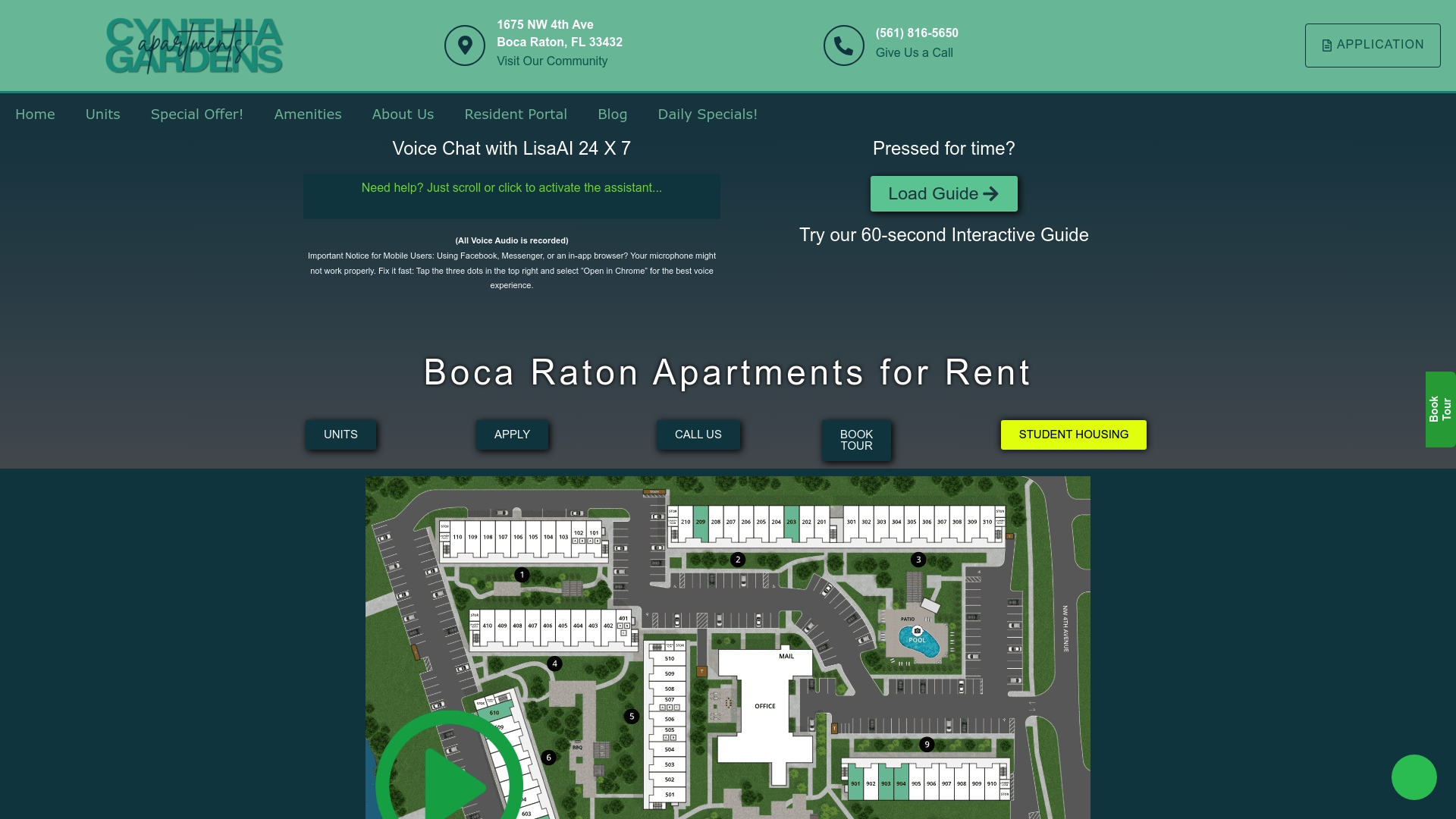
To see how a floor plan will fit a tree, a perch and a litter box, start with a virtual apartment tour and read our guide to choosing the best apartment for your cat. You can also look at cat-friendly amenities in Boca Raton before you decide, or visit Cynthiagardens to ask about availability.
FAQ
How much playtime does an indoor cat need each day?
AAHA suggests about 15 to 20 minutes of interactive play daily, using prey-like toys such as feather wands or toy mice. Split it into short sessions if that suits your cat better. End each session with a treat or a toy the cat can catch.
What is the cheapest way to enrich a small apartment?
Cardboard. Empty toilet paper rolls, boxes, egg cartons and paper bags can become puzzle feeders and hideouts, as animal welfare groups describe. Add a window perch and rotate the toys every few days, and you have covered most of what a cat needs for very little money.
How long should a cat stay in one room after moving?
VCA suggests several days while you unpack, and the Humane Society of Sonoma County notes that cats often eat, drink and play little at first. Open other rooms one at a time once your cat is eating, using the litter box and moving around confidently. Every cat sets its own pace.
How do I know if my cat is anxious about the move or sick?
You often cannot tell by looking, since hiding, eating less and litter-box changes can come from either. AAHA says medical conditions and pain can cause anxiety, so contact your veterinarian if the behavior continues or if your cat seems withdrawn or lethargic.
Can I keep a cat in a one-bedroom apartment?
Yes. Height, windows, daily play and a predictable routine matter more than square footage. At Cynthiagardens, cats are welcome in our one-bedroom apartments under a one-time pet fee and no ongoing pet rent.
Sources
- Bringing Cats Indoors, Ohio State Indoor Pet Initiative
- New Environments, Ohio State Indoor Pet Initiative
- Environmental Enrichment for Indoor Cats (peer-reviewed review)
- Environmental Enrichment for Indoor Cats, litter box guidance
- AAFP and ISFM Feline Environmental Needs Guidelines
- Happy Cat Month: How to Keep Your Indoor Cat Happy, AAHA
- DIY Enrichment Toys For Your Cat, AAHA
- Purrfectly Entertained: Indoor Enrichment for Cats, AAHA
- Cat Anxiety: Signs, Causes, and How to Help, AAHA
- Enrichment for Indoor Cats, VCA
- Cat Behavior and Training: Enrichment for Indoor Cats, VCA
- Moving to a New Home with Cats, VCA
- Environmental Enrichment for Cats, ASPCA Pet Health Insurance
- Feline DIY Enrichment, ASPCA
- Moving With Your Pet, ASPCA
- 5 Free (Or Darn Close) Feline Enrichment Ideas, ASPCApro
- Indoor Cat Enrichment Ideas, Best Friends Animal Society
- Indoor Cat Enrichment, The Scruff Guide
- Welcoming Your New Cat, Humane Society of Sonoma County
- Bringing your cat home, Cats Protection
- Moving With Your Cat, San Diego Humane Society
- How to Make Moving With Your Cat Less Stressful, Preventive Vet
- Moving With a Cat: A Practical Plan