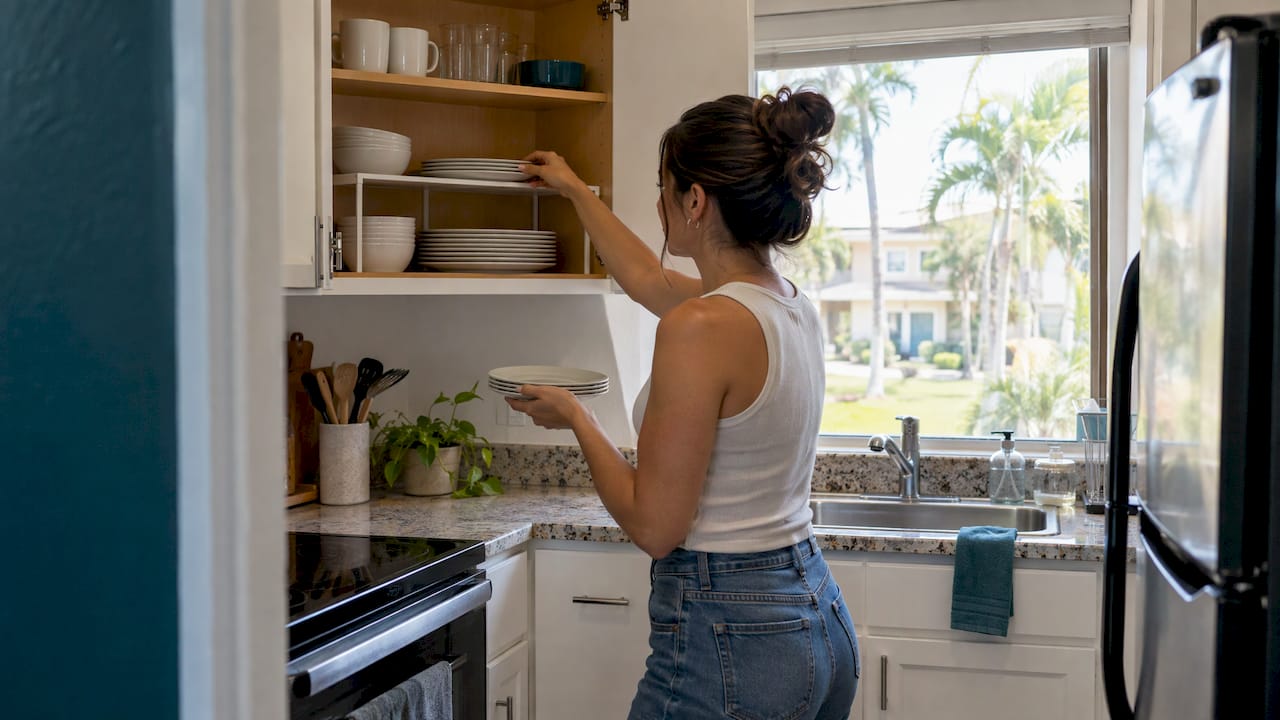
A small kitchen works when every item has a home near where you use it. Start by emptying the cabinets and keeping only what you actually use. Then sort what remains into zones, and add storage upward (risers, racks, over-door hooks) rather than outward. Nothing here needs a drill, so all of it suits a rental.
TL;DR
- Empty everything, group like items, and keep one of each tool you really use.
- Let the stove, sink and refrigerator decide where things live, then store by activity: prep, cooking, food storage, cleaning.
- Go vertical: shelf risers, plate racks, over-door organizers, deep drawers with dividers.
- Choose no-drill fixes (tension rods, adhesive hooks, freestanding racks) and check your lease before drilling anything.
- Pick compact, collapsible and nesting tools, so one item does two jobs.
Table of Contents
- Start with a reset, not a shopping trip
- Build your layout around zones
- Make cabinets and drawers work harder
- Add storage on walls, doors, counters and under the sink
- Renter-friendly fixes that leave no trace
- Choose compact, collapsible and nesting tools
- Keep it organized day to day
- Our perspective: a small kitchen is a design problem, not a limitation
- Looking for a one-bedroom in Boca Raton?
- FAQ
- Sources
Start with a reset, not a shopping trip
The most common mistake in a small kitchen is buying organizers before deciding what deserves the space. Containers do not create room. Removing things does.
The approach Apartment Therapy describes is simple: empty the cabinets, group like items together, and keep one of each item you use. Then think about how you actually cook, and place things accordingly. Frequently used items go in easy-to-reach spots or near where they are used. Less-used items move to harder-to-reach storage, or out of the kitchen entirely.
A quick way to run the reset in about an hour:
- Clear one cabinet or drawer at a time onto the counter, so you do not end up with the whole kitchen on the floor.
- Sort into three piles: use weekly, use a few times a year, never used.
- Remove duplicates. Three spatulas, two can openers and four mismatched mugs are the usual suspects.
- Relocate the occasional gear. The turkey roaster, the stand mixer and the party platters can live on a high shelf, under a bed or in a hall closet.
- Wipe down the empty space before anything goes back.
Anything in the “never used” pile is a donation, not a storage problem. If you are moving into a smaller place, our guide to downsizing from a house to an apartment covers the same sorting logic for the whole home.
Build your layout around zones
Before you decide where a single pan goes, look at where your stove, sink and refrigerator sit. Wirecutter’s small-kitchen guide recommends five functional zones: food preparation, cooking, food storage, non-food storage and cleaning. It says the placement of those three big fixtures should determine where everything else lives. In other words, you work with the room you have instead of a fixed cabinet formula.
Here is how that looks in a typical one-bedroom apartment kitchen:
| Zone | What lives there | Best spot |
|---|---|---|
| Prep | Cutting boards, knives, mixing bowls, measuring tools | Near the longest stretch of clear counter |
| Cooking | Pots, pans, spatulas, oils, salt, spices | Closest to the stove |
| Food storage | Pantry goods, containers, leftovers | Near the refrigerator |
| Cleaning | Dish soap, sponges, towels, trash bags | Under or beside the sink |
| Non-food storage | Small appliances, serving pieces, seasonal gear | High or low cabinets, or outside the kitchen |
The cleaning zone is the easiest one to get right. Architectural Digest’s organizing experts suggest keeping dish soap, towels and sponges together near the cleaning station, so you are never hunting for a sponge with wet hands.
You do not need to label zones. You just need to stop storing the coffee mugs on the far side of the room from the coffee maker.

Make cabinets and drawers work harder
In a small kitchen, the inside of a cabinet is wasted air. Most cabinets are tall and deep, and most of us stack things in a pile and lose what is at the bottom.
Use drawers for everyday dishes
The Spruce recommends deep drawers with dividers for everyday plates, bowls, cups and silverware, since drawers make items easy to reach and put away. It also suggests storing flat items vertically, using lazy Susans for bottles and jars, and reserving high cabinets for less-used gear.
If your drawers are deep, a peg system can make them customizable without any permanent change. Realtor.com reports that a peg system and spring-loaded dividers work well for renters, with the dividers keeping utensils, towels and food storage tidy.
Go vertical inside cabinets
Wirecutter’s cabinet guide, published September 21, 2023, says shelf risers create separate vertical zones, and that vertical plate racks can use less horizontal space than mixed stacks. It also advises putting heavy items in lower cabinets, where rollout shelves make them easier to reach. The logic is that vertical storage makes contents visible, so you do not unpack a pile to get the bottom plate.
One practical note on risers: The Renter Edit advises measuring shelf depth first and choosing a riser that does not waste space at the back.
Reach the awkward corners
Corner cabinets and deep shelves are where kitchen tools go to be forgotten. IKEA’s US kitchen guidance recommends full-extension drawers and pull-out wire baskets for pots, pans and dry goods, plus carousel or pull-out fittings for corner cabinets. In a rental you usually cannot swap the cabinet hardware, so the freestanding versions are the realistic equivalent: a lazy Susan in the corner, a pull-out basket on a shelf, a bin that slides out like a drawer.
Decant the pantry
Boxes and bags are bulky and awkward to stack. Architectural Digest recommends airtight, stackable containers for pantry goods, because moving food out of bulky packaging can free shelf space and make storage more orderly. Square containers waste less room than round ones, and a matching set stacks neatly.
Add storage on walls, doors, counters and under the sink
When cabinets are full, look at the surfaces you are not using yet. Wirecutter recommends wall storage, shelf risers and over-door hooks or baskets, along with consolidating smaller items inside larger ones and choosing dual-purpose tools.
The back of a door
A cabinet door or pantry door is free real estate. The Renter Edit suggests over-door racks for spices, foil, wrap and cleaning supplies. Measure the door’s thickness and the gap to the frame first, and check the weight limit on the organizer.
Under the sink
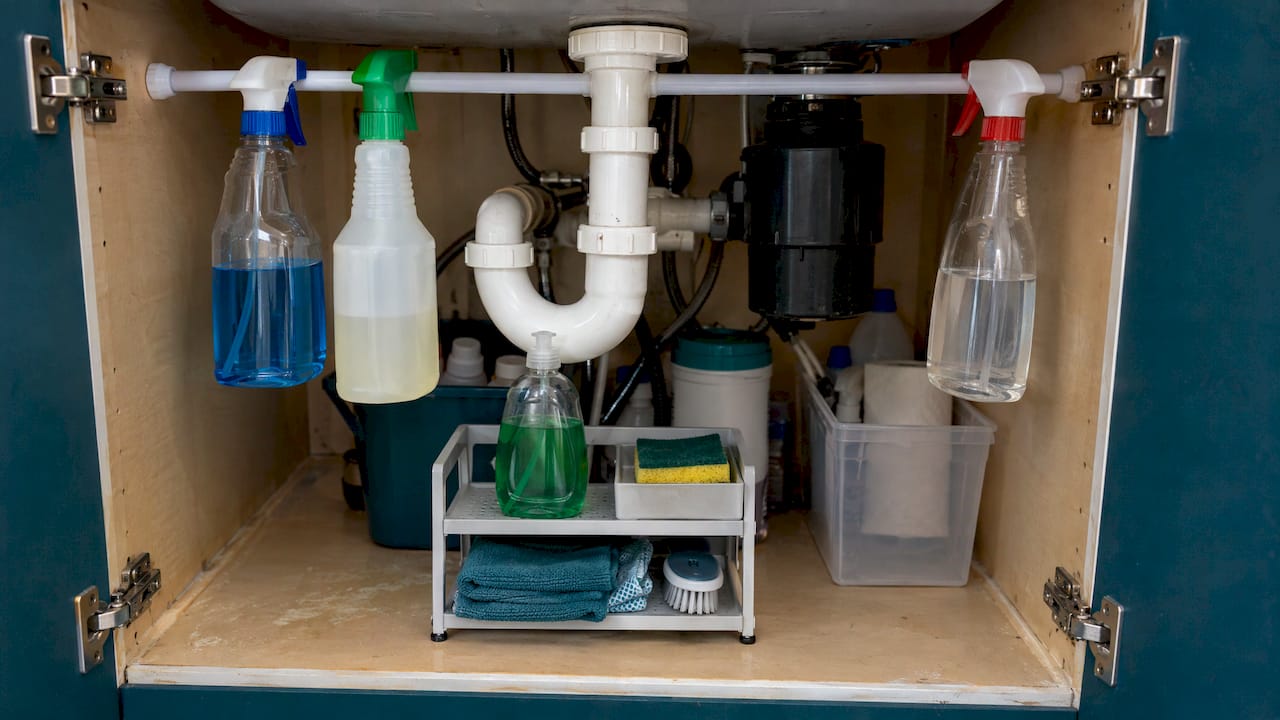
The space under the sink is awkward because of the pipes. Real Homes recommends hooked door organizers, expandable storage or roll-out drawers to keep cleaning supplies organized around limited cabinet space. A tension rod across the cabinet with spray bottles hanging from it is another no-drill option, which The Renter Edit also describes. Keep anything you use daily (sponges, dish soap) out front and the occasional products at the back.
Over the sink and on the counter
If you hand-wash dishes and counter space is tight, Real Homes recommends over-the-sink dish racks, especially foldable or stackable designs. That frees the counter for prep. Keep only true daily necessities on the counter: the coffee maker, a knife block or magnetic strip, and a small crock of utensils if you cook every day. Everything else goes away, because clear counters are what make a small kitchen feel bigger and function better.
If you want more ideas that go beyond the kitchen, see our small apartment organization ideas and the tips for maximizing space in a one-bedroom rental.
Renter-friendly fixes that leave no trace
Most small kitchens are rentals, and a rental changes the rules. You want capacity without holes in the wall.
Business Insider’s small-space guide lists the options that add capacity without construction: over-door organizers, freestanding shelf risers, drawer dividers, turntables, tension-rod baskets, removable hooks, rolling carts and foldable over-sink racks. Its advice is to measure doors and cabinets first, respect weight limits, and avoid drilling unless the lease expressly allows it. It also notes that over-the-door organizers are popular with renters because many attach with bars or simple hooks rather than permanent hardware.
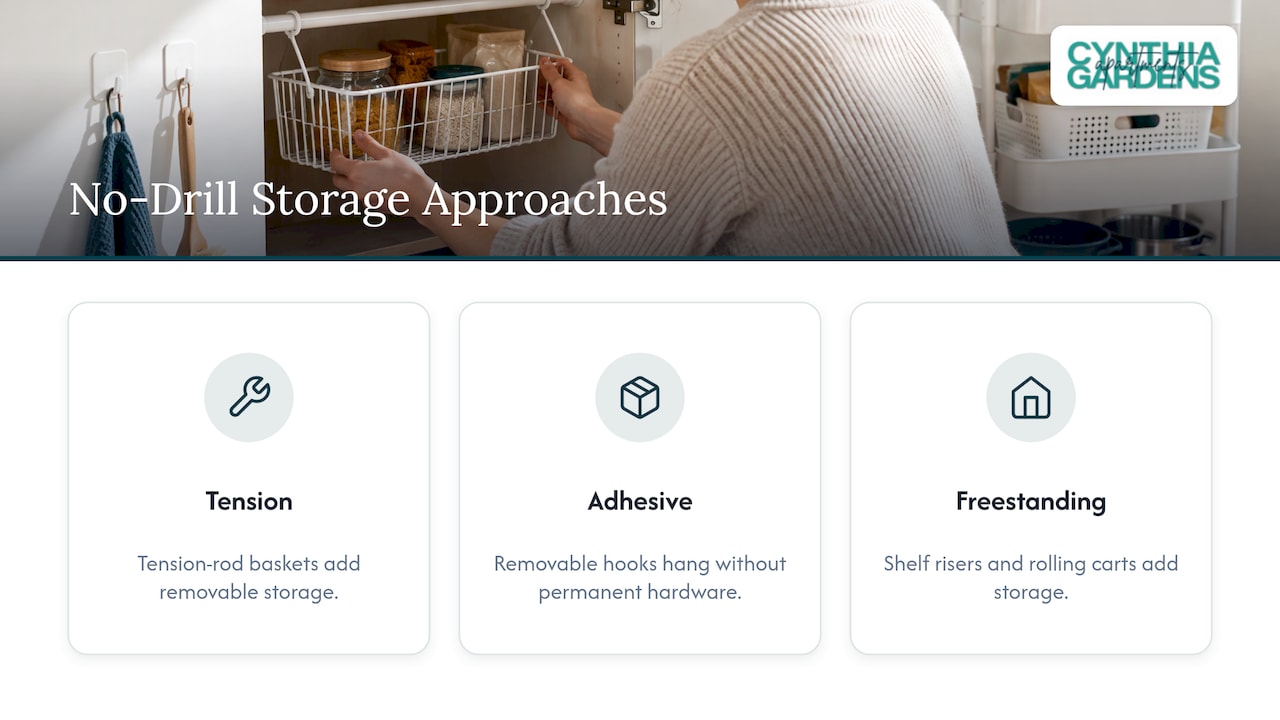
The Renter Edit groups the no-drill approaches into three types: tension, adhesive and freestanding. All three can be removed when you move, with no permanent installation.
A word on wall-mounted fixtures. Real Homes advises renters not to assume wall-mounted fixtures are appropriate in apartment kitchens, and to favor solutions that avoid drilling into thin walls. If you want a rail or a shelf, ask your property manager first and get the answer in writing. Our post on upgrading a rental kitchen without renovation covers more changes that stay within lease rules.
A simple rule: if it would leave a mark when removed, ask first. If it sits, hangs on a door or tensions between two surfaces, you can go ahead.
Choose compact, collapsible and nesting tools
When you cannot add storage, shrink what needs storing. Food & Wine’s roundup of collapsible tools points to nesting food-storage containers, collapsible strainers and steamers, foldable spatulas, collapsible measuring cups and spoons, and flat-folding dish racks as useful choices. Two of its reviewed items show the idea well: a compact dish rack that flattens to 2 inches and holds up to 10 dinner plates, and a collapsible steamer that can also work as a colander, splatter screen and trivet.
The pattern to look for is multipurpose. A roll-up rack over the sink can dry dishes, hold produce while you rinse it, serve as a trivet, then roll away. The same logic applies to:
- Nested mixing bowls that double as serving bowls.
- A single good pot with a lid instead of three that are nearly the same.
- Measuring cups and spoons that nest or collapse, so they take up a corner of a drawer instead of half of one.
- Matching food containers whose lids all fit, because a loose lid pile is a cabinet-wasting mess.
Before you buy anything, ask where it will live. If the answer is “somewhere”, leave it in the store.
Keep it organized day to day
Setting up is the easy part. Staying organized in a small space takes a few habits.
- Put prime spots to work. Apartment Therapy treats accessibility as the goal: frequently used items belong at eye level or in other easy spots, while rarely used equipment goes to harder-to-reach storage or outside the kitchen.
- Plan for the big, rarely used appliances. Good Housekeeping recommends planning storage for infrequently used large appliances and using customizable dividers for platters and casserole dishes. It also suggests making refrigerator contents visible, which helps meal prep and reduces hidden food waste.
- Follow a one-in, one-out rule. A new mug means an old one leaves.
- Reset for five minutes a day. Return what has wandered, wipe the counter, and check what is about to expire.
Cleaning also gets easier when the kitchen is uncluttered. For help prioritizing chores in compact homes, these cleaning priorities for small urban homes pair well with the zone approach above, since a clear counter is far faster to wipe.
Our perspective: a small kitchen is a design problem, not a limitation
We see small kitchens every day, because our community is built around one-bedroom apartments. Our residents are mostly young professionals, students and pet owners, and they tend to cook real meals in modest spaces. What we notice is that the tidiest kitchens are not the ones with the most organizers. They are the ones where someone decided what the kitchen is for.
Our advice is to treat a one-bedroom kitchen as a workspace. Put the daily things within an arm’s reach of where you use them, send the once-a-year things out of the room, and let vertical space do the heavy lifting. A compact kitchen is quicker to clean, quicker to cook in, and cheaper to run than a sprawling one.
We also believe a rental should feel like yours without costing you a deposit. That is why we favor tension rods, over-door racks and freestanding shelves. Everything on this page can go with you when you move.
Ayman
Looking for a one-bedroom in Boca Raton?
If you are planning a kitchen for your next place, it helps to start with an apartment that fits how you live. At Cynthia Gardens we offer one-bedroom apartments in Boca Raton for $1,990 to $2,220 per month, with transparent pricing and no hidden fees. Our community welcomes cats and is designed with young professionals and students in mind.
You can browse the one-bedroom apartments, see current options, and tour virtually before you visit. If you have a cat, the pet-friendly one-bedroom apartments page explains how our one-time pet fee works.
FAQ
How do I organize a very small kitchen with no pantry?
First remove everything you do not use, then store by zone. Use shelf risers and plate racks inside cabinets, an over-door rack for spices and wraps, and airtight stackable containers for dry goods. A rolling cart or freestanding shelf can act as a pantry if floor space allows.
What should I keep on the counter in a small kitchen?
Keep only what you use every day, such as the coffee maker, a knife block or magnetic strip, and a few cooking utensils. Everything else belongs in a cabinet, drawer or on a door. A clear counter leaves room to prep and makes cleaning quick.
How can I add kitchen storage without drilling?
Use tension rods, over-door organizers, removable adhesive hooks, freestanding shelves, rolling carts and foldable over-sink racks. Measure first and respect weight limits. If you want anything fixed to a wall, ask your property manager and check your lease before you start.
What is the best layout for a small kitchen?
There is no single layout, because your fixtures are usually fixed. Wirecutter’s advice is to let the stove, refrigerator and sink guide where things go, and to arrange items into prep, cooking, food storage, non-food storage and cleaning zones. That way, each task has what it needs close by.
Sources
- How to Organize a Small Apartment Kitchen: A 7-Step Plan, Apartment Therapy
- 35 Small-Kitchen Organizers That Make the Most of Tight Quarters, Wirecutter
- 21 Kitchen Organization Ideas, Architectural Digest
- How to Organize a Small Kitchen: 22 Ideas, The Spruce
- The Best Storage Solutions for Your Small Kitchen, Realtor.com
- How to Organize Your Kitchen Cabinets, Wirecutter
- Renter-Friendly Kitchen Organization on a Budget, The Renter Edit
- How to organize kitchen cabinets and drawers: 8 Ideas, IKEA
- Apartment kitchen organization ideas and best products, Real Homes
- 9 Best Small-Space Storage Products, Business Insider
- The 15 Best Collapsible Kitchen Tools, Food & Wine
- 18 Clever Kitchen Organization Ideas, Good Housekeeping