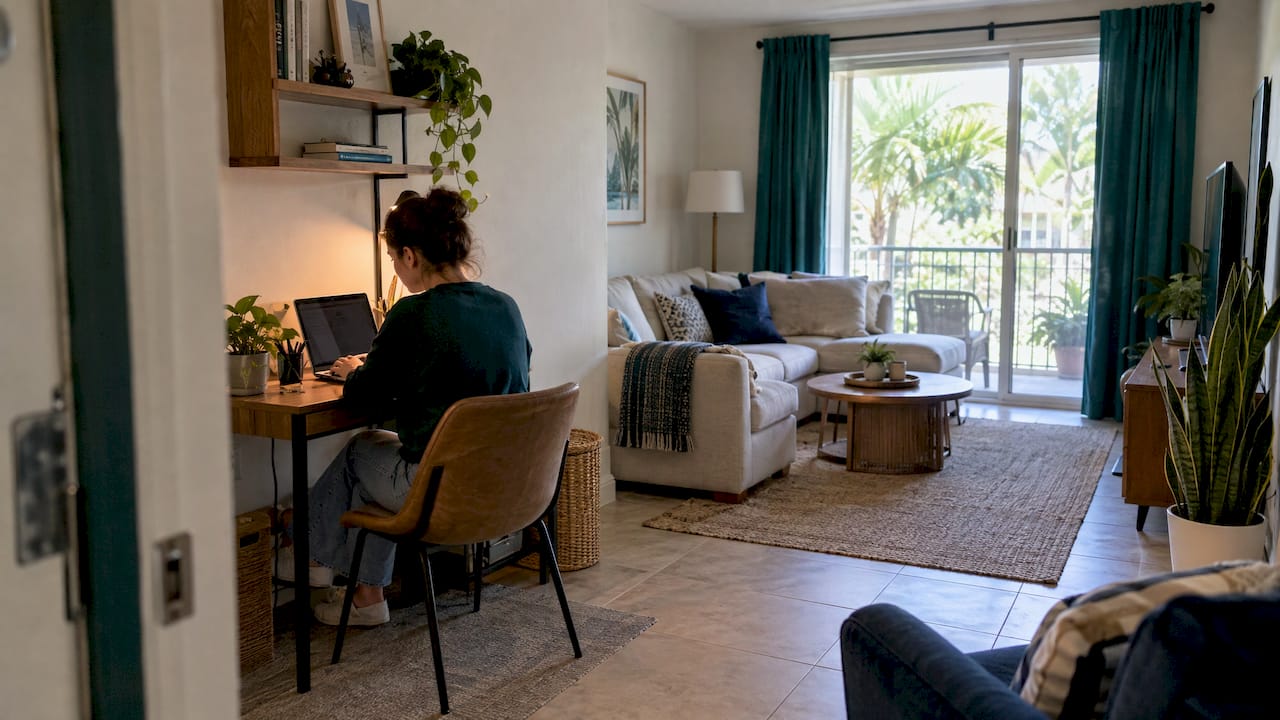
You can build a good study nook in almost any apartment with a corner, an alcove, a closet or a stretch of blank wall. You need a desk surface of at least 24 inches deep, about 30 inches of clearance for your chair, a task light and some visual boundary, such as a rug, that tells your brain this is where work happens. Everything below is built to be done in a rental, without drilling or losing your deposit.
TL;DR
- Best spots in a one-bedroom: a living room corner, a closet or alcove, a wall behind the sofa, or the space beside the bed.
- Plan for a desk at least 24 inches deep and about 30 inches of clearance behind the chair.
- Use a clamp lamp, a freestanding desk and damage-free adhesive strips so nothing needs drilling.
- A rug under the desk and chair marks the zone without walls.
- With a cat, hide cords, remove toxic plants and choose low, wide storage over tall bookcases.
Table of Contents
- Pick the spot first
- Twelve study nook ideas for small spaces
- How much space do you really need?
- Lighting that keeps you comfortable
- Set it up without drilling
- Study nook ideas for noisy or shared spaces
- Keep the nook cat-safe
- Perspective
- Find a one-bedroom with room for your nook
- Frequently asked questions
- Sources
Pick the spot first
The layout decides more than the furniture does. Before you buy anything, walk your apartment and look for places that already sit out of the way. Position the desk away from high-traffic areas if you can, because a path that runs behind your chair is a constant interruption, as More Than Wood advises in its small-home guide.
The most common candidates in a one-bedroom rental:
- The living room corner. Two walls give you shelving room and a natural boundary. It is the easiest spot to light and the easiest to hide when guests come over.
- An alcove or closet. Converting an alcove, closet or unused corner into a workspace with a wall-mounted or floating desk is a classic small-apartment move. If you rent, a freestanding narrow desk does the same job without touching the wall.
- Behind the sofa. A slim console or sofa-back table turns the line between living and dining areas into a work surface.
- Beside the bed. Works if the bedroom has a window and you can face away from the bed. It is the weakest spot for focus, so pair it with a clear end-of-day ritual (more on that below).
- The dining table. A table that is a desk by day and a dining or bar area by night is a legitimate setup. The Spruce points to folding desks and bar-height tables as dual-purpose options for tight spaces.
If your apartment has a window, try to use it. Natural light helps, but angle matters: The Spruce notes that direct sunlight hitting your monitor causes significant glare, so put the window to the side of your screen, not behind or in front of it.
Twelve study nook ideas for small spaces
1. The corner desk with floating shelves
A desk tucked into a corner with two shelves above it gives you storage without using floor space. For shelf depth, one compact-furniture guide suggests shelves around 7.8 inches deep, which holds books, binders and a laptop stand but stays out of your head’s way. If drilling is not allowed, a ladder-style leaning shelf does a similar job.
2. The closet office
Remove the closet doors if your lease and community rules allow it, or simply leave them open while you work. Slide in a narrow desk, add a clip-on light and a pinboard hung with adhesive strips. When the day is done, close the doors and the work disappears. Check with your community before taking any doors off their hinges.
3. The hidden cabinet nook
Some designers build a study area into storage systems so it is completely hidden when closed. In a rental, the renter-friendly version is a secretary desk or a drop-leaf cabinet that folds shut. Skip it if you leave projects spread out for days; it rewards people who can clear their desk nightly.
4. The fold-down or folding desk
When floor space is the limit, a folding desk with built-in storage saves the most. Fold-down wall desks normally need mounting, so renters should look at freestanding folding models that lean or sit against the wall and store flat behind a door or sofa.
5. The rug-defined zone
A dedicated rug under the desk and chair works as a soft partition, signaling that this is a work zone without walls or heavy furniture. It also gives you a way to define a nook without touching a wall, as one renter-focused guide notes about using a rug as the visual border. Pick a size big enough that the chair stays on the rug when you push back. For ideas on using texture and rugs to separate areas of a room, see this piece on styling a room with a hide rug.
6. The bookshelf divider
A low, open bookcase placed perpendicular to a wall creates a half-wall that separates the desk from the sofa. Keep it open-backed so light passes through. Glass partitions achieve the same separation and, according to More Than Wood, let light flow through so the home feels larger, though they are rarely an option in a rental.

7. The banquette or bench with hidden storage
If you share the space with school or work supplies, a bench seat with storage under it keeps clutter out of sight. Houzz recommends banquette seating with hidden storage and back-of-door hooks and baskets for managing supplies in open living areas.
8. The window-side desk
A narrow desk or a wide sill-height shelf under a window gives you daylight and a view to rest your eyes on. Put the screen perpendicular to the window and use a curtain on a tension rod to soften glare in the afternoon.
9. The vertical wall
For a blank wall, use vertical space: a pegboard hung with adhesive hooks, a wall calendar, a corkboard and a couple of shallow shelves. Shallower wall-mounted shelves, about 20 to 25 cm (8 to 10 inches) deep, hold books and files without the bulk of deep floor units.
10. The reading-and-study hybrid
If your study session includes long reading, add a small armchair or floor cushion beside the desk. Plug-in floor lamps, including a gooseneck model aimed at the page, light the spot without wiring a sconce or ceiling fixture.
11. The personal touch wall
Artwork and photos make a study room inviting for long work sessions, according to The Spruce. Keep it to one wall and out of your direct line of sight, so it warms the space without becoming a distraction.
12. The budget rebuild
Use what you have. Existing built-in shelves, a repurposed dresser, vintage finds and DIY decor can all become a study area, as This Old House points out in its roundup of homework areas. A solid door on two filing cabinets is a desk. A bookshelf turned sideways becomes a low console. Start with one thing you already own and add only what the space is missing.
How much space do you really need?
A nook is small, but it still has measurements that decide whether it works. Use this as a planning table:
| Element | Minimum to aim for | Why it matters |
|---|---|---|
| Desk depth | 24 inches | Recommended by a Los Angeles designer for the main section of a desk |
| Desk width | About 47 inches (120 cm) for one screen; 55 to 63 inches (140 to 160 cm) for two | Elbow room and equipment, per Megafurniture |
| Chair clearance | 30 inches behind the desk | Lets the chair slide out without hitting walls or doorways |
| Wall shelf depth | 8 to 10 inches | Keeps head and shoulder space free |
Measure more than width and depth. InterioHQ points out that door swing, window movement, daylight direction and furniture clearances all decide whether a nook stays functional. Tape the footprint on the floor with painter’s tape, sit in the spot for ten minutes, and see whether you can reach the door, the window and the outlet without moving anything.
If you are still choosing an apartment, count these measurements in the floor plan. A one-bedroom with a square living room almost always has a corner that fits a 24-by-47-inch desk. Our guide to maximizing space in a one-bedroom rental shows how to read a layout for it, and our work-from-home apartment ideas go deeper on the desk-and-routine side.

Lighting that keeps you comfortable
Poor light is why many nooks get abandoned after a week. Aim for layers: one task light for the page or screen, one softer room light.
- Hanging or shaded lights. For a pendant or lampshade over a work surface, This Old House suggests hanging it about 30 inches above the work surface for ample light without glare or shadows, with LED bulbs for efficiency and consistent light.
- Task light numbers. A renter-focused guide suggests around 800 lumens at about 3500K for a crisp white work surface, with a separate room light around 2700K to soften the contrast.
- Lamp placement. To avoid shadows, clamp the lamp on the side opposite your writing hand, as Little Nook Home suggests.
If color temperature is new to you, this short explainer on choosing light color temperature for each room helps you match bulbs to the way you use a space.

Set it up without drilling
Most leases limit what you can do to walls. A no-drill nook is easy:
- Start with a freestanding desk instead of a wall-mounted one.
- Clamp on a task lamp.
- Use damage-free adhesive strips for lightweight wall storage, and tension rods for curtains. All three are listed in one renter-friendly setup guide.
- Use a rug to mark the border of the zone.
- Check strip weight ratings on the package, and keep heavy items on the floor or desk.
If you need somewhere to put seasonal items so the nook stays clear, read about on-site storage lockers in apartments. Our tips on small apartment organization cover the rest of the clutter.
Study nook ideas for noisy or shared spaces
A nook in a living room is rarely quiet. Three habits help: face a wall or window rather than the room, use headphones, and schedule focus blocks when your household is out or asleep. For sound that comes through walls and doors, our one-hour soundproofing fixes for renters cost under $20 and suit a nook.
For students, the same ideas scale down to a dorm-sized footprint; see our tips on decorating a dorm room.
Keep the nook cat-safe
Cats love desks: they are warm, high and interesting. Rather than fight that, plan for it.
- Cords. Secure electrical cords with cable sleeves, clip-on trays or cord covers. One cat owner’s guide lists burns, electrocution and intestinal blockage as the risks of chewed cords.
- Plants. Remove lilies, pothos and philodendrons from the desk area and, if you want greenery, swap in spider plants or Boston ferns. If your cat has eaten any plant, call your veterinarian or a pet poison hotline right away.
- Storage. Choose low, wide units such as a 2×2 cube organizer over tall, narrow bookcases, since they are harder to tip.
- Redirect, don’t ban. Give your cat its own perch or a desk bed near you, so the keyboard is not the most comfortable place in the room.
If you are still searching for a place that welcomes cats, see our guide to pet-friendly one-bedroom apartments in Boca Raton.
Perspective
A study nook is a small piece of furniture with a big job: it tells you when work stops. In a one-bedroom, we think that is the difference between an apartment that feels cramped and one that feels organized.
That is why we run Cynthia Gardens around one-bedroom living for young professionals, students and cat owners. When residents are comparing floor plans, we encourage them to look for a wall and a window that can hold a desk, because a good nook costs far less than a bigger apartment.
Our approach to leasing follows the same logic: clear pricing, no hidden fees, and virtual tours and an interactive property map so you can judge corners and wall space before you visit. For cat owners, we charge a one-time pet fee and no ongoing pet rent, so a cat-friendly nook does not add a monthly cost.
Ayman
Find a one-bedroom with room for your nook
At Cynthia Gardens in Boca Raton, one-bedroom apartments are listed at $1,990 to $2,220 per month. Our fees are published up front: a $75 non-refundable application fee per applicant, a $300 administration fee, and for cats a non-refundable one-time pet fee of $300 to $500 per cat. You can see each apartment’s layout through virtual tours before you commit, and plan where your desk will go.
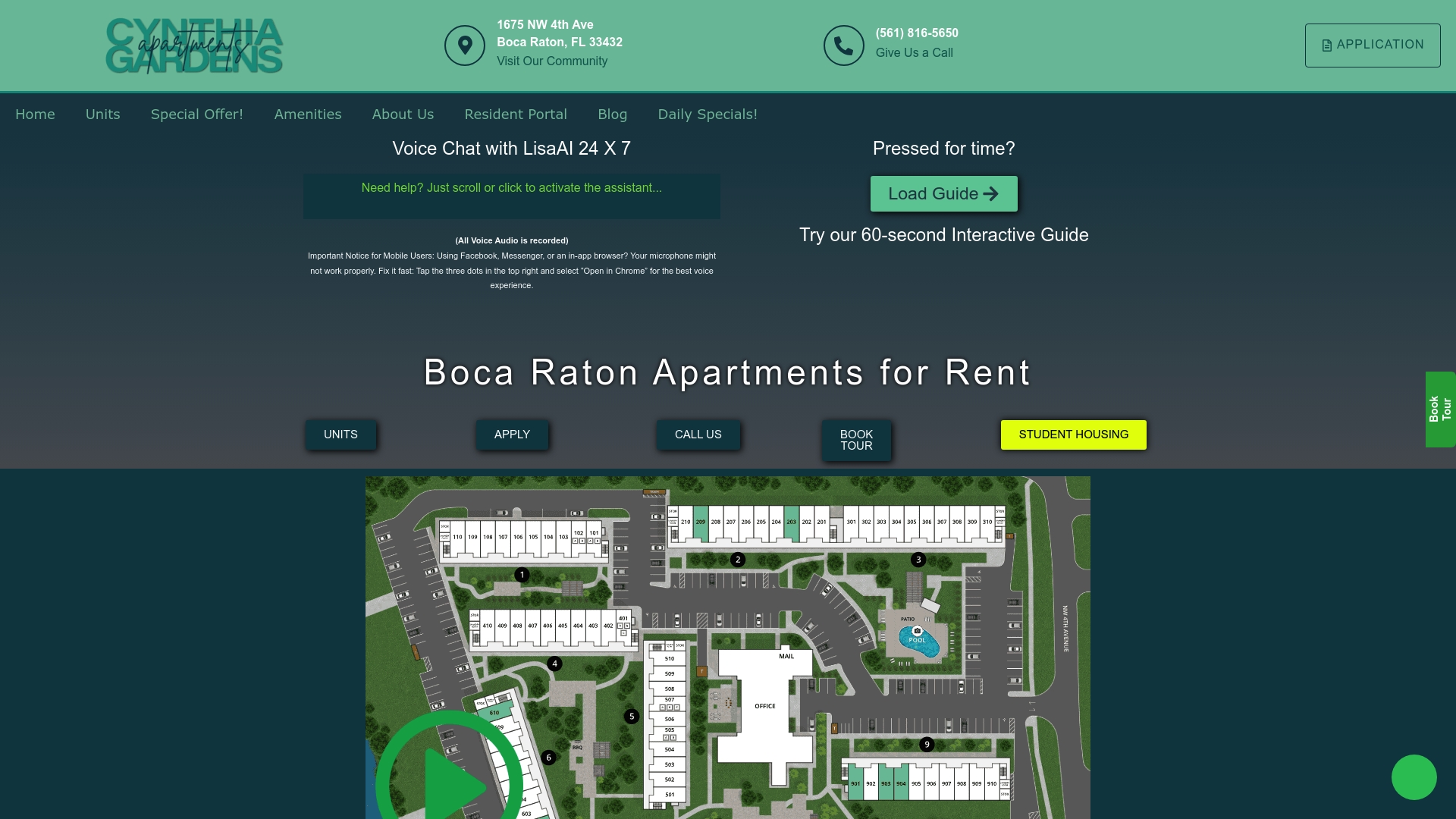
Browse our one-bedroom apartments or read the full list of application and move-in fees.
Frequently asked questions
What is the smallest space that can work as a study nook?
A desk 24 inches deep with about 30 inches of chair clearance is a workable minimum, according to the Livingetc and Journeyman HQ guidance above. That is roughly a closet or a wall section of a few feet. Add vertical shelves to make up for the lost floor storage.
How do I make a study nook in a rental without drilling?
Use a freestanding desk, a clamp-on lamp, damage-free adhesive strips and tension rods, as Little Nook Home suggests. Define the area with a rug. Check your lease for any limits on wall adhesives, and keep heavy objects off the strips.
Where should the desk go relative to a window?
Place the desk so the window is at your side. Direct sunlight on your monitor causes significant glare, and a window right behind you can do the same through reflections. A curtain on a tension rod lets you adjust through the day.
How can I keep my cat off my keyboard?
Give the cat a better option: a perch or a desk bed at the same height as your workspace. Secure cords, keep tall furniture from tipping and remove toxic plants, as one pet-supply guide recommends. Close the laptop when you step away.
Sources
- 22 Small Apartment Office Nook Ideas That Work
- How to Sneak In a Study Zone Without Creating Clutter (Houzz)
- The 8 Best Desks for Small Spaces (The Spruce)
- 28 Study Room Ideas Perfect for Productive Work Days (The Spruce)
- Study Room and Study Nook Design Ideas (More Than Wood)
- HDB Study Room Ideas (Megafurniture)
- 9 Compact Study Nook Furniture and Organization Tools
- 6 Small Home Office Layouts (Livingetc)
- Study Room Design: Small Room Planning Guide (InterioHQ)
- 27 Inspirational Homework Areas and Study Stations (This Old House)
- How to Set Up a Study Room, Renter-Friendly (Little Nook Home)
- Reading Nook Ideas for Renters
- How to Cat-Proof Your Home Office
- How To Create A Cat Friendly Home Office