
A notice to vacate is a written letter telling your landlord you are ending your lease and giving the date you will move out. Keep it short and put it in writing. Send it in a way that leaves proof, and send it early enough to meet the notice period in your lease or your state’s law. In Florida, that period is at least 30 days for a month-to-month rental, and a written lease can ask for 30 to 60 days at lease end.
Below you will find the exact timing rules, a letter you can copy, the ways to deliver it, and what to do between sending it and handing back the keys. The legal sections are about Florida, where we operate. If you rent elsewhere, the structure of the letter still works, but check your own state’s rules.
TL;DR
- A notice to vacate needs two things: a clear statement that you are ending the lease and the date you will move out.
- In Florida, a month-to-month tenant must give at least 30 days’ written notice before the end of a monthly period.
- With a fixed-term lease, read the notice clause. Florida allows a lease to require 30 to 60 days’ notice, and no more than that.
- Deliver it in writing, in a way you can prove, and keep a copy plus any confirmation of receipt.
- After sending it, document the unit’s condition with photos, schedule a walkthrough and get a written receipt for the keys.
Table of Contents
- What a notice to vacate actually is
- How much notice do you need to give in Florida?
- What to put in a notice to vacate
- How to deliver your notice
- What can go wrong with late or incomplete notice
- Special cases where the 30 days do not apply
- After you send the notice: a move-out plan
- Common mistakes
- Perspective
- Planning your next move in Boca Raton
- FAQ
- Sources
What a notice to vacate actually is
A notice to vacate (also called a notice of intent to vacate or a notice to move out) is the formal letter a tenant sends to end a tenancy. Legal aid guidance describes it as a letter that can be written by the tenant or by the landlord, and it explains that a written notice is needed to end a periodic lease (Notices to Vacate and Ending a Lease). That guide comes from Minnesota, but the basic idea carries across the country: you say you are leaving, and you say when.
The letter does three jobs:
- It starts the clock on your notice period.
- It gives the landlord time to plan an inspection and market the unit.
- It gives you a dated record if a dispute about rent or your deposit comes up later.
That third job is why a text message or a hallway conversation is a poor substitute. If anyone later asks when you told the landlord, a dated letter answers it.
How much notice do you need to give in Florida?
The answer depends on what kind of lease you have. Check which one is yours before you count any days.
Month-to-month tenancy
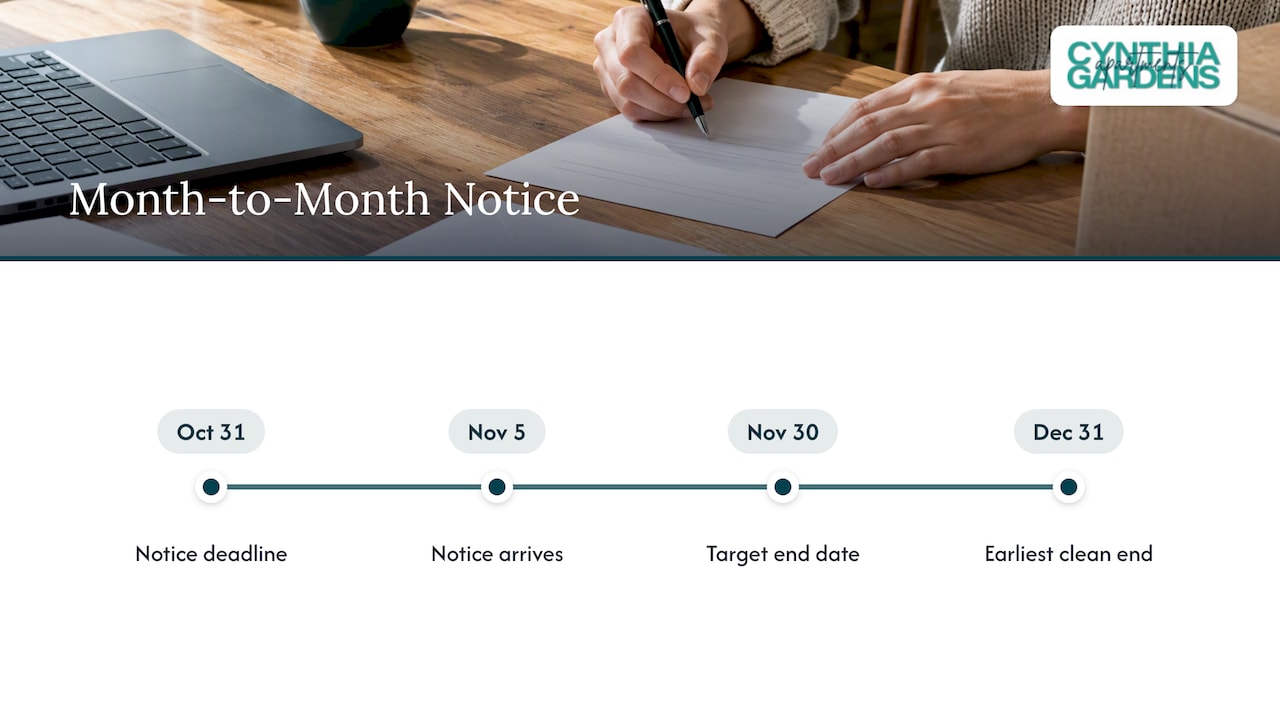
Under Florida Statutes Section 83.57, a month-to-month tenancy ends when either side gives not less than 30 days’ written notice before the end of any monthly period (Florida Statutes 83.57). The words “before the end of any monthly period” matter. The 30 days are counted toward the end of a rental month, not simply from the day you hand the letter over.
A worked example: your rent is due on the 1st, and your rental month runs from the 1st through the last day of the month. You want to be out on November 30. Your written notice needs to reach the landlord at least 30 days before that date, so by October 31 at the latest. If it arrives on November 5, the earliest clean end date is the end of the following rental month, December 31. Sending your letter a week or two earlier than the minimum removes any argument about the count.
Fixed-term lease (the typical one-year lease)
Most apartment leases run a year and simply end on a date. Here, your lease is the first document to read. The Florida Bar advises reading a written lease closely for notice requirements, because they can set terms for both landlord and tenant on renewal and move-out (Rights and Duties of Tenants and Landlords). The same guidance says a lease may require notice of up to 60 days and may not require less than 30 or more than 60.
There is a fairness condition built in. Under Section 83.575, a rental agreement may require tenant notice 30 to 60 days before the end of the lease only if it also requires the landlord to give notice within that period when the landlord will not renew (Florida Statutes 83.575). If your lease has a notice clause, look for that two-way language.
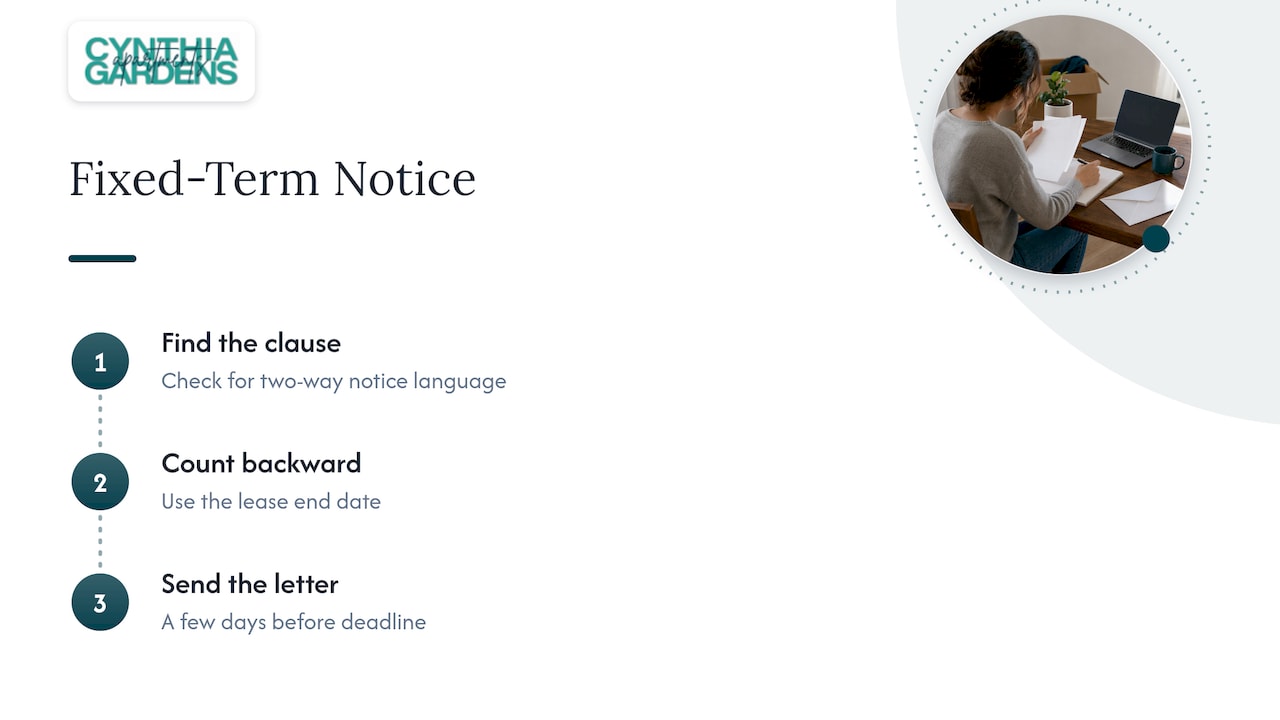
So the practical rule for a fixed-term lease is: find the clause, count backward from the lease end date, and send your letter a few days ahead of that deadline.
A quick reference
| Situation | What Florida law says | What to do |
|---|---|---|
| Month-to-month | At least 30 days’ written notice before the end of a monthly period | Send 35 to 45 days before your target move-out date |
| Fixed-term lease, notice clause | Lease may require 30 to 60 days, with matching landlord notice | Count back from the lease end date and send early |
| Fixed-term lease, no notice clause | Read your lease and ask the landlord to confirm in writing | Send written notice anyway, 30 to 60 days ahead |
| Leaving before the lease ends | Different rules and costs apply | See our guide on breaking a lease in Florida |
What to put in a notice to vacate
The letter does not need legal language. It needs to be unambiguous. Include:
- Your full name and the unit address, including the apartment number.
- The date of the letter.
- A clear statement that you are ending your tenancy, with the exact move-out date. Write the date out in full, such as “January 31, 2027,” not “end of January.”
- A forwarding address, so your deposit accounting and any final mail can reach you.
- Your phone number and email, in case the landlord needs to schedule the walkthrough.
- Your signature. If more than one person is on the lease, every tenant should sign.
Leave out the reasons, complaints and negotiation. You do not owe a landlord an explanation for moving, and a letter that mixes in a maintenance dispute or a rent question becomes harder to read and easier to misinterpret. If you have a real issue with the unit, handle it in a separate written message.
A letter you can copy
[Your full name]
[Unit address, apartment number]
[City, State ZIP]
[Phone] | [Email]

[Date]

[Landlord or property manager name]
[Property or management office address]

Re: Notice to Vacate, [unit address]

Dear [Name],

This letter is my written notice that I am ending my tenancy at the
address above. I will move out and return possession of the unit on
[move-out date].

Please send my security deposit and any required accounting to my
forwarding address: [new address].

Please contact me at [phone/email] to schedule a move-out walkthrough.
I would appreciate written confirmation that you received this notice.

Sincerely,
[Signature]
[Printed name]
That is the whole letter. Fill it in, check the date against your lease and the statute, and send it.
How to deliver your notice
A good letter that cannot be proven delivered is a weak letter. Look first at your lease: many spell out how notices must be sent (to the office address, by certified mail, through a resident portal). Follow that method exactly.
Where the lease is silent or allows options, choose the one that leaves you a record:
- Certified mail with a return receipt. Slower, but it gives you a dated receipt that is hard to dispute.
- Hand delivery to the office, with a second copy stamped or signed as received. Ask the staff member to sign and date your copy.
- Email or resident portal, followed by a printed copy. Fast, and it creates a timestamp. Use it alongside a physical method unless your lease clearly accepts it alone.
Whichever you use, keep a copy of the letter and any confirmation of delivery or receipt. Jacksonville Area Legal Aid’s moving-out guidance encourages tenants to hold on to exactly those records (Tips for Moving Out). The same guidance recommends putting any deal that departs from the written lease, such as an early termination or a different notice period, in writing.

What can go wrong with late or incomplete notice
Giving too little notice rarely means you cannot leave. It means you may pay for time you are not using.
Florida’s Section 83.575 lets a landlord collect liquidated damages in certain situations, when the landlord gave the tenant written notice of their obligations, the termination date and the applicable charges within 15 days before the notice period starts (Florida Statutes 83.575). The Florida Bar also notes that a tenant who stays on with the landlord’s permission after a lease ends, without giving the required notice, can be liable for an additional month’s rent (Rights and Duties of Tenants and Landlords).
The easiest way to avoid both: send the notice early, in writing, with a specific date.
If you are thinking about leaving before your lease’s end date, that is a different situation with its own costs. Our guide to breaking an apartment lease early walks through the options.
Special cases where the 30 days do not apply
A few Florida situations run on different clocks. These are not reasons to skip written notice, but they change the timing:
- Damaged or destroyed premises. Under Florida Statute 83.63, a tenant may end the rental agreement and move out immediately if the home is damaged or destroyed, not through the tenant’s negligence, to the point that enjoyment of the premises is substantially impaired (Florida Legal Services). Put the damage and your decision in writing right away.
- Landlord’s material noncompliance. Section 83.56(2) sets a seven-day notice for terminating a lease over material noncompliance with lease terms (The Consumer Law Bench Book). Because a wrong step here can cost you, speak with a legal aid office or a Florida attorney before relying on it.
- Unsafe or unhealthy conditions. Florida Legal Services says landlords must maintain safe, habitable housing and that tenants should report maintenance problems promptly and in writing (Florida Legal Services). That written record helps if you ever need to rely on a habitability argument.
If you are in a hard spot, such as domestic violence or a major repair failure, contact a local legal aid organization about your particular facts before choosing your date.
After you send the notice: a move-out plan
The notice is one step. What you do in the final weeks decides whether your deposit comes back in full.
- Confirm receipt. If you have no written acknowledgment within a few business days, follow up by email and keep the thread.
- Plan the handover. If you are curious about how smooth hand-offs work when a unit has to be re-let, a workflow for finding a replacement tenant shows how landlords and tenants coordinate dates, viewings and condition checks.
- Expect entry for showings or inspections. Landlords generally have to give notice before entering. Our explainer on landlord entry notices in Florida covers what to expect.
- Clean thoroughly. Cleaning is the most common source of deposit disputes. If your unit came furnished, see our checklist for furnished move-out cleaning, where sofas and ovens are the usual misses.
- Photograph everything once the unit is clean and empty. Legal aid guidance recommends photos of all rooms and the outside, a scheduled walkthrough, and a written receipt when you return all keys (Tips for Moving Out).
- Know the deposit timeline. Charges and deadlines for your deposit are covered in our piece on Florida move-out charges and the 15/30/15 rule.
- Forward your mail and update addresses with your bank, employer and the post office.
Common mistakes
- Counting from the wrong day. In a month-to-month rental the 30 days run toward the end of a monthly period. Add a buffer.
- Giving a vague date. “Sometime in March” is not a move-out date.
- Verbal-only notice. Florida’s month-to-month rule calls for written notice, and a conversation is not proof.
- Skipping the lease. The notice clause is the first thing a property manager will check.
- Mixing complaints into the letter. Keep disputes in a separate, dated message.
- Forgetting co-tenants. If two names are on the lease, both should sign.
- Not keeping copies. Photograph or scan the letter and any receipt.
Perspective
We read a lot of move-out notices, and the best ones are the plainest: a name, a unit number, a date and a signature. That is all we need to schedule a walkthrough and plan the next resident.
What helps residents most is clarity on both sides. We publish our pricing openly, with no hidden fees, so people know what they are signing from day one, and we think move-out should be just as predictable. Read the notice clause in your lease when you sign, put the date on your calendar, and you will not be scrambling later.
We also handle maintenance requests quickly, including same-day attention, because a well-kept unit makes the final walkthrough simple for everyone. If you are a student finishing a semester or a young professional changing jobs, give us your date early and tell us what you need. We would rather plan a smooth hand-off with you than sort out surprises at the end.
Ayman
Planning your next move in Boca Raton
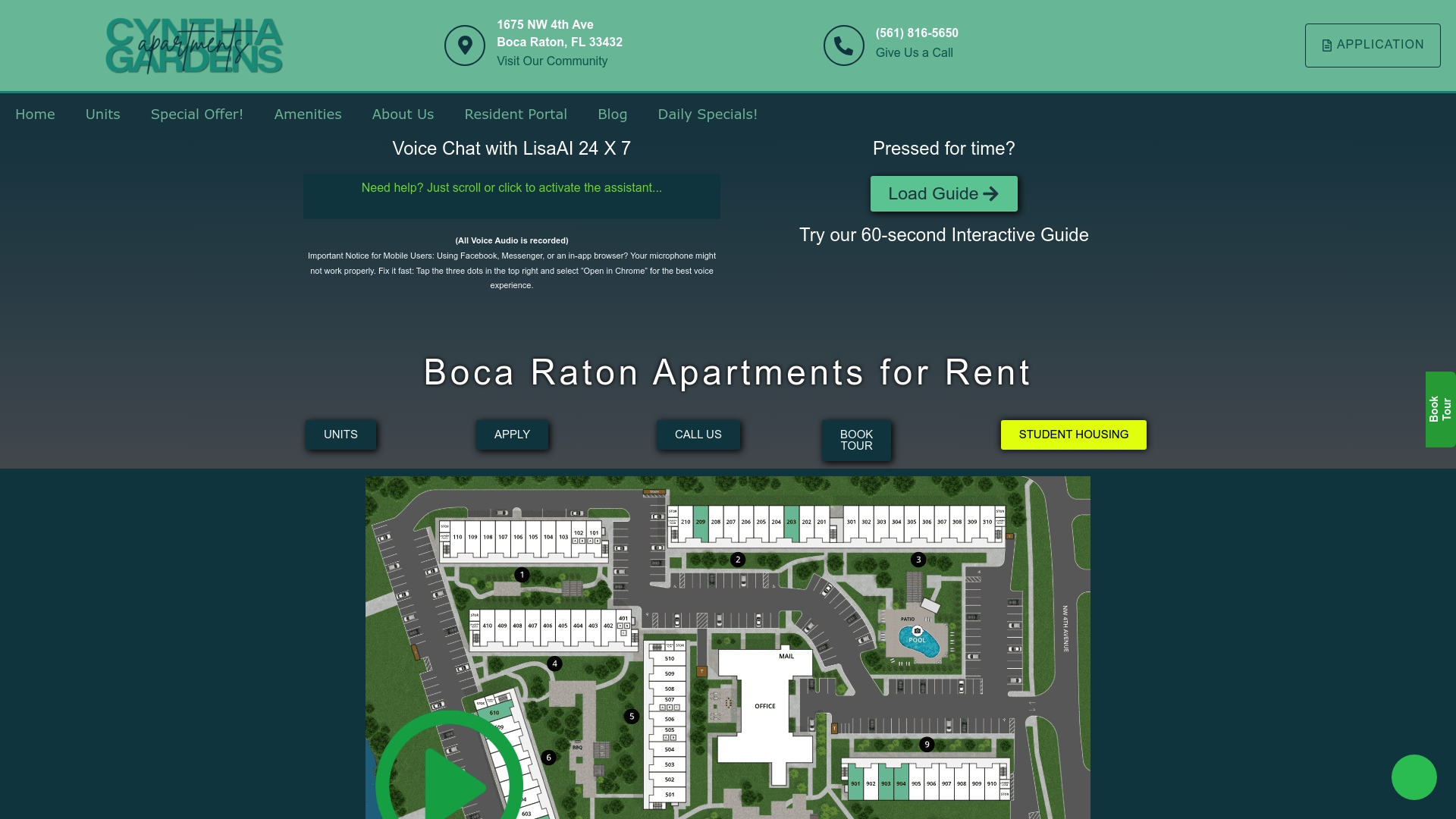
If you are giving notice because you are moving to the area or upgrading, we offer one-bedroom apartments in Boca Raton at $1,990 to $2,220 per month, with transparent pricing, a cat-friendly policy with a one-time pet fee and no ongoing pet rent, and virtual tours so you can see a unit before you travel. You can browse the current one-bedroom apartments and start the leasing process online.
If you want to know what a one-time fee covers before you apply, the fees and policies page lists them in full.
FAQ
Do I need to give a reason when I send a notice to vacate?
No. The letter only needs to say you are ending your tenancy and give your move-out date. Leaving out reasons keeps the letter clear and avoids mixing it with any dispute.
Is a 30-day notice enough in Florida?
For a month-to-month tenancy, Florida requires at least 30 days’ written notice before the end of a monthly period (Florida Statutes 83.57). For a fixed-term lease, your lease may require 30 to 60 days, so check the clause and send early.
Can I write my own notice to vacate?
Yes. Tenants write their own all the time, and the letter above is enough for most situations. Include your name, address, the move-out date, a forwarding address and your signature, and keep a copy.
Can I send my notice by email or text?
Only if your lease or the landlord’s written instructions allow it. Even then, send a printed copy by certified mail or hand delivery as well, and keep the confirmation.
What should I do if my landlord says my notice was late?
Compare your letter’s delivery date with the notice clause in your lease and the statute. If the landlord’s position seems wrong, contact your local legal aid office or a Florida attorney with your documents in hand.
Sources
- Notices to Vacate and Ending a Lease
- Florida Statutes 83.57
- Florida Statutes 83.575
- Rights and Duties of Tenants and Landlords
- Tips for Moving Out
- Florida Legal Services, September 2024
- Florida Legal Services, February 2026
- The Consumer Law Bench Book