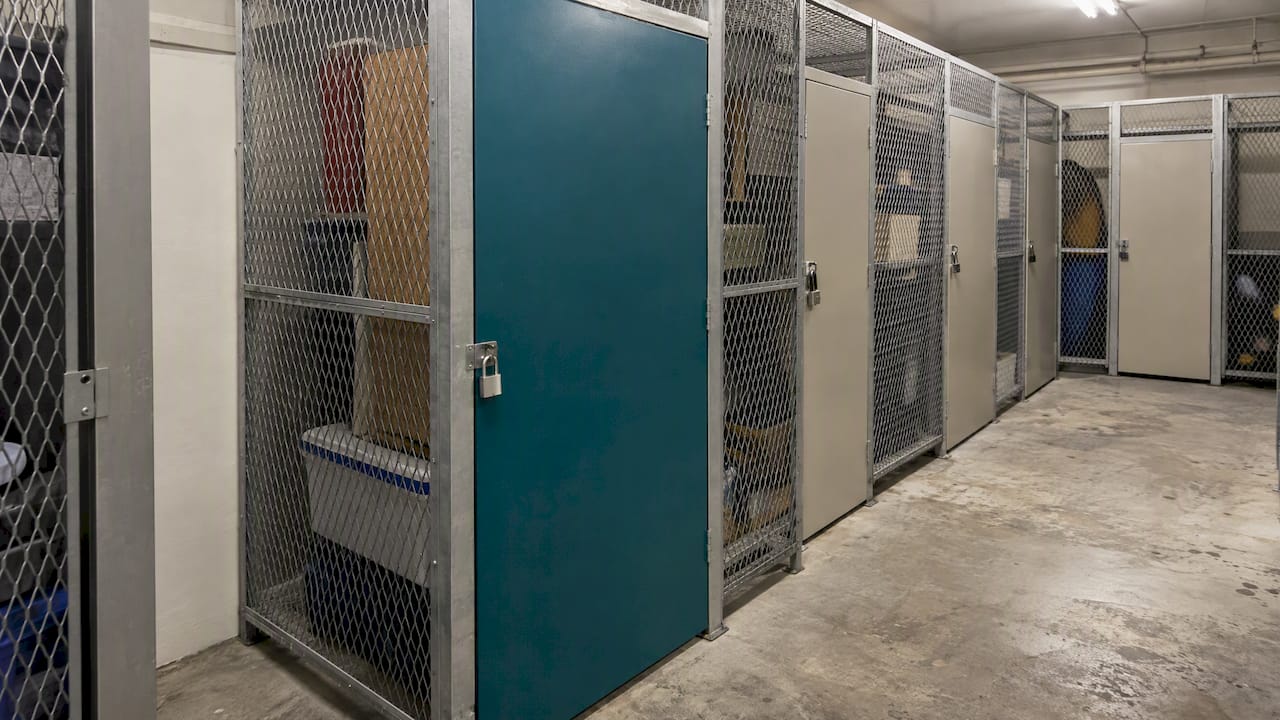
An on-site storage locker is a lockable space in a shared area of your apartment building, such as a basement, parking garage or storage room, where you keep items that don’t fit in the unit. Whether you can get one, what it costs and what you may put inside are set by the community and its lease paperwork. So ask before you sign, and get the answers in writing.
This guide explains how lockers work, how residents get them, what to measure and ask, and how to keep your belongings safe. It is written for renters comparing one-bedroom apartments, especially students, young professionals and pet owners who tend to run out of closet space first.
TL;DR
- An apartment storage locker is an individual, lockable space in a shared area of the building, separate from your unit.
- Availability, price and assignment differ by community, so ask whether a locker is included, assigned or rented separately, and get it in the lease or an addendum.
- Measure the locker and the route to it, and ask about access hours, before you pay anything.
- Lockers are generally for your own property only. Hazardous or illegal items are off limits, and management is usually not liable for loss, so renters insurance matters.
- At Cynthia Gardens we publish our fees openly. Ask our leasing team what storage options apply to the apartment you like.
Table of Contents
- What an apartment storage locker actually is
- How residents get a locker
- What to check before you rent: a practical checklist
- What you can and can’t store
- Security: what to look for
- Is a locker worth it for you?
- Our perspective
- Renting a one-bedroom at Cynthia Gardens
- Questions to ask on your tour
- FAQ
- Sources
What an apartment storage locker actually is
The idea is simple. Tenant storage is made up of secure, individual spaces in areas such as basements, parking garages or dedicated storage rooms, which give residents extra space without making the apartment itself bigger. The locker sits outside your front door, sometimes on another level, and has its own lock.
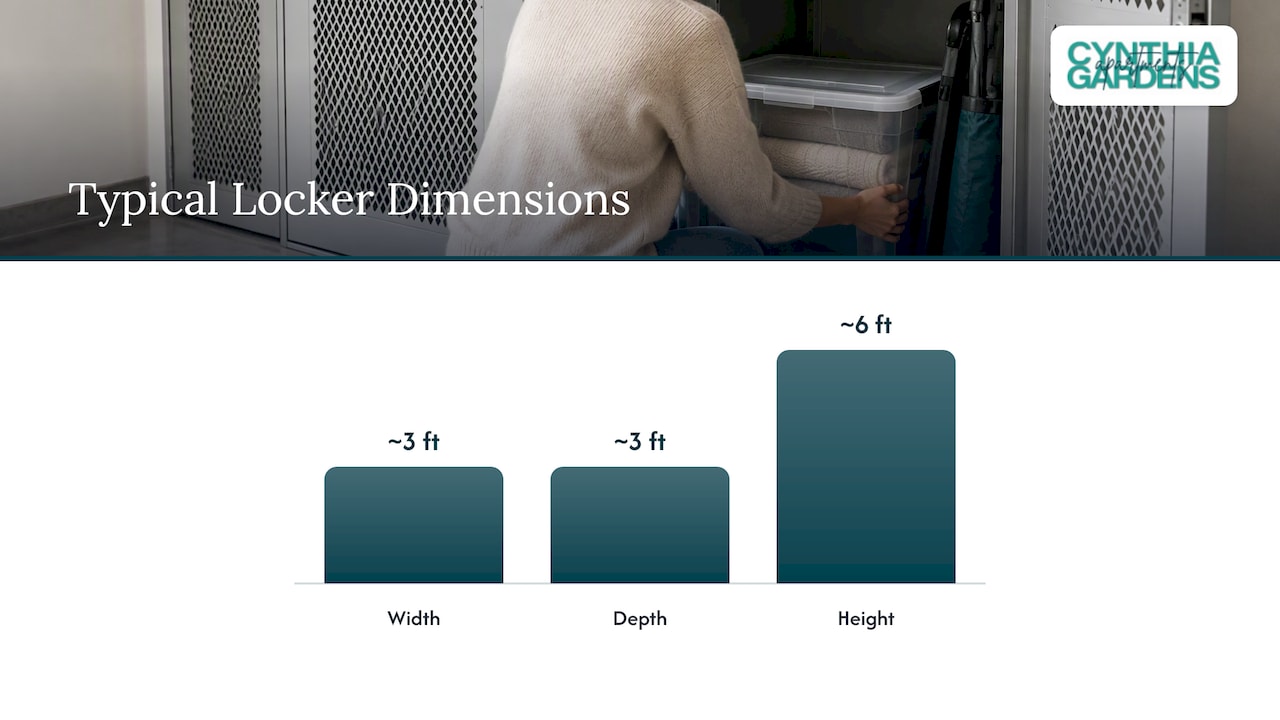
A locker is usually a small, compartmentalized space. A common size is about 3 feet wide, 3 feet deep and 6 feet tall, though real dimensions vary from building to building. That is roughly the footprint of a narrow wardrobe, with a full-height door.
Typical contents, according to one industry guide, are seasonal items, sports gear and oversized belongings you don’t need every day. Think holiday decorations, a camping set, a surfboard, off-season clothing, a spare suitcase or boxes of textbooks.
Locker, closet or storage unit: the differences
| In-unit closet | On-site apartment locker | Off-site self-storage unit | |
|---|---|---|---|
| Location | Inside your apartment | Shared area of your building | Separate facility, often a drive away |
| Access | Anytime | Set by the community, may have hours | Set by the facility |
| Typical size | Fixed by floor plan | Small, often a few dozen cubic feet to a wardrobe-sized space | Many sizes |
| Terms | Part of the lease | Included, assigned or rented under a separate agreement | Separate rental contract |
| Best for | Daily items | Seasonal and bulky items you want close by | Large volumes or long-term storage |
The main appeal of an on-site locker is convenience. You walk down a hallway or a flight of stairs, with no trip across town and no second contract with a different company.
How residents get a locker
There is no single rule. In practice there are three common setups, and you should find out which one applies.
- Included with the unit. A locker comes with your apartment, sometimes assigned by number. It may be a defined part of what you rent.
- Assigned on request. Lockers are limited, so the community assigns them as they become available, sometimes with a waitlist.
- Rented separately. You sign a short storage or locker agreement and pay a monthly or one-time charge on top of rent.
A good first step is the checklist an apartment-search guide suggests: confirm whether a locker is available, included with the unit or assigned, then measure the entrance and interior and ask about access hours and the route to it.
Whatever the setup, expect the locker to be yours alone. A typical storage agreement says only the assigned user may use the storage unit and bars transferring, subletting or sharing it. That matters for roommates and for subleases: if you move out or sublet, the locker doesn’t automatically pass to someone else.
Why the paperwork matters
If a locker is rented separately, it usually comes with its own agreement. Read it the way you read your lease. Our guide to the apartment lease agreement form walks through the clauses to look for, and the same habits apply to a locker addendum: who signs, what the charge is, how long the term runs and how you end it.
If you are a student, our explainer on student housing lease agreements covers how lease terms interact with extras such as storage.
What to check before you rent: a practical checklist
Lockers look identical in a listing photo, and the differences show up after you have moved in. Run through this list on a tour, in person or virtually.
Size and shape
- Interior dimensions. Ask for width, depth and height, or measure them yourself. Wire-mesh and solid-door lockers can differ in usable space.
- Door opening. The opening can be narrower than the interior. Check that your biggest item can pass through.
- Shelving. Some agreements allow shelving or other additions, with a condition. One locker rental agreement lets residents add shelving if it is removed and the locker restored when the agreement ends. Ask before you drill or bolt anything.
A quick way to size up what you need: list what you want to store, stack the boxes in your living room, and measure the stack. If it takes more than a wardrobe-sized footprint, a locker may not cover it all, and you may need to edit what you keep. Our apartment organization tips and small apartment organization ideas help you decide what truly earns space.
Location and route
- How far is the locker from your door and your parking space?
- Is the route step-free, or are there stairs or a freight elevator?
- Is the area well lit and covered by cameras or controlled entry?
- In a humid climate like South Florida, is the space indoors and ventilated, or open to the weather?
That last question is worth asking in Boca Raton, where humidity can damage cardboard, fabric and paper. Use sealed plastic bins, not cardboard, for anything stored outside the climate-controlled apartment.
The route matters as much as the locker. If you plan to carry a bike, surfboard or boxes, consider the hallway width as well. For a sense of how to think about tight corridors, these space-saving hallway ideas show how much a few inches of clearance changes how a passage works.
Access hours and procedures
Some lockers are open around the clock. Others are reachable only during office hours or require a key from management. Ask what happens if you lose the key or the lock, and whether you provide your own lock or the community does.
Charges
Ask for the full cost in writing: monthly fee, deposit, key or lock replacement, and any late fee. Compare that with what you pay now. If it is more than you expected, it may be cheaper to trim your belongings than to rent space.
What you can and can’t store
Rules are broadly consistent across communities. A resident handbook for one property says that if a locker is provided, tenants may store only their own property and may not keep hazardous, illegal or inappropriate items.
In practice, that rules out:
- Gasoline, propane tanks, fireworks, solvents and other flammables
- Anything illegal or stolen
- Perishable food, which attracts pests
- Items belonging to friends or a business
- Pets or live animals, of course
Some associations reserve the right to check. One storage policy says the association may enter lockers and remove hazards without notice, and that contents can be removed after reasonable notice and held for 30 days before disposal if a violation isn’t fixed. Your own lease or addendum is what counts, so read what yours says about entry and removal.
Who is responsible if something is lost or damaged
Plan on the basis that you carry the risk. The same handbook notes that management is not responsible for theft, loss or damage. Another resident handbook describes storage areas as a convenience, not a warehouse, used strictly at the resident’s own risk.
Two practical consequences:
- Check your renters insurance. Ask your insurer whether belongings in a building storage area are covered and under what limits. Our piece on apartment insurance for Boca Raton renters explains what a policy typically does.
- Don’t store irreplaceable items. Keep passports, family photos, laptops, jewelry and documents in your apartment.
If you want to go further on protecting your things, see our security tips for apartment living and the step-by-step guide to securing your apartment.
Security: what to look for
A locker is only as safe as the space around it. Look at these features when you tour:
- A solid lock. Ask whether the community supplies locks, or whether you bring a quality padlock. Some providers offer upgraded cylinders, such as core locks, as an added security measure.
- Controlled entry. A storage room behind a keyed or fob-controlled door is better than an open corridor.
- Lighting and cameras. You should feel comfortable walking there at night.
- Floor-level protection. In flood-prone or humid areas, raise boxes off the floor on pallets or shelves.
- Labels that don’t advertise value. Label boxes by category, not “electronics” or “jewelry.”
Is a locker worth it for you?
Some industry sources argue that on-site storage is a valued amenity. One media piece says storage lockers can please residents with limited closet space, and that adding amenities can increase property values. A locker earns its keep when it solves a specific problem.
It tends to pay off if you:
- Live alone in a one-bedroom and have bulky gear (bike, paddleboard, golf clubs, luggage)
- Are a student who stores belongings between semesters
- Own a cat and want litter, carriers and supplies out of the living area
- Are moving in with a smaller closet than your last place
You may not need one if your belongings fit in your closets after a sort, or if you mostly need space for a bike. For bikes, read our look at the role of bike storage for renters, which covers a different kind of shared storage.
A simple cost test
Take the monthly locker charge, multiply by 12, and compare that with the value of what you’d keep in it. If you’d pay more over a year than it would cost to replace the items, sell or donate them instead. If you’d keep them and love having them close by, a locker is a sensible convenience.
Our perspective
When we talk with prospective residents, storage comes up almost as often as rent. People ask where the bikes go, where the suitcases go, and what happens to a student’s boxes over the summer. Our answer starts with honesty about the apartment: a one-bedroom is a smart, affordable way to live alone in Boca Raton, and it works best when you plan the space.
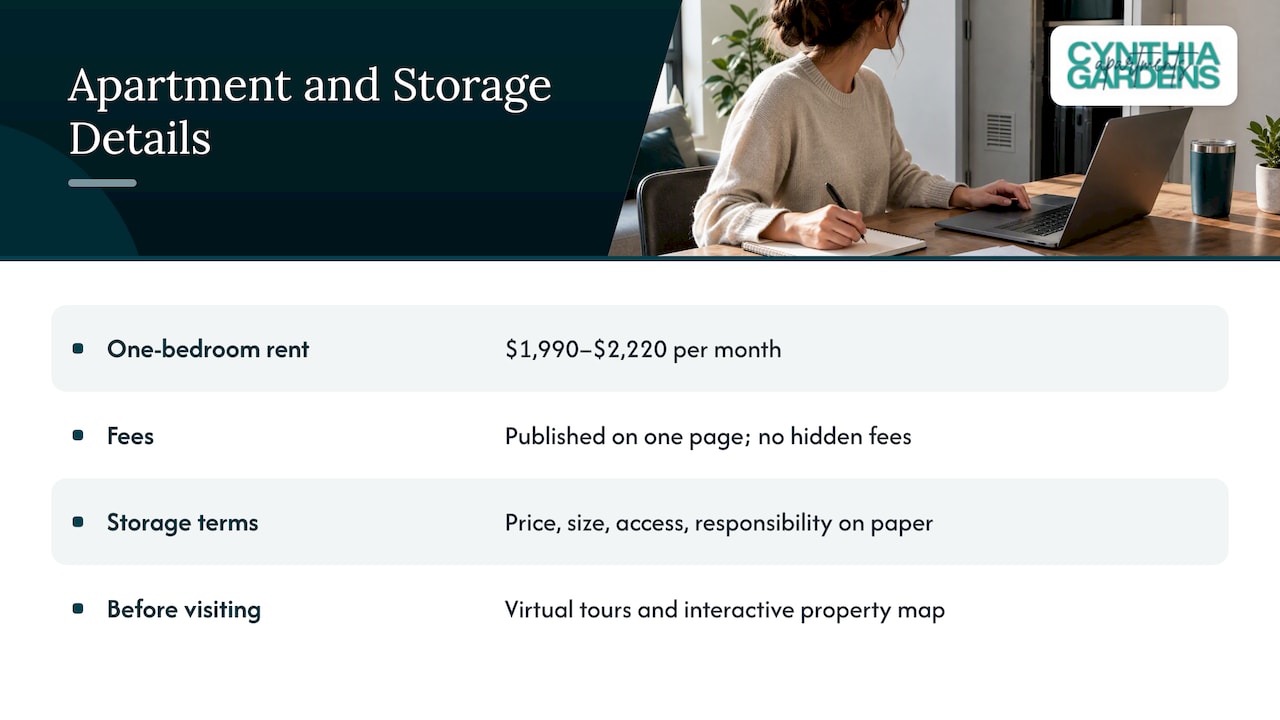
We believe the same principle should apply to everything around a lease, storage included. Our one-bedroom apartments are listed at $1,990 to $2,220 per month, and our fees are published on one page, with no hidden fees. That is how we think any extra should work. If a community offers storage, the price, the size, the access rules and who is responsible for what should be on paper before you sign, not discovered after move-in.
So bring your questions. Tell us what you need to store, and we will tell you what is available for the apartment you like. Our virtual tours and interactive property map are there so you can see the layout and think through where everything goes before you visit.
— Ayman
Renting a one-bedroom at Cynthia Gardens
If you are comparing apartments and want to know what fits your life, start with our one-bedroom apartments, listed from $1,990 to $2,220 per month. Our one-time charges are listed on our fees page: a $75 non-refundable application fee per applicant, a $300 administration fee, a $15 wire transfer fee and a $500 transfer fee. Cat owners pay a non-refundable pet fee of $300 to $500 per cat, with no ongoing pet rent.
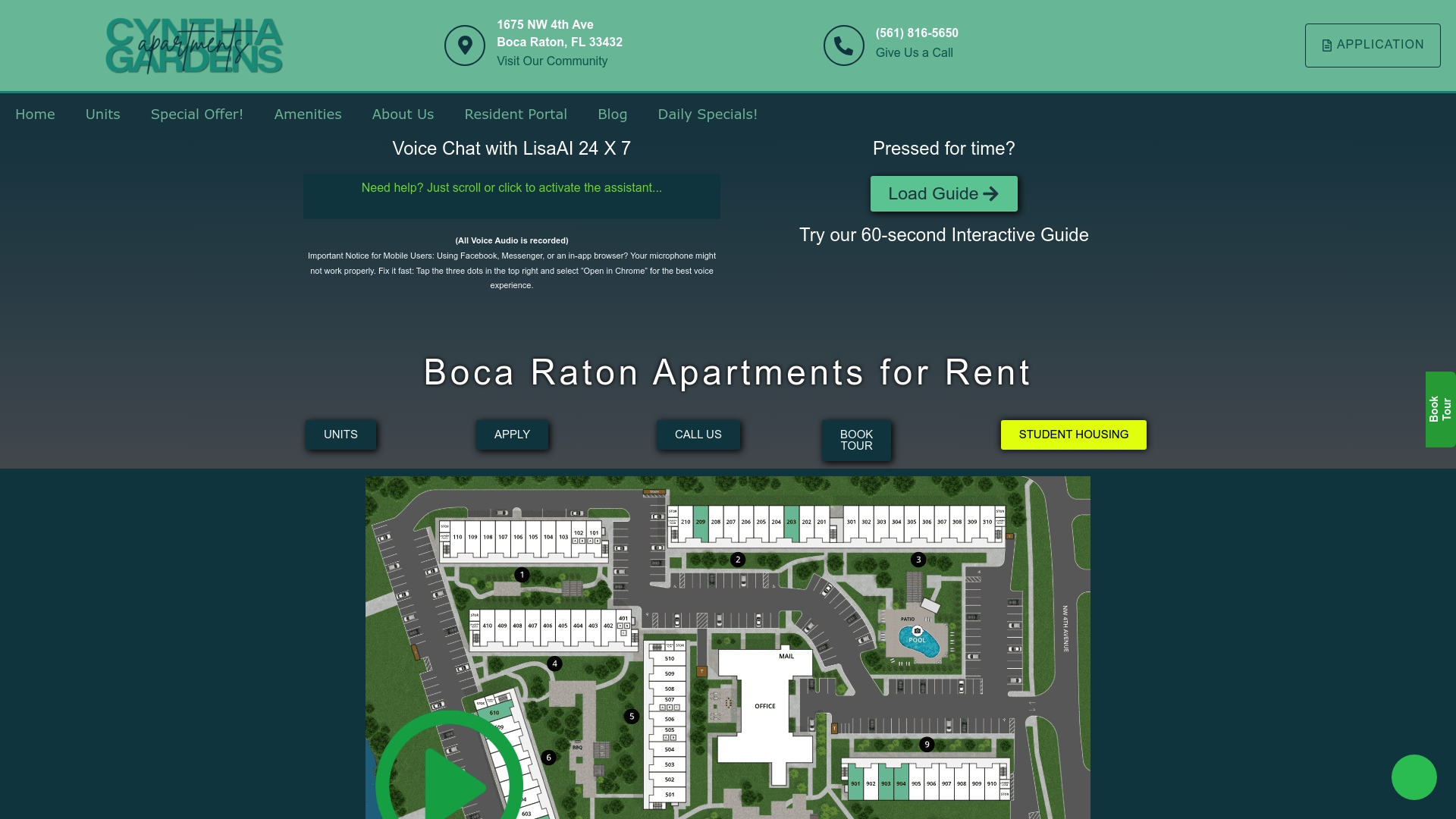
Tour online, chat with our AI assistant or use voice assistance, and ask the leasing team about storage for your move.
Questions to ask on your tour
Bring this short list to any leasing office:
- Is a storage locker available, and is it included, assigned or rented separately?
- What are the dimensions, and can I see one?
- What does it cost per month, and are there deposits or lock fees?
- When can I access it, and how do I get in?
- What may I not store?
- What happens if I lose the key, or if something is damaged or stolen?
- Is there a waitlist, and how long is it usually?
- Can I keep it when my lease renews or if I move to another unit?
An answer in writing for each item is better than a verbal yes. If a community can’t answer them, treat that as information about how organized the building is.
FAQ
Are apartment storage lockers free?
Sometimes. Some communities include a locker with the unit, and others charge a monthly or one-time fee under a separate agreement. Ask for the total cost in writing, including any deposit or lock charge, before you commit.
Can I keep anything I want in an apartment locker?
No. Typically you may store only your own property, and hazardous, illegal or inappropriate items are prohibited. Flammables such as gasoline and propane are the usual examples. Check your lease or locker agreement for the exact list.
Does my renters insurance cover a storage locker?
It depends on your policy, so ask your insurer directly. Management is commonly not responsible for theft, loss or damage, so confirm coverage and limits for items kept outside your unit.
How big is a typical apartment storage locker?
A common size is about 3 feet wide, 3 feet deep and 6 feet tall, but sizes vary between buildings. Ask for exact interior and door-opening dimensions, and measure your largest item first.
Can a roommate or friend use my locker?
Usually not. Storage agreements commonly allow only the assigned user to use the space and bar sharing, subletting or transferring it. If you need shared storage, ask the community about a second locker.
Sources
- What Is Tenant Storage and Why Developers Are Installing It
- Storage Lockers vs. Storage Units
- Apartment Storage Lockers: Types, Sizes & Costs Explained
- Evaluating an Apartment Storage Locker During a Rental Search
- Storage Agreement Form
- Private Storage Locker Agreement
- Storage Lockers, The Resident Handbook
- Section 15, Storage
- Market Rate Resident Handbook
- Providing Storage is a Most Valuable Amenity
- Space-saving hallway ideas