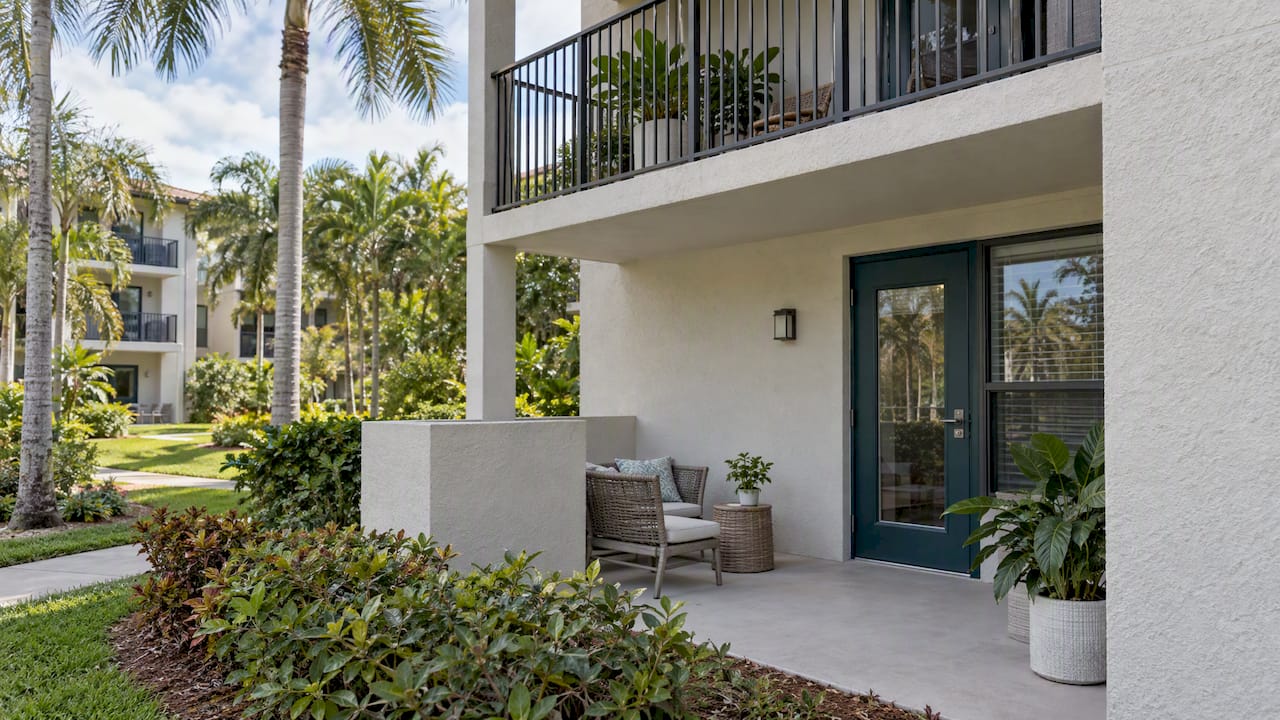
A balcony is a platform that sticks out from an upper-floor apartment. A patio is a paved area at ground level, usually right outside a first-floor unit. That one difference in height changes almost everything else: how much room you get, who can see you, what you can put out there, how your cat behaves near the edge, and what you will pay attention to at a tour. This guide walks through each of those points so you can choose with the lease in front of you, not just the photos.
TL;DR
- A balcony is attached to the building above ground level. A patio sits on the ground, so it is usually larger but also more exposed to foot traffic.
- Choose a balcony for views, a bit more separation from the street, and a small coffee-and-reading spot. Choose a patio for more floor area, easy access for a dog or a leashed cat, and plants.
- Check the lease before you buy a grill, heavy planters or storage. Florida’s fire code bars open-flame cooking on multifamily balconies.
- Cat owners should treat a bare balcony as a fall risk and a bare patio as an escape route. A screen, a harness or a supervised-only rule solves both.
Table of Contents
- What is the difference between a balcony and a patio?
- Balcony vs. patio at a glance
- Space and how you will actually use it
- Privacy and noise
- Safety, rules and what you can put outside
- Balcony or patio with a cat
- Upkeep and cost
- A quick decision guide
- Questions to ask at the tour
- Our perspective
- Renting a one-bedroom in Boca Raton
- FAQ
- Sources
What is the difference between a balcony and a patio?
The dictionary version is simple. Cambridge defines a balcony as a narrow floor attached to the outside wall of a building above ground level, usually with sides or bars. A patio is the ground-level counterpart: a paved outdoor area, typically stone, brick or concrete, that can sit against the building or stand alone.
In apartment listings the words follow the floor number:
- Second floor or higher: the outdoor space is a balcony.
- Ground floor: it is a patio. Some listings say terrace, which usually means a larger or more landscaped version of the same idea.
That means a true balcony cannot exist on the first floor, and a true patio cannot hang in the air. If a listing says “private patio” on the third floor, ask what it really is. Often it is a large balcony or a rooftop section, and the size or the rules may be different from what the word suggests.
Two more terms come up in searches. A porch is typically roofed and attached to an entrance. A deck is a raised platform, usually wood, that is more common at houses than at apartment buildings. Neither is the main choice you face when you tour a one-bedroom.
Balcony vs. patio at a glance
| Factor | Balcony | Patio |
|---|---|---|
| Location | Upper floors, projecting from the wall | Ground level, next to the unit |
| Typical size | Compact: a chair or two and a small table | Usually more room for dining, lounging and plants |
| Privacy | Harder to see into from the street, but neighbors above and beside can see you | Easier for passersby to see, especially without a fence or hedge |
| Access | Through the unit only | Often the unit’s door, sometimes also a gate or path |
| Views | Better, the higher you go | Limited to what is at eye level |
| Pets | Fall risk, needs a screen or supervision | Escape risk, needs a fence and a gate that closes |
| Weather | Overhang above may shelter you | May be open to sun and rain unless covered |
| Upkeep | Sweep, wipe the railing, watch drainage | Sweep, handle leaves and pests, watch drainage |
Size is the general pattern, not a rule. Patios tend to offer more usable space for dining, entertaining and gardening, while balconies suit compact seating, coffee, reading and views. Always measure the specific unit.
Space and how you will actually use it
Before comparing square footage, ask what you want to do outside. A peer-reviewed study in Buildings & Cities frames a balcony as a private outdoor space whose usefulness depends on its design, its surroundings and the residents’ needs, not just on whether the unit has one. A narrow ledge with a railing you cannot sit behind is not much of an amenity.
A few ways to match the space to your routine:
- Morning coffee and a laptop: a balcony 4 to 5 feet deep fits a small bistro table. You do not need a patio.
- Hosting friends: a patio usually handles a small table and several chairs. A balcony may hold two people comfortably.
- Container garden: a patio gives you floor space for pots. On a balcony, weight and railing rules matter more.
- Working from home: either one works, but check where the sun lands in the afternoon so your screen is not unreadable.
- Remote tour: photos can hide depth. Ask for dimensions or a video that shows a person standing in the space.
Privacy and noise
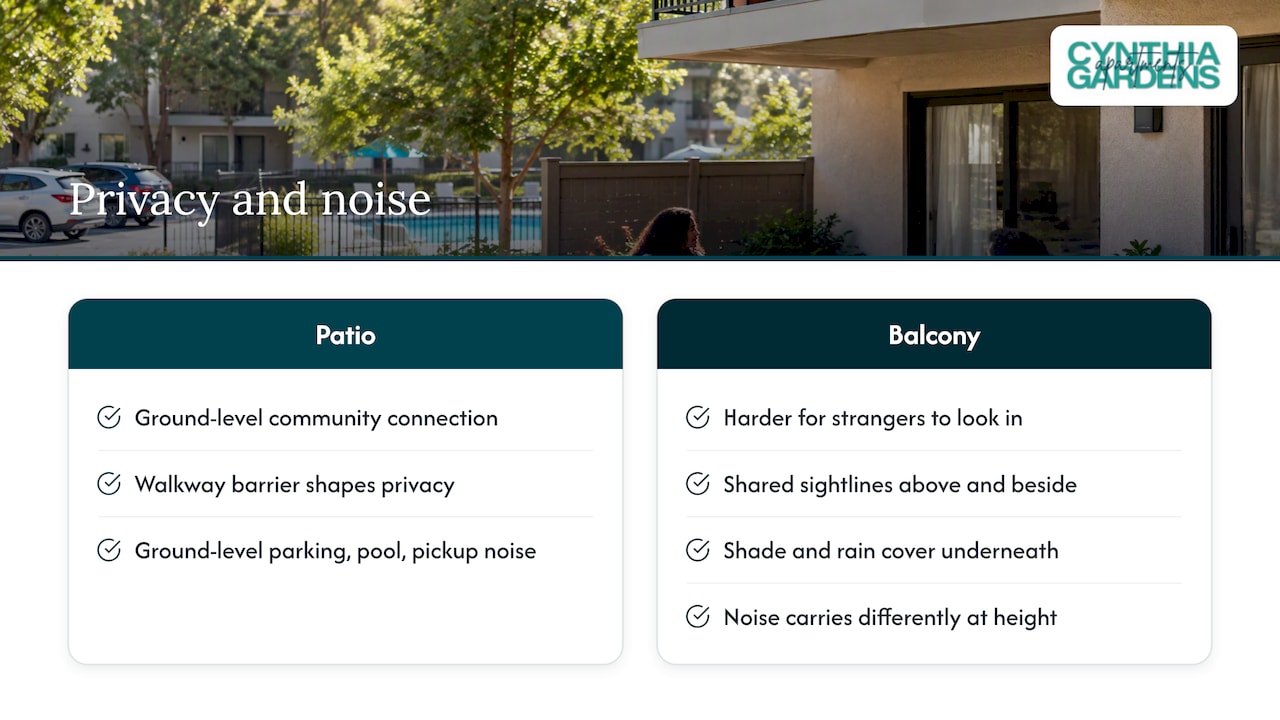
Ground-level patios feel more connected to the community. That is a plus if you like to chat with neighbors and a minus if you want to sit outside in a robe. Look at what separates your patio from the walkway: a fence, a hedge, a storage wall or nothing at all.
Balconies are harder for strangers to look into, but you share sightlines with the units above and beside yours. A solid divider between neighboring balconies makes a real difference. Also look up: a unit under another balcony gets shade and rain cover, but may hear chairs scraping overhead.
At a tour, stand in the space and listen for ten minutes if you can. Parking lot noise, pool noise and dumpster pickups carry differently on the ground than at height.
Safety, rules and what you can put outside
This is where renters most often get caught out. The lease, not the listing, tells you what is allowed.
Grills and open flames
If you want to cook outside, read the fire rules before you buy anything. Florida’s fire code, as explained by the Town of Weston, bars grills and similar devices used for cooking or heating on any balcony, under an overhang, or within 10 feet of a structure in buildings other than one- and two-family homes. The same page says a listed electric tabletop grill is one way to cook outdoors legally in a multifamily building. Your community may be stricter than the code, so ask management in writing.
That 10-foot rule also affects ground-floor patios. A patio against the building is within 10 feet of a structure by definition.
Weight, storage and planters
Ask what the lease says about heavy planters, storage items and furniture. Renters are advised to check lease and building restrictions before placing grills, heavy planters or stored items on a balcony. Soil is heavy when it is wet, and standing water against the wall can cause damage that you may be asked to pay for.
Child safety rules vary by place
Requirements differ by city. In New York City, for example, Local Law 57 requires approved window guards on windows leading onto a balcony or terrace in an apartment where a child age 10 or younger lives. That is a New York rule, not a national one. If you have a young child, ask management what applies where you are renting and look at the railing height and spacing yourself.
Balcony or patio with a cat
Cats change the calculation more than any other household member. The two spaces carry different risks.
Why balconies need extra care
Veterinarians use the term high-rise syndrome. A peer-reviewed review defines it as a fall from two or more stories causing combinations of chest, abdominal, orthopedic and facial injuries, and says falls often follow slipping, mating behavior or chasing prey. A published clinical study of 119 cats found that 59.6% were younger than one year, the average fall was four stories, 46.2% had fractured limbs and 33.6% had chest trauma. The same authors link falls to play, prey-chasing and slipping.
The reviewers also note that cats may suffer less severe injuries because of their righting reflex. That is no reason to relax. A bird landing on the railing is enough to send a young cat over it.
What helps:
- Supervise or do not allow free access. Keep the door closed when you are not watching.
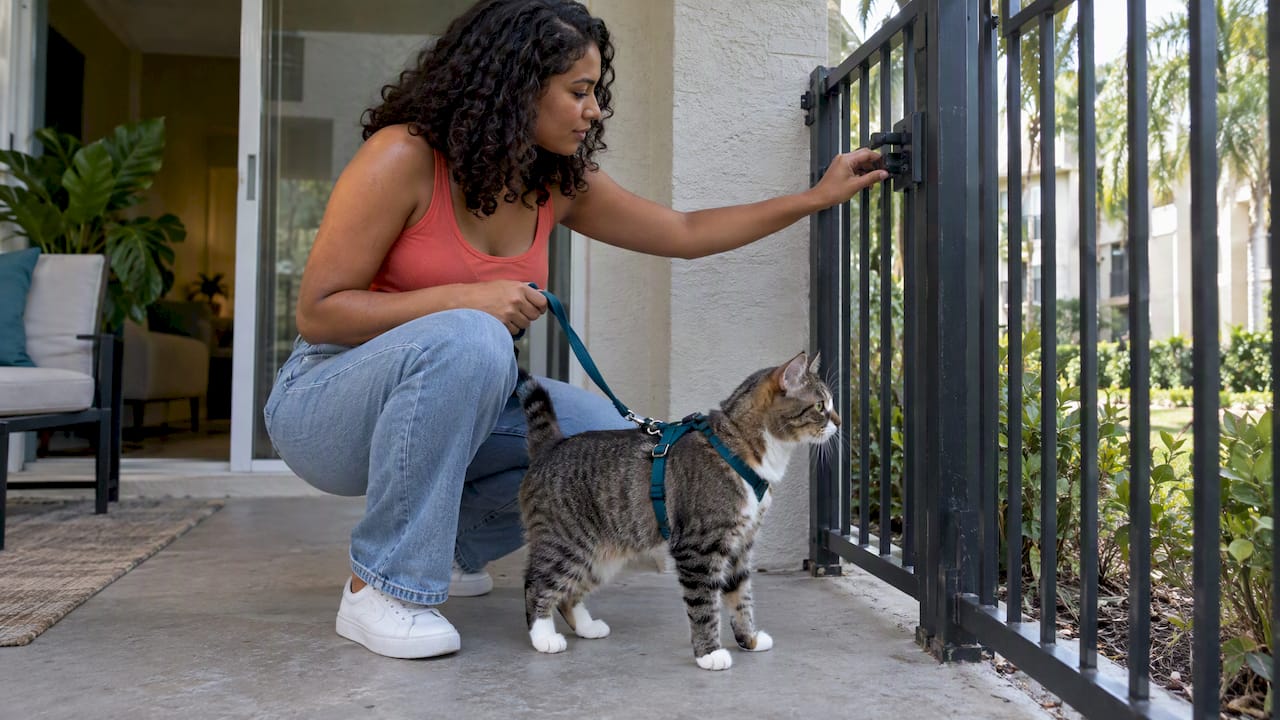
- Use an enclosure. Indiana University’s ScIU blog, citing ASPCA guidance, describes screened outdoor enclosures for balconies or patios and harness-and-leash walking as safer than free access. It also recommends indoor enrichment such as toys, window access, cat trees and puzzle feeders.
- Get permission first. Many leases bar permanent alterations. Ask whether a freestanding or tension-mounted enclosure is acceptable.
- Remove launch pads. Move chairs and tables away from the railing so your cat has no easy way up.
We go further in our guides on how to cat-proof a balcony and apartment balcony pet rules.
Why patios are not automatically safer
A ground-level patio removes the fall but adds exits. A gap under a gate or a low fence is an invitation. Outdoors, cats meet other animals, traffic, plants and weather. Check that the fence is solid and tall, that the gate latches, and that your cat wears a collar with an ID tag and is microchipped. Keep it on a harness when you are outside together.
For the rest of the home, our cat-proofing tips for renters cover steps that do not damage the unit.
Upkeep and cost
Neither space is high-maintenance, but they ask for different things.
- Balcony: sweep regularly, wipe the railing, keep drains clear, and do not let water pool. Salt air and humidity are common in South Florida, so metal furniture needs a rinse.
- Patio: expect leaves, dirt and more insects. You may also need to trim or move plants away from the wall.
- Both: report cracks, loose railings, standing water and rust. Fast repair matters more outside, because small problems grow.
Cost differences usually show up in the rent, not in a separate line. Ask whether the unit’s price includes the outdoor space, and whether any outdoor-related fee, deposit or rule appears in the lease. If your cat will be outside even occasionally, our guide to maintenance in cat-friendly apartments explains what to ask about repairs and response times.

A quick decision guide
A balcony fits you if:
- You want a quiet place to sit, read or have coffee, and you do not need much room.
- You like views and a feeling of separation from the street.
- You can supervise your cat or are ready to use an enclosure.
A patio fits you if:
- You want space for plants, a small table and a couple of chairs.
- You value easy access from the door to the outdoors.
- You can live with more foot traffic and need to confirm a secure fence and gate.
Neither is essential if:
- Your budget is tight and the rent difference matters more than the outdoors.
- You are a student or a young professional who spends most of the day on campus or at the office. Shared garden spaces, pool decks and walking paths may do the same job for less.
Questions to ask at the tour
Bring this list, whether you tour in person or online:
- How deep and wide is the space, and can you see it in a video?
- Is it covered, and which direction does it face?
- What does the lease say about grills, plants, furniture and storage?
- Is there a divider between neighbors, and what is the railing or fence height?
- Can pets use it, and are enclosures or screens allowed?
- How are maintenance requests handled, and how fast?
- What fees apply to pets or to the application, and are they all listed in writing?
Virtual tours make the first pass easy, but they flatten depth. Our pages on how to tour apartments remotely and spotting virtual tour scams explain how to use them well and safely.
Our perspective
We talk to a lot of renters who start out asking whether they need a balcony or a patio and end up asking something else: can my cat live here safely, and will the monthly cost stay what I was told? Those two questions matter more to us than the outdoor space itself.
We are a community of one-bedroom apartments in Boca Raton, built for young professionals, students and pet owners. Our approach to cats is plain. We allow them, we charge a one-time pet fee per cat, and we do not charge ongoing pet rent. We would rather you know the whole number before you tour than discover a surprise after you sign.
On outdoor space, our advice is to be honest about your cat. A calm adult cat that watches birds from a window may be fine with a supervised balcony visit. A young, curious one may not be. The research on falls points to young cats most often, and we take that seriously. For many cat owners, a good window perch, a cat tree and a harness-and-leash routine does more than an unsupervised open balcony ever will.
Whichever you pick, ask for the rules in writing, look at the railing with your own eyes, and test the door latch. A good community will be happy to walk you through all of it.
— Ayman
Renting a one-bedroom in Boca Raton
Our one-bedroom apartments are listed at $1,990 to $2,220 per month. The published fees are a $75 non-refundable application fee per applicant, a $300 administration fee, a $15 wire transfer fee and a $500 transfer fee. For cats, the non-refundable pet fee is $300 to $500 one-time per cat. You can see current pricing on our one-bedroom apartments page and the full fee list on our fees page.
If you want to compare floor plans before a visit, our virtual tours and interactive property map let you look at layouts from your phone. Ask us about any outdoor space for the specific unit you like, and we will tell you what it includes. To see what is available, browse our pet-friendly one-bedroom apartments in Boca Raton.
FAQ
Is a patio better than a balcony?
Neither is better in general. A patio usually gives you more room and easier access to the ground, while a balcony gives you more separation and better views. Pick based on how you will use it, what the lease allows, and whether you have a pet.
Can a first-floor apartment have a balcony?
Not by the usual definition. A balcony is above ground level, so a first-floor outdoor space is called a patio or terrace. Some listings use the words loosely, so check the photos and ask for the dimensions.
Can I grill on an apartment balcony in Florida?
Usually not with an open flame. Florida’s fire code bars grills and similar devices on balconies, under overhangs, and within 10 feet of a structure at multifamily buildings, per the Town of Weston. A listed electric tabletop grill is described there as one legal option. Ask your community what it permits.
Is a balcony safe for cats?
Only with precautions. Falls from two or more stories can cause serious injuries, and young cats are over-represented in the clinical data. Keep the door closed when you cannot supervise, use an approved enclosure or a harness and leash, and move furniture away from the railing. If your cat has already tried to climb, talk to your vet.
Do I need an outdoor space to be happy in an apartment?
No. Many renters are happy with good windows, shared green areas and a comfortable layout. If outdoor time matters to you, make it a deciding factor. If it does not, spend the difference on location or a better floor plan.
Sources
- BALCONY | definition in the Cambridge English Dictionary
- Patio vs Balcony: Key Differences, Pros, Cons, and How to Choose
- The use of apartment balconies: context, design and social aspects
- Grills, Condos, Apartments and the Florida Fire Code, Town of Weston
- Window Guards, NYC HPD
- High-rise syndrome in cats and dogs, PubMed
- Feline high-rise syndrome: 119 cases (1998 to 2001)
- The perils of outdoor cats, ScIU