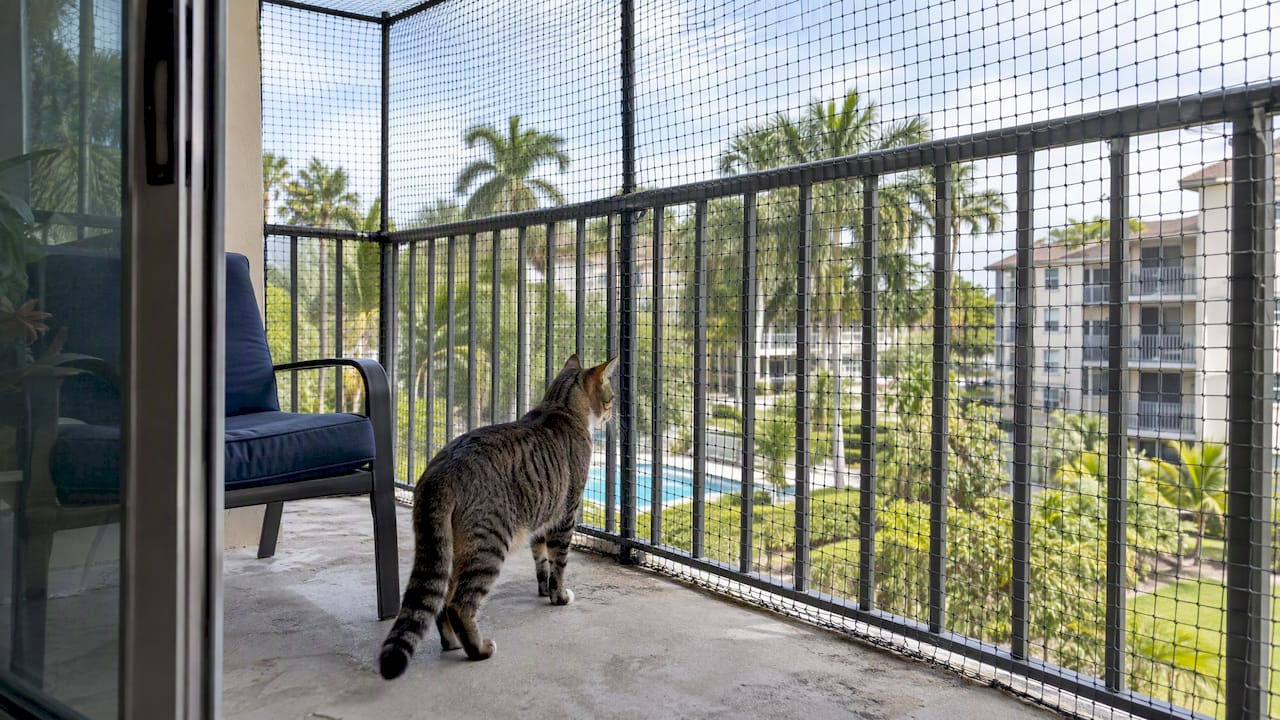
An unprotected balcony is not safe for a cat, even a calm, well-trained indoor one. The safe options are a fully enclosed balcony (a catio built from bite-resistant mesh), a supervised harness session, or keeping the cat off the balcony entirely. Below you will find why falls happen, what to look for in netting, how to do it as a renter, and how to give your cat outdoor stimulation without the risk.
TL;DR
- Falls from balconies and windows are an avoidable emergency. The ASPCA says high-rise syndrome is 100% preventable.
- A cat does not need to be reckless to fall. A bird or insect can pull its attention away from where its paws are.
- Use stainless steel-reinforced, UV-resistant mesh with small holes, installed taut with no gaps at the railing, floor or ceiling.
- As a renter, get written approval first and choose a reversible, no-drill setup. Never block an exit path.
- If an enclosure isn’t possible, a secure window perch, a cat tree and harness walks are better than an open balcony.
Table of Contents
- Why balconies are dangerous even for careful cats
- Your options, from safest to least safe
- How to choose balcony netting
- Top and overhang: the part people skip
- Renting? Do this before you buy anything
- Making the balcony worth using
- If you can’t enclose it
- Our perspective
- Looking for a cat-friendly one-bedroom in Boca Raton?
- A quick safety checklist
- FAQ
- Sources
Why balconies are dangerous even for careful cats
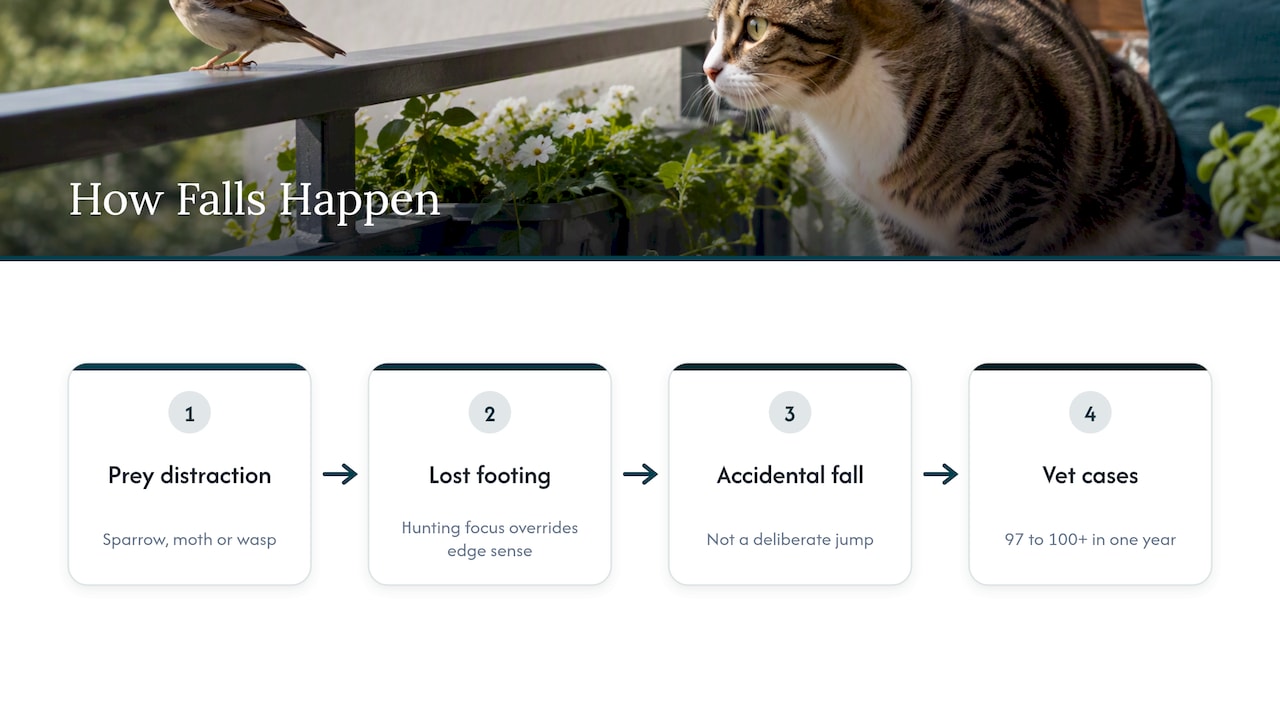
Most owners assume their cat is too sensible to fall. Veterinarians see the opposite. The ASPCA describes high-rise syndrome as the result of accidental falls, often when a cat is distracted by prey, loses its footing and falls. It is not about cats deliberately jumping.
That distraction is the part owners underestimate. A cat that has sat quietly on your windowsill for two years can still lunge at a passing sparrow, moth or wasp. Its hunting focus overrides its sense of where the edge is. Your cat’s earlier calm behavior doesn’t predict the moment it chases something.
The injuries are serious. The ASPCA reports that its veterinarians have treated 97 to 100+ cases in a single year. The most common injuries are shattered jaws, bruised or punctured lungs, and broken limbs or pelvises.
Low floors are not a safe zone
It is tempting to think a second-floor balcony is low enough. The ASPCA warns the opposite can be true: falls from around two to three stories can cause more severe head and pelvis injuries than some higher falls, because the cat has less time to orient its body for landing. A cat that survives a fall also still needs emergency veterinary care. Treat every floor as a risk.
Railings are built for people
Balcony railings are designed to keep humans in. Gaps between balusters, a flat top rail wide enough to perch on, and a bottom gap above the floor are all fine for a person and wide open for a cat. The ASPCA makes the same point about windows: childproof window guards are not enough for cats, because they leave gaps a cat can slip through. Apply the same skepticism to any barrier made for children.
Your options, from safest to least safe
| Option | How safe | Best for | Watch out for |
|---|---|---|---|
| Fully enclosed balcony (mesh on sides and top) | High, if built and tensioned correctly | Cats who love fresh air and watching birds | Needs landlord approval, regular inspection |
| Freestanding or clip-on catio unit | High, if rated for its use | Renters who can’t attach anything to the structure | Stability in wind, gaps at the base |
| Supervised harness walk | Moderate, depends on training | Cats that accept a harness | Escape from a poorly fitted harness |
| Closed balcony door, enrichment indoors | Highest | Cats of any temperament | Needs a good window perch and play routine |
| Open balcony with a railing only | Unsafe | Nobody | Falls, squeezing through balusters |
| Open balcony with loose or nylon netting | Unsafe | Nobody | Slipping underneath, chewed-through mesh |
People who tried basic nylon netting often report that it fails. In one forum thread on cat-proofing a balcony, owners say a cat needs stronger fencing, such as metal, with smaller holes, but we treat that as anecdote rather than evidence. The practical takeaway is the same as the materials advice below: don’t trust light, loose mesh.
How to choose balcony netting
Netting is the most common way to cat-proof a balcony, so the details matter.
Material
Look for HDPE (high-density polyethylene) netting that is UV-treated and reinforced with stainless steel wire. Standard nylon degrades in sun and is easier for a cat to bite through. A typical product, such as a 10 x 20 ft stainless steel reinforced cat netting listing, advertises bite resistance, tear resistance and UV and weather resistance. Read the specifications of whatever you buy rather than trusting a headline.
Mesh size
The holes must be small enough that a head can’t pass through. Around 3 cm x 3 cm (about 1.2 inches) or smaller is the common standard for cat netting. A kitten needs the smaller end of that range. Very small holes can trap birds or insects, so check the mesh regularly for wildlife.
Size and cutting
Most kits come in sheets you cut to fit, with common sizes running from about 10 x 13 ft to 36 x 6 ft. Measure the railing length, the height to the ceiling and any overhang before ordering, and buy more than you think you need. Kits usually include hooks, rope and zip ties. You supply the patience.
Tension is everything
The most common installation failure is slack. If the net is loose, a cat can slip underneath it or wedge itself between the mesh and the railing. After installing:
- Push hard on the middle of each panel. It should barely give.
- Run your hand along every edge. There should be no gap where a paw or head fits.
- Check the corners and the point where the net meets the floor, the most frequent escape spots.
- Re-check after a storm and monthly, since ties loosen and UV weakens materials over time.
Top and overhang: the part people skip
A cat that can climb will climb. Sides alone won’t keep a determined jumper in. A fully enclosed space needs a roof of netting, or an inward-angled overhang on top of the railing. Without it, a cat that can leap onto the top rail may simply go over. If your cat is a climber, treat the roof as mandatory.
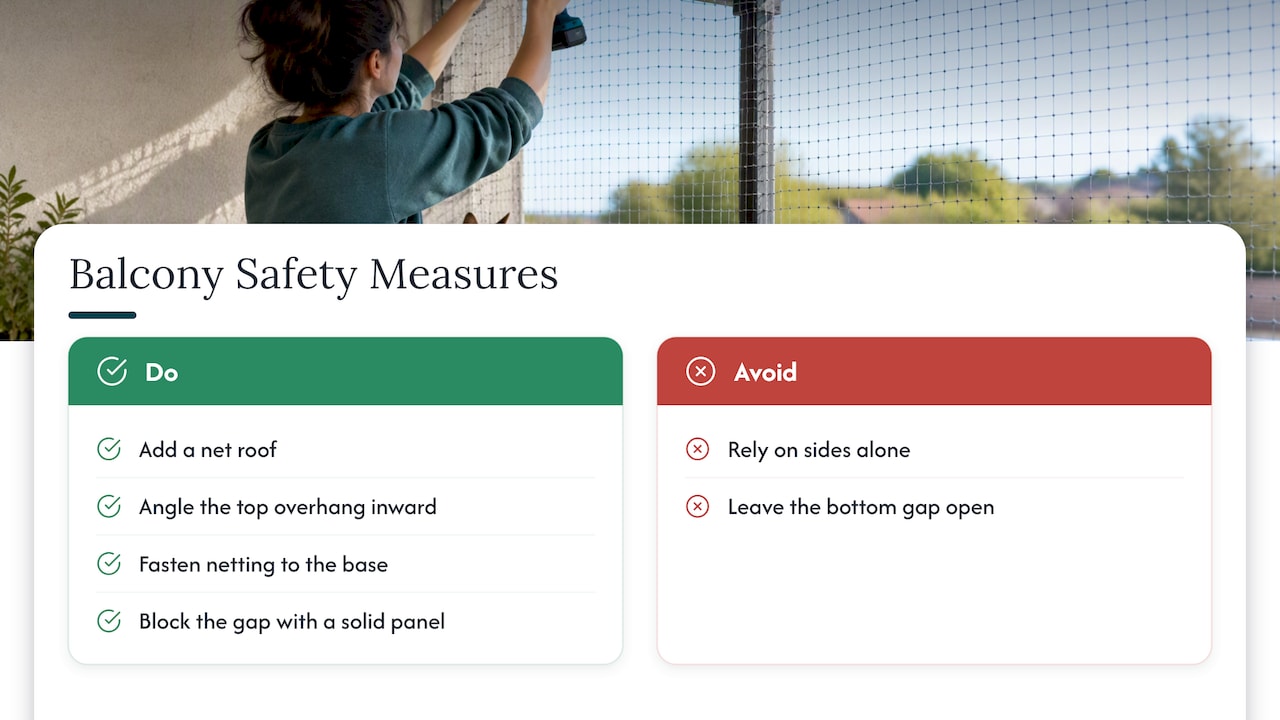
Also look at the floor. Cats can push through the gap between the bottom of the net and the deck. Fasten the net to the base, or block the gap with a solid panel.
Renting? Do this before you buy anything
A cat enclosure can run into your lease, so sort that out first.
- Read the lease. Look for clauses on balcony alterations, drilling, attachments to railings and exterior appearance.
- Ask in writing. Describe exactly what you want to install, the materials, and how you will remove it. Keep the reply.
- Choose reversible fixings. Clamps, tension poles and freestanding catio units avoid holes in walls and railings.
- Photograph the balcony before and after. It protects your deposit.
See how a community can lay these expectations out in advance in our apartment balcony pet rules page.
Fire code and exits
Florida renters have one more consideration. Balconies in multi-unit buildings are covered by fire safety rules. Under the Florida Fire Prevention Code (NFPA 1), cooking and heating devices such as grills are not allowed on balconies of buildings that aren’t one- and two-family dwellings, and local fire departments publish guidance for multi-residential buildings, such as the Miami-Dade Fire Safety Handbook. The point for your cat project: whatever you install must not block an evacuation route or be treated as a hazard. Ask your property manager whether any enclosure has to leave a way out.
If you want a general read on balcony hazards that go beyond cats, this Italian-language guide to terrace fire safety explains the risks of open flames on outdoor spaces. It is a useful reminder that a cat, a balcony and heat sources do not mix.
Making the balcony worth using
A safe balcony that bores your cat will not stay popular. The Feline Veterinary Medical Association notes that a safe place is only the first of five pillars of feline wellbeing, and that physical safety alone is not enough because boredom can lead to stress and behavior problems. Once the enclosure is secure, add:
- A perch or bed in a sunny, sheltered corner. Keep it away from the railing line so it doesn’t become a launching pad.
- Vertical space. A short cat tree or wall shelves, anchored so they can’t tip.
- Cat-safe plants only. Check each plant against the ASPCA’s toxic and non-toxic plant lists before it goes outside.
- Shade and water. Florida sun heats a balcony fast, and a cat can overheat. Provide shade and fresh water, and don’t leave a cat out in the afternoon heat.
- A scratching post to keep claws away from the netting.
Veterinary experts at UC Davis also recommend enclosed catios or harness-trained walks as safe ways to give indoor cats outdoor time, and note that indoor cats generally live much longer than free-roaming ones.
If you can’t enclose it
Sometimes you can’t. The lease says no, the budget is tight, or the railing design won’t take a mesh. Then keep the balcony door closed when your cat is loose, and invest in what you can control:
- A window perch with a snug, sturdy screen in the frame. The ASPCA stresses secure screens in all windows, even where childproof guards are installed.
- A bird feeder placed outside a screened window, for entertainment from a safe distance.
- Daily play sessions with wand toys, which mimic the hunt.
- A harness and leash, introduced slowly indoors first.
For more apartment-level ideas, see our guides on cat-proofing an apartment as a renter and how to pet-proof an apartment for cat owners.
Our perspective
We run a one-bedroom apartment community in Boca Raton, and we talk to cat owners about this all the time. Our view is simple: a balcony is a wonderful extra room for you and a risk for your cat unless it has been prepared. We would rather a resident ask a question before installing anything than learn the hard way.
Three things guide how we think about it. First, ask before you build. A written approval protects both you and the community, and it keeps fire exits clear. Second, don’t rely on your cat’s temperament. A calm cat can still lunge at a bird. Third, safety and enrichment go together. A cat with a window perch, a tree and daily play is less likely to be desperate to get outside.
We also try to make cat ownership predictable. Our cat policy has a one-time pet fee per cat and no ongoing pet rent, so you know the cost before you sign. You can read more about cat-friendly apartments in Boca Raton and the features that matter to pet owners.
— Ayman
Looking for a cat-friendly one-bedroom in Boca Raton?
If you are searching for a home where your cat is welcome, our one-bedroom apartments are listed at $1,990 to $2,220 per month. The non-refundable pet fee is $300 to $500 per cat, one time, with no monthly pet rent. Other fees, such as the $75 per applicant application fee and the $300 administration fee, are listed on our fees page, so there are no surprises. You can start with a virtual tour from home and ask about balcony and pet rules before you apply.
A quick safety checklist
- Decide whether your cat will use the balcony at all, or whether a window perch is the better answer.
- Get written permission from your property manager.
- Buy stainless steel-reinforced, UV-resistant mesh with holes of about 3 cm or smaller.
- Cover the sides, the top and the floor gap.
- Tension the mesh and check every corner.
- Keep exits and any required evacuation paths clear.
- Add shade, water, a perch and cat-safe plants.
- Inspect the setup monthly and after storms.
- Supervise at first, and never leave a new setup unwatched until you trust it.
FAQ
Are balconies safe for cats?
Not unless they are enclosed. Cats fall when they are distracted by birds or insects, and the ASPCA calls these falls fully preventable. A fully enclosed, taut mesh balcony or a supervised harness session is much safer than an open railing.
What is the best netting for a cat-proof balcony?
Choose UV-treated HDPE netting reinforced with stainless steel wire, with holes of about 3 cm or smaller. It resists bites and sun better than basic nylon. Whatever you buy, install it tightly, with no gaps at the railing, floor or ceiling.
Can I turn my apartment balcony into a catio?
Often yes, but check your lease and ask your property manager in writing first. Use reversible fixings like clamps or a freestanding unit, and make sure nothing blocks an evacuation path. In Florida, multi-unit buildings also have fire code rules, so confirm with the community.
Is a low balcony safer than a high one?
No. The ASPCA warns that falls from around two or three stories can cause severe head and pelvis injuries. Treat every balcony the same, and see a veterinarian immediately if your cat has fallen, even if it seems fine.
Sources
- ASPCA: High-Rise Syndrome, Lifesaving Tips for Cat Parents
- ASPCA: Install and secure window screens to prevent high-rise syndrome
- ASPCA: High-Rise Kitty Bounces Back After Injuries
- UC Davis: Cats, Indoors or Outdoors
- AVMA: Indoor cats’ wellbeing requires more than physical safety
- Miami-Dade Fire Rescue: Fire Safety Handbook
- North Port Fire Rescue: Portable Cooking Grills and Fire Prevention
- Amazon: stainless steel reinforced cat netting listing