Apartment parking permits control who can park where, and most communities now use online, license-plate-based systems instead of paper hangtags. If you live in a community, find the resident portal or ask management how to register your vehicle. If you manage one, set your permit policy first, then confirm your vendor and any enforcement partners are working from the same plate list.
TL;DR:
- Municipal street permits and apartment lot permits follow separate rules; residents near a city district may need both, with separate eligibility and enforcement.
- Applications commonly require a driver’s license, vehicle registration, and proof of residency; one city charges $25 annually for residents and $30 for annual guest permits.
- Guests can register by QR code or through a resident portal, but properties may cap daily passes, quarterly use, or each unit’s visitor allowance.
- Managers should confirm policies, documents, and plate data with enforcement before launch, then issue warnings during testing to catch errors before towing or citations.
- A single mistyped plate can trigger a false violation, so check every entry and update the portal immediately after changing cars or plates.
Table of Contents
- How do virtual license-plate permits differ from hangtags?
- What types of parking permits exist?
- What do you need to register for a permit?
- How do guests and visitors get permits?
- How should property managers roll out a permit program?
- What are the benefits and common issues of modern permit systems?
- Who is eligible for an apartment parking permit?
- How long do permits last and how do renewals work?
- What rules and restrictions apply to permit use?
- What should you do if a permit is lost or stolen?
- How do temporary permits and special event parking work?
- Do motorcycles, electric vehicles and other vehicles need different permits?
- What do we recommend for residents and managers?
- FAQ
- Sources
How do virtual license-plate permits differ from hangtags?
A virtual permit is a digital record tied to your license plate. You register the vehicle through a portal, and enforcement staff check plates instead of looking for a tag on the mirror. Houston’s ParkHouston program is one example: the city replaced paper hangtags with digital permits linked to plates, and residents register vehicles and guests online.
Enforcement usually runs on automated license plate recognition (ALPR). A camera reads the plate, software compares it to the active permit list, and a mismatch flags the vehicle. San José’s residential program publishes how its ALPR and virtual permit workflow operates, including guest QR codes.
Physical tags and stickers still exist, but they have a weakness: they can be copied, lent or moved between cars. City officials in San José report that plate-linked permits reduce fraud compared with transferable hangtags and allow real-time data sharing.
Why communities switch:
- Less fraud: a permit tied to one plate can’t be handed to a neighbor’s friend.
- Real-time checks: enforcement sees new, expired and revoked permits immediately.
- Resident convenience: no mailing, pickup or replacement of tags.
- Less admin work: staff stop printing, tracking and reissuing physical items.
What types of parking permits exist?
Most permit programs fall into a few models, and knowing which one applies to you saves a lot of confusion.
- Annual resident permits: issued per vehicle, usually with a household limit.
- Annual guest permits: a longer-term pass for a regular visitor, such as a family member or caregiver.
- Daily guest and event permits: short-term passes for one-time visitors or gatherings.
- Paid or reserved permits: some communities sell reserved spaces or priority lanes, which can also bring in revenue.
One distinction trips people up: private apartment-lot permits versus municipal Residential Permit Parking (RPP). Your property sets and enforces rules for its own lots. A city RPP district covers public streets, follows municipal rules, and is run by the city. Some cities even require signed petitions before an RPP zone can be created, and they set their own eligibility, documentation and enforcement procedures.
If you live in a complex that borders an RPP district, you may need both: a permit from your property for the lot and a city permit for the curb.
We cover the cost side of this in our guide to apartment parking convenience, cost and lifestyle.
What do you need to register for a permit?
Requirements vary by city and by property, but the checklist below covers what most programs ask for. Houston, for example, requires proof of residency such as an electric, water or gas utility bill along with a valid state driver’s license.
- Create an account on the property or city portal using your email address.
- Upload your ID, typically a valid driver’s license or other government ID.
- Add your vehicle registration for each car, so the plate and owner name can be matched.
- Provide proof of residency, which may be your lease or, in many cities, a recent utility bill.
- Pay any fee and wait for verification before the permit activates.
Some cities want more than a lease. Municipal programs often ask for a driver’s license plus a recent utility bill, so check the exact list before you start.
Fees depend on locality. As one real example, a municipal RPP document lists a $25 annual resident permit, a $30 annual guest permit, and $5 to $10 daily guest permits. Private properties set their own prices, and some include parking in rent.
Fee example: one city program lists a $25 annual resident permit, a figure that shows how modest municipal fees can be compared with private lot charges.
Timelines depend on how quickly staff verify documents. Account setup takes minutes, verification can take anywhere from same-day to several business days, and activation follows approval. Renewals and replacements often move faster because your records are already on file.
How do guests and visitors get permits?
Guest flows have become the most visible benefit of virtual systems. There are usually three paths:
- Resident-assigned permits: you log in, enter your guest’s plate, and choose dates. Frequent visitors’ plates can be saved so you don’t retype them.
- Self-registration by QR code: the visitor scans a code posted at the property or sent by you, enters their plate, and receives a temporary permit tied to it. San José’s program offers guest QR codes alongside advance assignment.
- Last-minute arrivals: a guest who shows up without a pass can usually register on the spot through the QR code, or you can add the plate from your phone.
Managers typically control how generous this is. Common limits include daily caps on visitor passes, per-quarter limits per unit, and rules for how long one plate can stay registered.
Pro Tip: Save the plates of anyone who visits regularly. It saves you from re-entering them and may help prevent a surprise citation on a busy weekend.
How should property managers roll out a permit program?
A smooth rollout is mostly about coordination, not software. Use this sequence:
- Define the policy. Decide who gets permits, how many per household, whether any lanes are paid, and what documents prove eligibility.
- Map required documentation. Mirror what your city asks for so your process holds up if questioned.
- Bring enforcement in early. Whether it’s a towing contractor, a vendor with ALPR or a city agency, they need your active permit list in a format they can use. FTA guidance stresses early coordination with third-party enforcement to avoid delays and compliance problems.
- Test the data flow. Confirm the plates in your portal appear correctly in the enforcement system before go-live.
- Announce clearly. Send resident notices with the portal link, deadline, required documents and a support contact.
- Plan for recovery. Decide how residents regain access after a lost password, a new car or a misread plate.
A common pitfall is leaving residents, enforcement partners and property staff out of the planning until launch day. Another is setting looser verification than the city uses, which can create audit or compliance problems later. Matching municipal standards, such as requiring a license plus a utility bill where the city does, keeps you consistent.
Pro Tip: Run a soft launch where violations produce warnings, not tows. You’ll catch misassigned plates before they cost anyone money.
Our own guide to digital leasing tools for property managers covers related technology choices.
What are the benefits and common issues of modern permit systems?
Communities adopt virtual permits for good reasons, but a few routine problems are worth planning for.
- Benefits: less fraud, faster enforcement, resident self-service, and optional revenue from paid or reserved spaces. The FTA notes that modern parking policy increasingly favors digital permit systems to manage demand.
- Privacy: ALPR collects plate reads, so ask how long data is kept and who can see it. Some cities publish retention schedules, as San José does for its ALPR data.
- Lost access: a forgotten login or changed email can lock you out. Keep a contact for management handy.
- Misassigned plates: a single mistyped character causes a false violation. Double-check every plate you enter, and ask management to correct errors right away.
Who is eligible for an apartment parking permit?
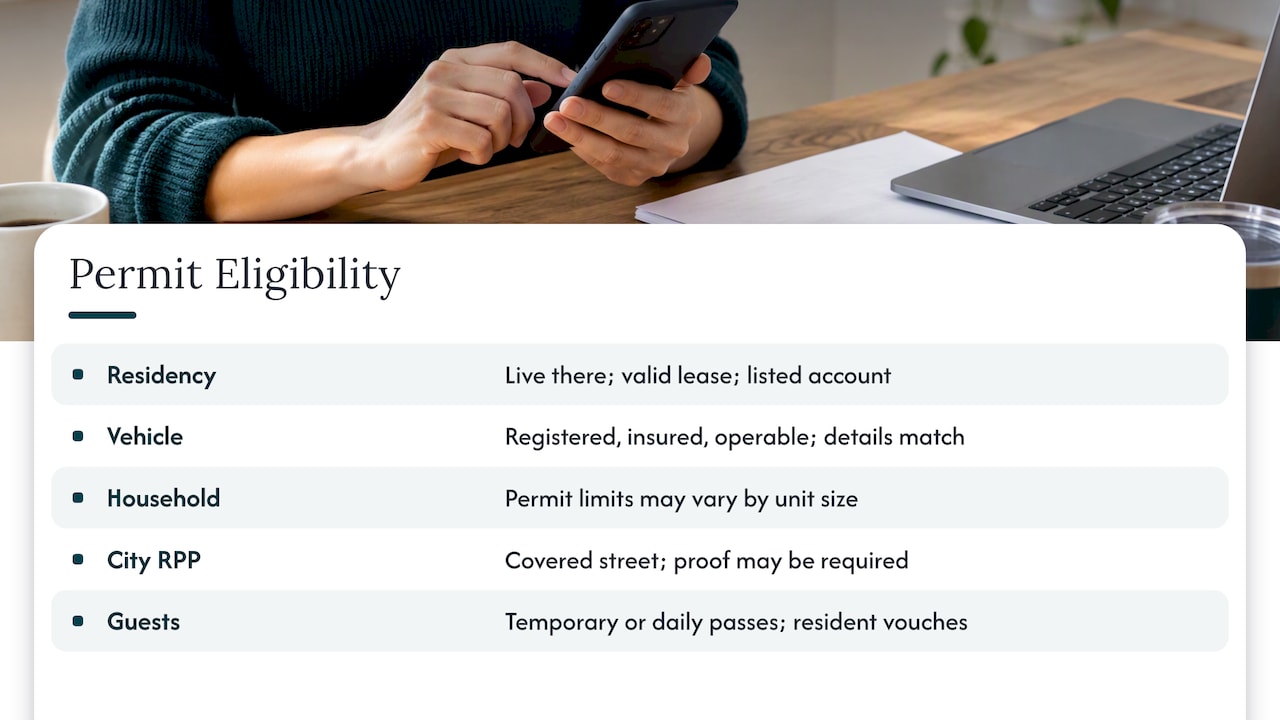
Eligibility starts with residency. In nearly every program, you must live at the property, hold a valid lease or occupancy agreement, and be listed on the account. Management may also require that you are in good standing, meaning rent and fees are current, though policies differ.
Vehicle rules matter too. The car typically has to be registered, insured and in operable condition, and the registration name or address should match what you gave management. Many communities exclude abandoned or inoperable vehicles, and some restrict commercial vehicles, trailers or oversized trucks.
Household limits are common. A smaller unit might be allowed fewer permits than a larger one. If you need extra spaces, ask whether the property sells additional permits or reserved spots.
For city RPP districts, eligibility is geographic as well. You generally have to live on a covered street, and the city may require proof such as a license plus a recent utility bill. Some areas require a petition before a district exists at all.
Guests and visitors qualify differently. They are normally eligible for temporary or daily passes rather than annual ones, and the resident usually vouches for them.
If you are not sure whether you qualify, ask the leasing office before buying anything. If you are still choosing a home, our one-bedroom apartments page and our Boca Raton parking fees overview explain what to expect.
How long do permits last and how do renewals work?
Duration depends on the permit type. Annual resident permits may be tied to the calendar year or to your lease term. Guest permit durations vary by program, and event or temporary passes last only as long as the event.
Virtual systems make renewal simpler because your account and plate history are already stored. Typically you log in, confirm your vehicle and address, pay any fee, and the permit extends. Some properties renew permits automatically alongside a lease renewal; others expect you to act before an expiration date.
A few habits prevent gaps:
- Note your expiration date in your phone calendar.
- Update the portal immediately when you buy a new car or change plates.
- Re-upload documents if your license or registration has expired, since the system may block renewal without current ones.
- Confirm that your lease renewal does not require a new application.
Cities handle renewals their own way. Some mail reminders, some require a fresh proof of residency every year, and others carry approval forward. Check the municipal program page for your district rather than assuming it matches your property.
If a permit lapses, there may be a grace period, but don’t count on one. Parking without a valid permit, even by a day, can trigger a warning, a citation or a tow depending on the rules.
What rules and restrictions apply to permit use?
A permit gives you the right to park in specific places under specific conditions. Read the rules once, because violations are the most common source of citations.
Typical restrictions include:
- Designated areas: a permit may only be valid in certain lots, levels or districts. Municipal RPP permits, for example, are valid only within their district.
- Time limits: visitor and daily permits may cap stays, and some lots limit how long any vehicle can sit unmoved.
- Display or plate rules: physical permits must be visible as directed, while virtual permits require that the registered plate match the car exactly.
- Reserved and accessible spaces: these require specific permits regardless of your resident status.
- Prohibited uses: storing vehicles, repairs in the lot, parking commercial trucks or blocking fire lanes are commonly banned.
- Transfer limits: a permit belongs to the registered vehicle and can’t be lent to someone else’s car.
Municipal materials show these same themes: household limits, fee schedules and rules on display and district validity.
Your lease or community rules document is the final word on private lots. If a rule seems unclear, ask management to clarify in writing, and keep that message.
What should you do if a permit is lost or stolen?
Act quickly, because a lost physical tag can be misused until it is canceled.
- Notify management or the permit office right away. Phone or portal, whichever is fastest, then follow up in writing.
- Request cancellation. Ask them to void the old permit so no one else can use it.
- File a police report if it was stolen, since some programs ask for a report number before issuing a replacement.
- Verify your identity. Expect to confirm your ID, address and vehicle details.
- Pay any replacement fee, if one applies, and ask when the new permit becomes active.
Virtual permits reduce this problem because nothing physical can be taken. What can be lost is account access, such as a password or the email used to register. In that case, use the portal’s recovery tool or contact support, and confirm that the plates on file are still correct.
Managers should keep a clear recovery process, including who can verify a resident and how quickly. As noted above, planning for account recovery before launch avoids long lockouts.
If you find a permit you reported missing, tell management so records stay accurate and you aren’t charged twice.
How do temporary permits and special event parking work?
Temporary passes cover the situations an annual permit can’t: a moving day, a contractor’s visit, a birthday party or a short stay by a relative. The approach is similar across most communities.
For residents, the process usually looks like this:
- Request early. Add each guest plate through the portal as soon as you know the dates.
- Use the QR option for strangers. Contractors, movers and delivery drivers can self-register at the property, which puts the work on them.
- Ask about overflow. For gatherings, management may open extra lots, set a temporary cap per unit or require a list of attending vehicles.
- Check time and quantity limits. Daily caps and per-quarter limits are common, so a large event may need management approval.
For managers, special events call for a few controls:
- Set a maximum number of temporary permits per unit and per day.
- Publish the rules before peak seasons, such as holidays and move-in weeks.
- Give enforcement partners an updated list when exceptions are approved.
- Decide whether event permits are free or paid.
City programs treat daily visitors the same way. One municipal document lists $5 to $10 daily guest permits, showing how short-term passes are often priced lower than annual ones.
When in doubt, ask before the event, not after a citation arrives.
Do motorcycles, electric vehicles and other vehicles need different permits?
Often, yes, though the details depend on the property. The permit system tracks plates, so any registered vehicle with a plate can usually be added. What changes is the space and the rules around it.
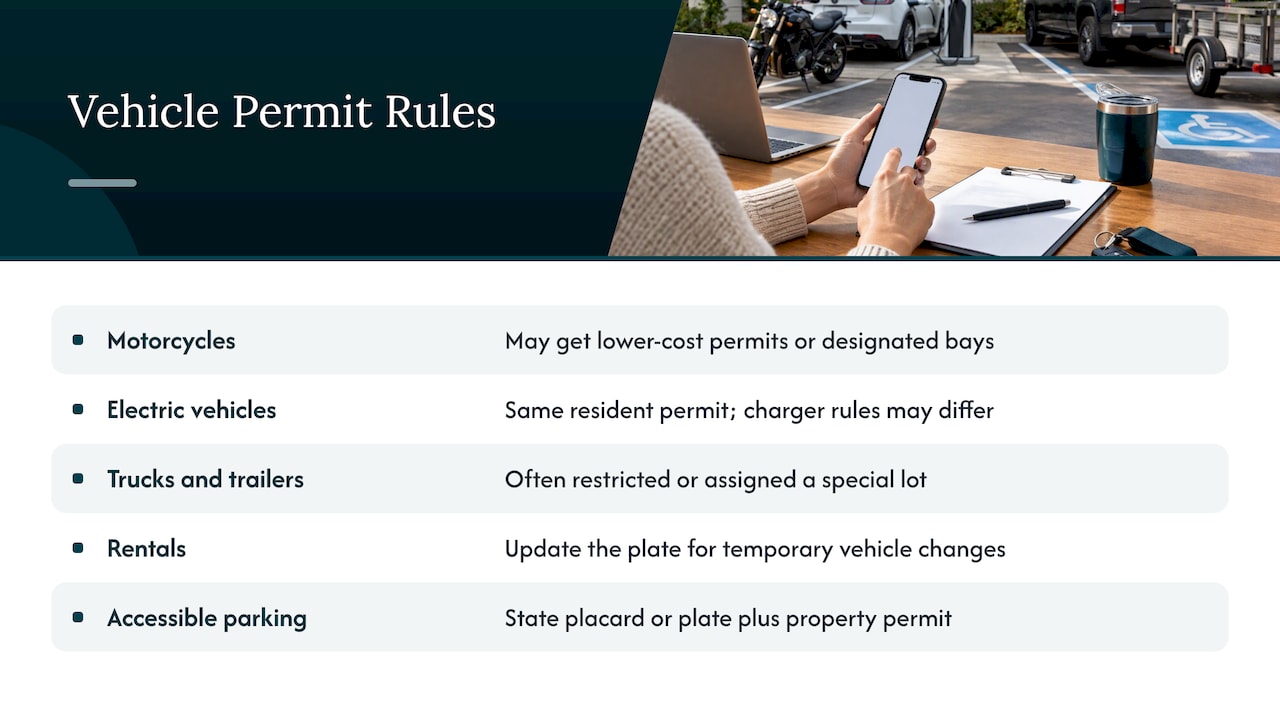
Motorcycles and scooters: some communities issue a lower-cost or no-cost permit, or assign designated motorcycle bays. Others count a motorcycle toward your household vehicle limit like any car. Make sure the plate is registered, because a small vehicle with an unregistered plate is just as easy for ALPR to flag.
Electric vehicles: an EV needs the same resident permit as any car. If your community offers charging stations, access may require a separate agreement, reservation or fee, and charging spots can have time limits to keep them available. Ask management whether chargers are first-come or assigned.
Trucks, vans and trailers: oversized or commercial vehicles are frequently restricted or must use a special lot. Confirm before you buy or lease one.
Rentals and temporary cars: if you swap vehicles, update your plate in the portal. Many systems allow a short-term plate change for a rental or loaner.
Accessible parking: these spaces require a state-issued placard or plate in addition to any property permit.
If your vehicle doesn’t fit a standard category, send management the make, model and plate so they can tell you where it belongs and what it costs.
What do we recommend for residents and managers?
Here is where we land after looking at how these programs run. Parking problems rarely come from the technology. They come from unclear rules, missing paperwork and enforcement that wasn’t told what changed. A virtual permit is only as good as the plate list behind it.
For residents, gather your license, vehicle registration and proof of address before you open the portal, and save the plates of regular guests. For managers, put enforcement coordination and resident communication ahead of everything else during rollout, then test with warnings before issuing citations.
We think parking should be one of the easier parts of renting. At Cynthia Gardens, our team is happy to walk you through how parking works on our property, and our apartment parking guide is a good place to start.
— Ayman
FAQ
What are apartment parking permits?
Apartment parking permits are credentials that show a vehicle is allowed to park in a property’s lots or on a permit-controlled street. Many are now virtual and tied to a license plate rather than a hangtag.
How much does a residential parking permit cost?
Cost depends on the city or property. One municipal program lists a $25 annual resident permit and $30 annual guest permit, while private apartment communities set their own fees. Check your city’s program page or ask your property manager.
What documents do I need to apply?
Most programs ask for a valid driver’s license, vehicle registration and proof of residency. In Houston, proof of residency means a utility bill, along with a state driver’s license. Your city or property may ask for different documents.
Can my guests get a permit without me?
Often they can. Many systems let visitors self-register by scanning a QR code and entering their plate, as in San José’s guest workflow. You can also assign a permit in advance through your portal.
Sources
- Houstontx
- Technology Behind the Virtual Residential Permit Parking (RPP) Program | Blog | City of San José
- Residential Permit Parking Program (RPPP)
- Mitigating Problems of Third Party Coordination | FTA