
Most students without steady income or established credit will need a guarantor or an accepted alternative to sign a lease. Call the leasing office before you do anything else and ask which income multiple they require and which third-party guarantor providers they actually accept. Do this before you pay any fee, because being a guarantor carries real financial exposure for whoever signs.
TL;DR:
- Most guarantors need an income of at least 40 times the monthly rent in standard markets, but this rises to 80 to 100 times in high-cost areas like New York City.
- Guarantors are typically required to have a credit score of 620 to 650 or higher and U.S. residency, making international guarantors less commonly accepted.
- Landlords often demand extensive documentation from guarantors, including ID, proof of income, bank statements, and tax returns, and perform credit checks that can temporarily impact credit scores.
- A guarantor’s liability usually includes full lease obligations unless specifically capped, which can lead to significant financial exposure for the guarantor.
- Alternatives such as prepaying several months’ rent, increasing security deposits, or using institutional guarantor services may be accepted if a personal guarantor is unavailable or unqualified.
Table of Contents
- Student Lease Guarantor Requirements: What a Guarantor Actually Is
- Who Can Be a Guarantor and What Landlords Look For
- Documents Landlords Usually Require From a Guarantor
- How Guarantor Liability Actually Works
- Alternatives When You Can’t Find a Personal Guarantor
- What International Students Need to Know About Guarantors
- How to Verify a Third-Party Guarantor Before You Pay
- How Cynthiagardens Approaches Guarantor Requirements
- Ready to Apply? What Cynthiagardens Students Should Know First
- Sources
- FAQ
Student Lease Guarantor Requirements: What a Guarantor Actually Is
A guarantor signs a separate guaranty attached to the lease. That person backs the rent financially but gets no occupancy rights and never moves in. A cosigner is different: landlords typically add a cosigner as a co-tenant, which means that person’s name goes on the lease itself and they share legal occupancy along with financial responsibility, according to Avail Education.
Landlords lean on guarantors for student applicants because most students haven’t built two years of pay stubs or a credit file yet. A guaranty gives the landlord a second income stream to chase if rent goes unpaid, without complicating who legally lives in the unit.
Here’s the practical difference in plain terms:
- A cosigner’s name appears on the lease as a tenant, with the rights that come with that.
- A guarantor’s name appears on a separate guaranty document, with none of those rights.
- If a landlord requires a guarantor, your parent or relative backs the debt but can’t move in or claim the unit.
Who Can Be a Guarantor and What Landlords Look For
Parents are the most common guarantors, followed by other relatives and, less often, a trusted family friend with strong finances. Landlords screen guarantors almost like a mortgage underwriter would, checking income, credit, and sometimes residency status before signing off.
Income requirements vary sharply by market. Most leasing offices ask a guarantor to earn around 40 times the monthly rent annually, but that threshold jumps to 80 to 100 times monthly rent in expensive markets like New York City, according to Columbia University’s off-campus housing office.
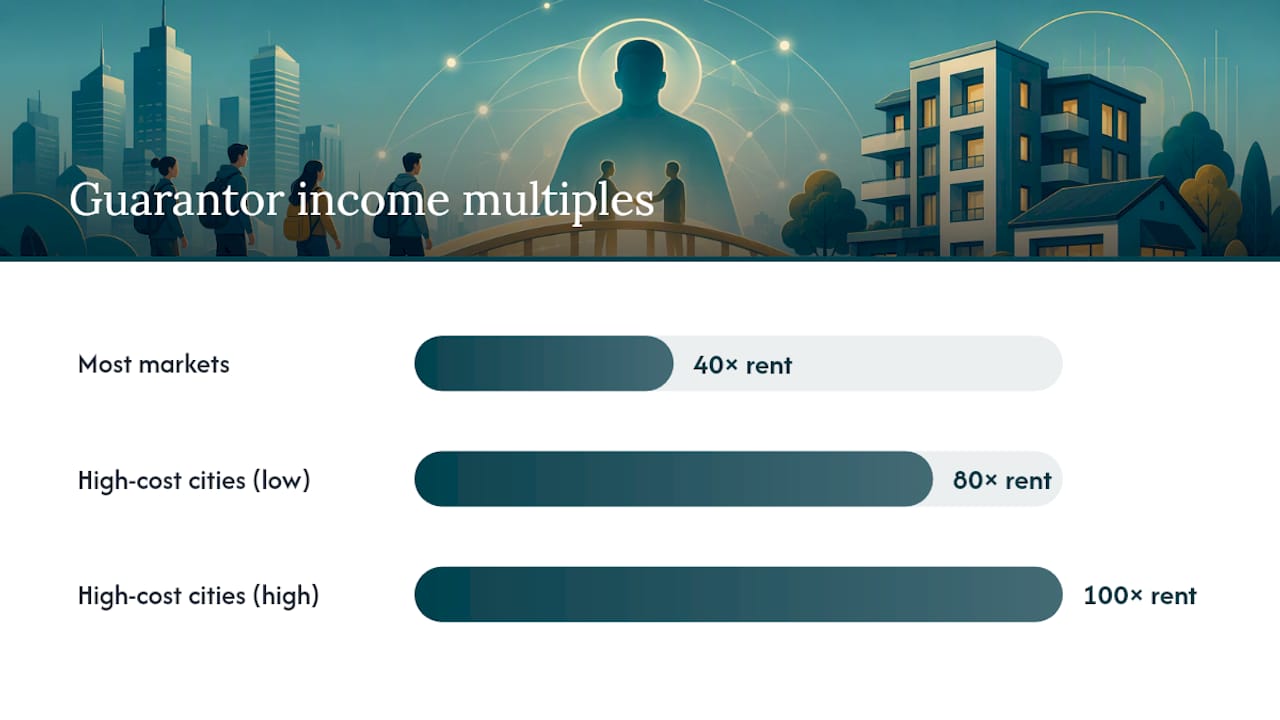
Statistic Callout: A guarantor earning 40 times the monthly rent baseline in most markets, or 80 to 100 times in high-cost cities, is the single most common qualifying number cited by university housing offices.
Common eligibility criteria include:
- Steady income at or above the landlord’s stated multiple.
- A credit score generally in the 620 to 650 range or higher, though some properties set the bar higher.
- U.S. residency, since many landlords worry that a guaranty against someone living overseas is difficult to enforce in court.
Documents Landlords Usually Require From a Guarantor
Expect a guarantor application to feel closer to a loan application than a rental form. Landlords want proof the person can actually cover the rent if things go wrong, and they want it documented.
A typical guarantor document checklist includes:
- A government-issued photo ID and Social Security number.
- Two to three recent pay stubs showing current income.
- One to two months of bank statements.
- One to two years of tax returns, especially for self-employed guarantors.
- An employment verification letter, or a CPA letter if the guarantor is self-employed.
Landlords commonly run a hard credit check on the guarantor as part of this process, according to ApartmentList’s guarantor guidance. That inquiry can briefly dip the guarantor’s credit score, and screening usually adds a few days to a week onto the leasing timeline, plus a separate application or screening fee in most cases.
How Guarantor Liability Actually Works
Signing a guaranty means accepting joint and several liability in most leases, unless the document says otherwise. That phrase sounds like legal boilerplate, but it has teeth: if a lease has three student tenants and one stops paying, the landlord can pursue the guarantor for the full unpaid balance, not just one student’s share.

Unpaid rent doesn’t just disappear if the guarantor ignores it. It can escalate into collections, wage garnishment, or a court judgment, all of which can damage the guarantor’s credit and future borrowing power, according to reporting on guarantor credit risk.
Before anyone signs, it’s worth pushing back on the terms:
- Ask whether the guaranty can be capped to the student’s individual share of rent rather than the full lease amount.
- Ask about a release clause after a set number of consecutive on-time payments.
- Ask whether the guaranty term can be limited to the initial lease period instead of automatically renewing.
Pro Tip: Read the guaranty’s exact wording before signing. A clause guaranteeing “all obligations under this lease” exposes the guarantor to the full lease amount, while negotiated language can cap that exposure to a single tenant’s portion.
Alternatives When You Can’t Find a Personal Guarantor
Not every student has a relative who qualifies, and that’s more common than most leasing offices let on. Several accepted workarounds exist, though each comes with tradeoffs worth weighing carefully.
Paid institutional guarantor services are the most visible option. These companies charge a one-time fee at signing, typically running 70% to 110% of one month’s rent, in exchange for backing the lease in place of a personal guarantor, according to RealEstateSkills.
Statistic Callout: That 70% to 110% fee is nonrefundable in most cases, which is exactly why confirming acceptance before paying matters so much.
Other paths landlords sometimes accept instead of a guarantor:
- Prepaying several months of rent upfront in place of a guaranty.
- Offering a significantly larger security deposit.
- Submitting a documented financial aid award letter or university-affiliated housing assistance program, where the property allows it.
Not all “guarantor” products work the same way. Some services have shifted their business model toward deposit replacement rather than a full lease guaranty, so read the fine print on exactly what the product covers before you count on it as a substitute, per Find My Place’s guarantor overview.
What International Students Need to Know About Guarantors
Landlords often require a U.S.-based guarantor because a foreign guaranty is harder to enforce through U.S. courts, and the guarantor’s income and credit history are harder to verify. That preference shows up constantly in student housing FAQs, and it catches a lot of international applicants off guard during their first apartment search.
International students without a qualifying U.S. guarantor typically have a few workable options:
- Institutional guarantor or credit-translation services built specifically for international renters, though you should confirm exactly what they file with the landlord before paying.
- Prepaying multiple months of rent in place of a guaranty.
- Submitting translated tax and pay documents if a family member abroad is willing to serve as guarantor and the landlord permits it.
- Checking university-affiliated housing programs, which sometimes have separate guarantor policies for international students.
How to Verify a Third-Party Guarantor Before You Pay
Skipping this step is how students lose money on guarantor fees that never actually get them approved. Work through this before signing anything or paying a cent:
- Call the leasing office directly and ask whether they accept the specific guarantor provider by name.
- Request written confirmation, ideally by email, rather than relying on a verbal “yes.”
- Confirm the service’s exact fee, its refund policy, and exactly what documentation it files with the landlord on your behalf.
- Ask directly whether the property will accept a guaranty bond in place of a traditional cosigner.
- Save every email, receipt, and confirmation in one folder in case a dispute comes up later.
Pro Tip: Refunds on paid guarantor services are often difficult to get once you’ve paid, especially if the provider turns out not to be accepted. Get the leasing office’s acceptance in writing first, always.
How Cynthiagardens Approaches Guarantor Requirements
Leasing offices vary widely on this, and Cynthiagardens keeps the process straightforward. Applicants can review lease requirements for Boca Raton apartments online before applying, and the virtual tours and digital document submission cut down the back-and-forth that usually slows guarantor screening elsewhere. Students who don’t have a qualifying personal guarantor should reach out to the leasing team directly to ask what documented alternatives, such as financial aid letters or a larger deposit, the community currently accepts. Every case gets reviewed individually, so a phone call before you apply saves you a guessing game later.
— Ayman
Ready to Apply? What Cynthiagardens Students Should Know First
The community keeps pricing transparent from the first quote, avoiding surprise charges buried in leases. One-bedroom apartments run $1,990 to $2,220 per month, and every fee, including the $75 application fee and $300 administration fee, is listed upfront rather than tucked into fine print.
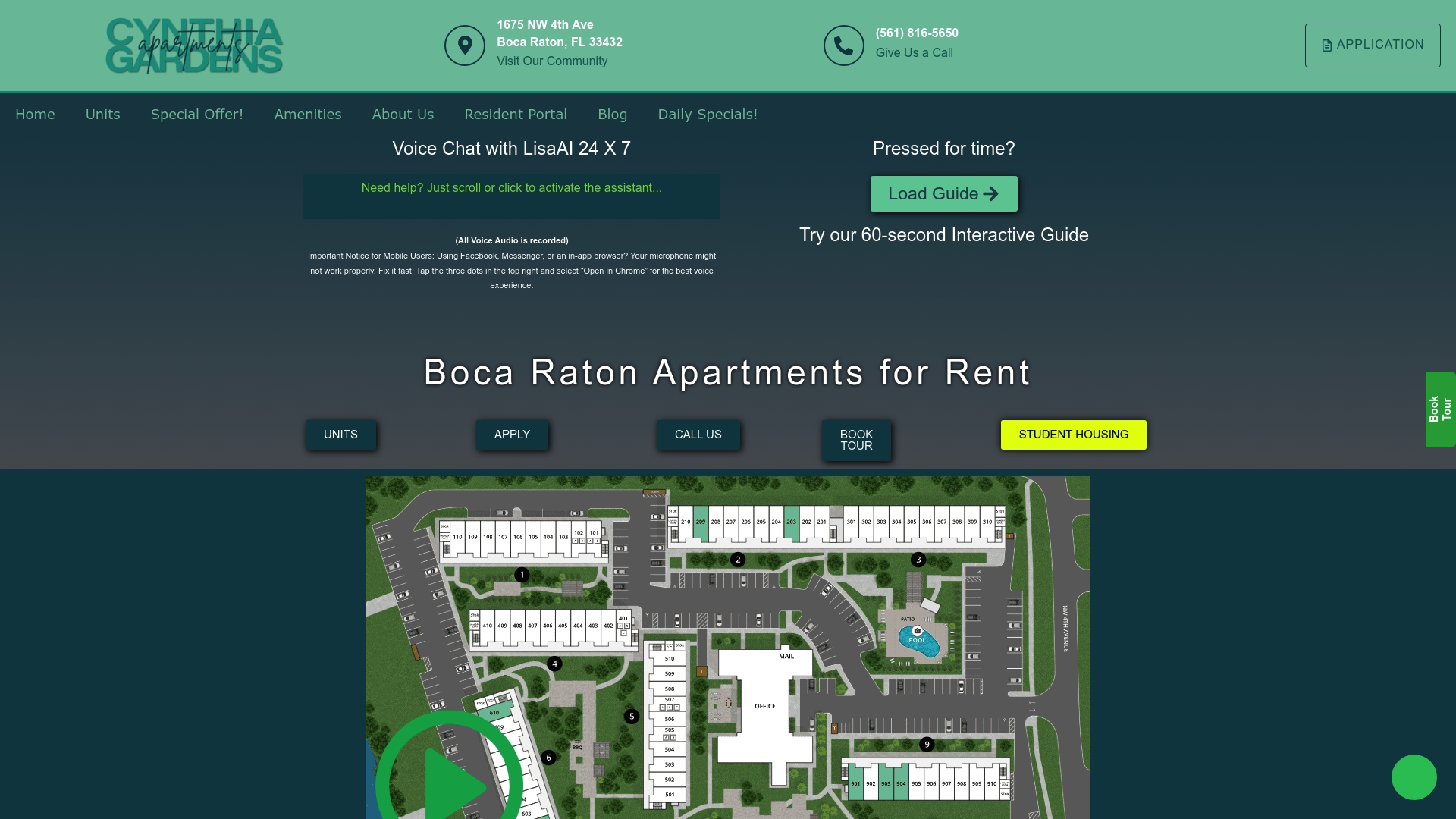
The leasing process runs online end to end, with AI chat support and an interactive property map that lets you compare units without driving across Boca Raton five times. If guarantor questions are holding up your decision, the leasing staff can walk you through exactly what the community accepts as an alternative, whether that’s a documented financial aid letter or a larger deposit, before you commit to anything. Confirm your specific guarantor situation with the team, then browse available one-bedroom units and start your application while the unit you want is still on the market.
Sources
Verify income multiples and required documents directly with your leasing office or university housing FAQ, since these figures shift by market. The sources cited throughout this guide, including Columbia University’s housing office and ApartmentList’s guarantor breakdown, are strong starting points for deeper reading.
- Best lease guarantor companies — RealEstateSkills
- Off-Campus Frequently Asked Questions — Columbia University OCHA
- Lease guarantor FAQs — ApartmentList
- Lease guarantor vs co-signer — Avail Education
FAQ
Who Can Be Your Guarantor for Student Housing?
A parent, relative, or sometimes a trusted family friend can serve as a guarantor, as long as they meet the landlord’s income and credit thresholds. Most properties also expect the guarantor to be a U.S. resident, since enforcement gets complicated across borders.
What Documents Are Required for a Guarantor?
Landlords typically ask for a government ID, Social Security number, recent pay stubs, one to two months of bank statements, and one to two years of tax returns, according to ApartmentList. Self-employed guarantors usually need to add a CPA letter or additional employment verification.
What Is the Minimum Income Requirement for a Guarantor in a High-Cost Market?
In expensive markets like New York City, landlords often expect a guarantor’s annual income to reach 80 to 100 times the monthly rent, compared to the more common 40 times benchmark elsewhere, per Columbia University’s housing office. Requirements vary by property, so always confirm the exact multiple with the leasing office directly.
Who Cannot Be a Guarantor?
Someone without U.S. residency, insufficient income relative to the rent, or a credit score below the property’s minimum usually won’t qualify as a guarantor. A current tenant on the same lease also generally can’t serve as their own guarantor, since the point is to add an independent financial backstop.
Does Cynthiagardens Require a Guarantor for Student Applicants?
Guarantor requirements at Cynthiagardens depend on the applicant’s income and credit profile, reviewed case by case during the online application. Students who don’t meet standard criteria should contact the leasing team to discuss accepted alternatives, such as a documented financial aid letter or a larger security deposit.