
Florida has no statewide cap on rent increases, and no city or county can pass one either. Landlords can raise rent by any amount once a lease term ends, but they still have to follow the notice rules in Fla. Stat. § 83.57 for month-to-month and other periodic tenancies. Recent 2023 legislative changes locked this preemption in even tighter, closing off the emergency exceptions cities used to lean on.
TL;DR:
- Local rent control measures are nearly impossible in Florida due to state statutes that prohibit counties and municipalities from regulating private rent amounts, even during emergencies.
- Landlords must give written notices at least 30, 60, or 7 days before a rent increase depending on the tenancy type, and improper notice invalidates the hike.
- Rent can be freely increased after a lease ends, with no statutory limit, but proper notification is crucial for enforceability.
- Tenant protections against retaliatory or discriminatory rent hikes rely heavily on documented timing and notices, not on rent caps.
- Local ordinances related to notices or disclosures may remain enforceable but cannot function as de facto rent controls under preemption laws.
Table of Contents
- Rent Increase Laws in Florida: The Preemption Rule Explained
- Notice Requirements and Timelines for Changing Rent
- Fixed-Term Leases vs. Month-to-Month: When Rent Can Actually Change
- Tenant Protections: Retaliation, Discrimination, and Legal Defenses
- Responding to a Rent Increase: A Step-by-Step Plan
- Local Ordinances and County-Level Pitfalls to Watch For
- How Cynthia Gardens Approaches Renewals and Rent Notices in Boca Raton
- An Editorial Take on Florida’s Rent Increase Rules
- Sources
Rent Increase Laws in Florida: The Preemption Rule Explained
Two statutes do the heavy lifting here. Fla. Stat. § 125.0103 bars counties from adopting any ordinance that controls the rent a private landlord charges. Fla. Stat. § 166.043 applies the same restriction to municipalities and lays out the narrow, difficult path a city would have had to take to enact rent control in a declared housing emergency, including a local referendum and a one-year sunset.
That emergency path is effectively gone now. Legislative changes tied to the broader housing package known as the Live Local Act narrowed and, in practical terms, eliminated the conditions a municipality could point to for emergency rent stabilization. Miami Beach tried to use the old emergency provision back in 2022 and got blocked in court before it ever took effect. After the 2023 changes, that kind of attempt is even less viable.
Here’s what this preemption actually stops, and what it leaves alone:
- Blocked: City or county ordinances that cap the dollar amount or percentage a landlord can raise rent.
- Blocked: Local rent boards or rent stabilization boards with authority over private rental pricing.
- Allowed: Local affordable housing incentive programs, density bonuses, and land-use tools tied to the Live Local Act.
- Allowed: Local tenant notification or fee-disclosure rules that don’t touch the rent amount itself.
- Allowed: County-run housing assistance or relocation programs for displaced renters.
The takeaway: if you’re a Florida tenant hoping a local ordinance will cap your increase, it won’t. State law forecloses that option almost entirely, and the 2023 changes made the gap even harder to close at the local level.
Notice Requirements and Timelines for Changing Rent
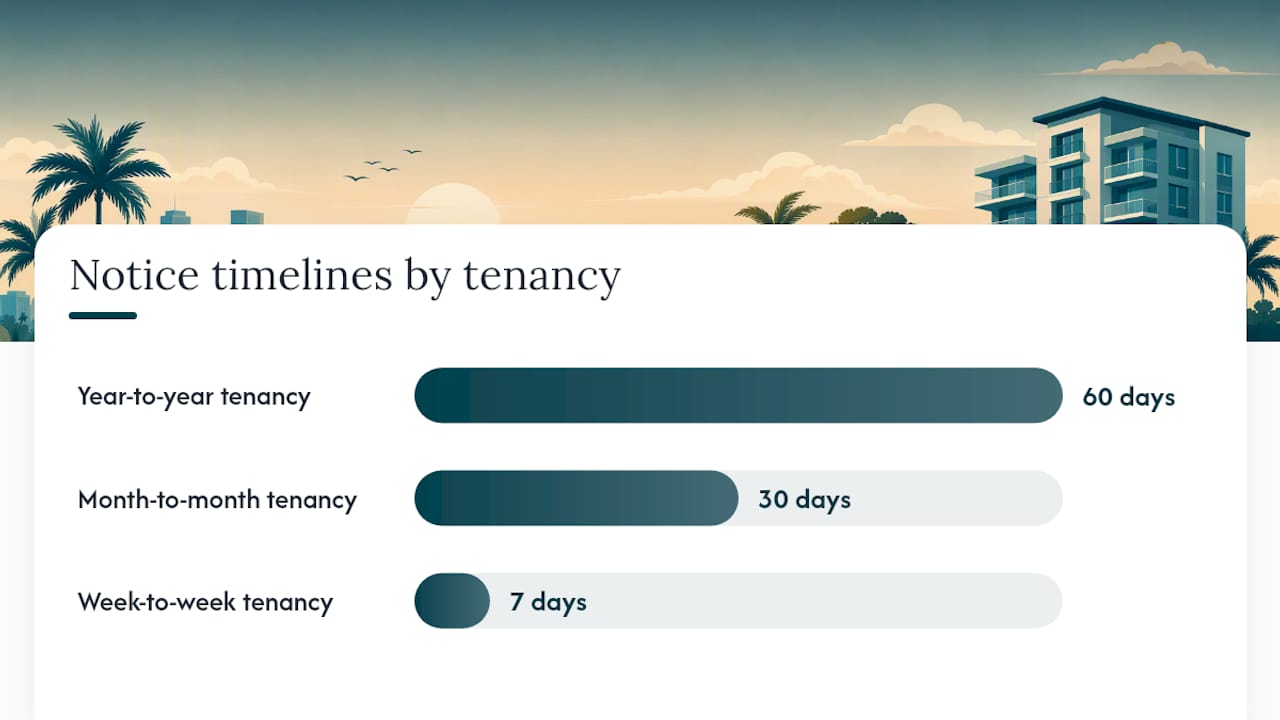
For any tenancy without a fixed lease term, a landlord can’t just announce a new rent number and expect it to stick the next billing cycle. Florida law requires written notice tied to how the tenancy is structured, under Fla. Stat. § 83.57:
- Year-to-year tenancy: at least 60 days’ written notice before the end of the annual period.
- Month-to-month tenancy: at least 30 days’ written notice before the end of the monthly period.
- Week-to-week tenancy: at least 7 days’ written notice before the end of the weekly period.
There’s no separate “rent increase notice” form in Florida statute for periodic tenancies. Instead, landlords use the same termination/change mechanism: they issue a notice ending the current terms and offering renewal at a new rent. If the tenant doesn’t want to accept the new number, they can give matching notice and vacate at the end of that period. Practical guidance on how landlords should word these notices is available from resources like the Prop-Pocket rent increase notice guide, which walks through sample language many property managers use.
Miss the notice window, and the increase generally can’t take effect until a full new notice period runs. A landlord who tries to bill a higher rent without proper notice is on shaky legal ground if a tenant refuses to pay the difference. That gap between “sent an email” and “sent a compliant statutory notice” is one of the most common tenant defenses in Florida rent disputes.
Pro Tip: Always ask for the rent increase notice in writing with a clear effective date, even if your landlord mentions it verbally first. If there’s ever a dispute, the written notice date is what determines whether the increase is enforceable.
Fixed-Term Leases vs. Month-to-Month: When Rent Can Actually Change
A signed, fixed-term lease locks your rent for the life of that term. A landlord cannot raise it mid-lease unless the lease itself contains a specific clause allowing an adjustment, such as an annual escalation tied to a set percentage. This is standard guidance the Florida Bar’s consumer pamphlet on tenant and landlord rights lays out plainly for renters trying to figure out what they actually agreed to.
Once that term ends, the picture changes completely. The landlord can propose any new rent for the next term, and there’s no statutory ceiling on how much it can jump. What Florida law does require is that the landlord follow proper notice timing if the arrangement is shifting to month-to-month, or simply present new lease terms before the current lease expires if renewing into another fixed term.
If you’re a tenant approaching the end of a lease and worried about the renewal number, a few moves matter:
- Start the conversation 60 to 90 days before your lease ends, not the week before.
- Ask whether the increase is negotiable in exchange for a longer renewal term.
- Get any verbal concession, like a phased increase or a one-time credit, in writing before signing.
Our step-by-step renewal guide covers the timing side of this in more detail if you want a checklist to work from.
Tenant Protections: Retaliation, Discrimination, and Legal Defenses
An otherwise legal rent increase can still be challenged if it’s really punishment in disguise. Florida law recognizes a retaliation defense: if a landlord raises rent shortly after a tenant files a code complaint, joins a tenant organization, or exercises another protected right, the timing itself can create a presumption of retaliatory intent. The Florida Bar’s guidance walks through how tenants can raise this defense when a landlord’s actions look like payback rather than a normal business decision.
Discrimination is the other major check on landlord discretion. Federal fair housing law protects renters from increases targeting race, color, national origin, religion, sex, familial status, or disability, and HUD’s fair housing enforcement resources outline how to file a complaint if you suspect that’s what’s happening. State law adds its own protected categories on top of the federal list.
If you think either defense might apply, documentation is everything:
- Keep every notice, text, and email tied to the rent increase, dated and saved.
- Write down the timeline of any complaint you filed before the increase showed up.
- Save copies of code-violation reports or maintenance requests that predate the notice.
Pro Tip: If you suspect retaliation, don’t wait to see what happens. File your code complaint or maintenance request through a channel that creates a paper trail, like a written email or your property’s tenant portal, rather than a phone call nobody can verify later.
Responding to a Rent Increase: A Step-by-Step Plan
Getting a rent increase notice doesn’t mean you’re out of options. The order you take action in matters.
- Pull your lease first. Check whether you’re in a fixed term or month-to-month, and look for any increase clause.
- Verify the notice timing. Count backward from your renewal or termination date to confirm the landlord hit the 60/30/7-day windows under § 83.57.
- Request written confirmation if the notice arrived verbally, by text, or informally.
- Calculate your real deadline to accept, negotiate, or give your own termination notice.
- Open a negotiation if the number feels steep. Ask about phased increases, a shorter renewal at the old rate, or a rent freeze in exchange for a longer commitment.
- Document everything if you suspect retaliation or discrimination, and consult a tenant rights organization or attorney before signing anything you’re unsure about.
Many landlords aren’t trying to push tenants out. They’re testing what the market will bear, and a well-timed, well-documented counteroffer often gets further than silence or an immediate move-out.
Legal aid organizations and local bar association referral services can review a notice for free in many Florida counties if the situation escalates past a simple negotiation. If your security deposit becomes part of the dispute, our breakdown of Florida security deposit law covers what landlords can and can’t withhold.
Local Ordinances and County-Level Pitfalls to Watch For
State preemption doesn’t mean every local rule about rent disappeared. Counties and cities can’t cap the rent number itself, but some still maintain procedural requirements around notice delivery, fee disclosures, or tenant registration that operate alongside state law. Miami-Dade County, for instance, publishes ordinance language covering landlord-tenant procedures that renters sometimes mistake for a rent-control provision when it’s actually a notice or disclosure rule. You can check the specific language yourself through the Miami-Dade County code.
The catch is that enforceability of any local rule always has to be checked against state preemption. A city ordinance that looks binding on paper may not survive a legal challenge if it functions as a de facto price control. Before assuming a local rule protects you or a tenant, verify it through the county’s official municipal code lookup tool, or run it past a local legal aid office. Don’t rely on secondhand summaries from social media or older news coverage, since several ordinances predating the 2023 changes are no longer good law.
How Cynthia Gardens Approaches Renewals and Rent Notices in Boca Raton
Every renewal notice we send follows the statutory framework above, in writing, with clear effective dates and no surprise fees layered in after the fact. That’s consistent with our broader commitment to transparent pricing across the community. If you’re a current or prospective resident trying to understand renewal timing before your lease turns over, our lease renewal guide for Boca Raton renters and our quick guide to new lease terms walk through what to expect and when. If you’re searching for a one-bedroom apartment with straightforward lease terms and no hidden fees, take a look at available units at Cynthia Gardens or reach out to our leasing office directly for tailored answers.
An Editorial Take on Florida’s Rent Increase Rules
The gap most Florida renters miss isn’t in the law itself. It’s in the assumption that “no rent control” means “landlords can do whatever they want, whenever they want.” That’s not quite right. The real leverage in Florida rent law sits almost entirely in the notice mechanics, not in any dollar cap, and most tenants never bother to check whether their landlord actually followed the § 83.57 timeline before rolling over and accepting a new number.
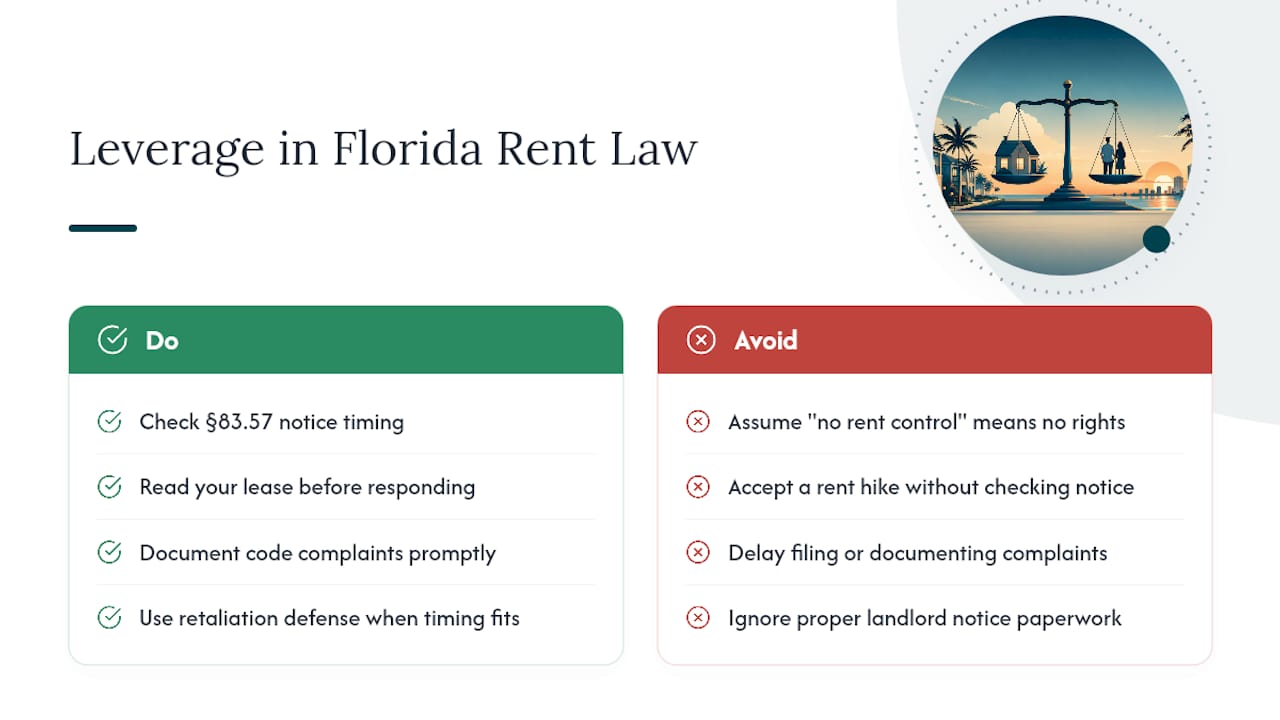
Here’s the uncomfortable part: this system works against tenants who don’t read their lease and works against landlords who don’t paper their notices correctly. I’d argue the retaliation defense is the most underused tool in the entire framework. Tenants sit on documented code complaints for months, then get hit with a rent hike, and never connect the timing to a legal defense because they assume Florida’s lack of rent control means they have no legal footing at all. They have more than they think, just not in the form of a price ceiling.
The 2023 changes to municipal preemption authority closed a door that was already mostly shut, but they sent a clear signal: Tallahassee isn’t interested in letting cities experiment with rent stabilization, even in a genuine housing emergency. Renters who want real protection in this market need to get fluent in notice timing and documentation, because that’s the terrain the law actually gives them to fight on.
— Ayman
Sources
- Florida Senate — Statutes: 125.0103
- Florida Legislature — Fla. Stat. § 83.57
- The Florida Bar — Consumer pamphlet: Rights and duties of tenants and landlords (tip014)
- Florida House — Statute § 166.043
- HUD — Fair Housing (overview)