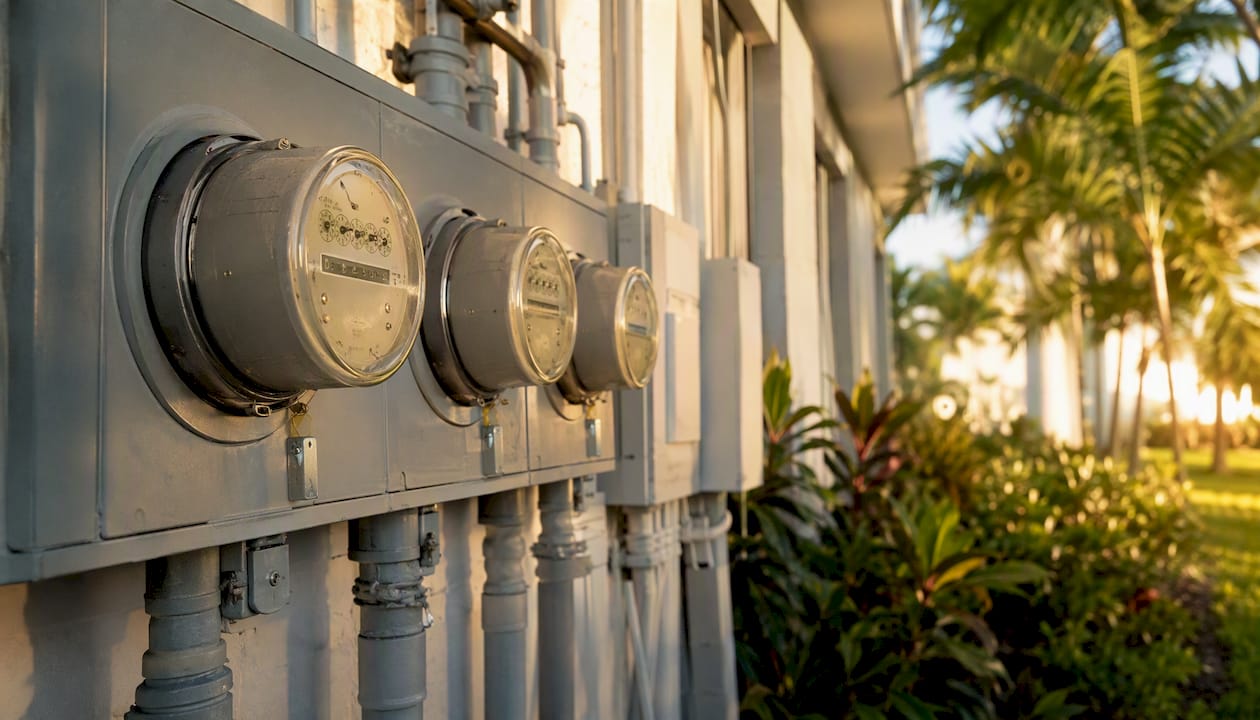
In most U.S. apartments, you pay electricity, gas, and internet directly to the utility company, while your landlord covers water, sewer, and trash — but your lease is the only document that actually controls that split. Billing setups fall into three main types: individually metered (your own account, your own meter), submetered (landlord-billed based on your actual unit usage), and master-metered (landlord pays one bill, then charges you back through RUBS or a flat fee). Before you sign anything, request the last 12 months of utility bills for that specific unit.
The three billing setups you’ll most often see:
- Individual meter: You open your own account with the utility company and pay them directly. Your usage, your bill.
- Submetering: The landlord installs unit-level meters and bills you based on what your unit actually consumed, usually with a small admin fee added.
- Master meter with RUBS or flat fee: One meter covers the whole building. The landlord splits the total bill across units using a formula (RUBS) or charges a fixed monthly amount regardless of what you use.
Pro Tip: Ask the property manager for 12 months of prior utility bills for your specific unit, not just the building average. That single request gives you a more accurate forecast than any national average.
Key Takeaways
Apartment utility billing in the U.S. follows no single standard, so your lease language and billing method determine your actual monthly cost more than any national average.
| Point | Details |
|---|---|
| Lease language controls the split | “Utilities included” means nothing without a specific list; always confirm which utilities and whether caps apply. |
| RUBS vs. submetering trade-off | Submetering bills your actual usage; RUBS estimates your share of a building total, which can feel unfair to low-usage renters. |
| Budget at the high end | Basic utilities for a 1-bedroom run $130–$226/month; add $40–$90 for internet and use the upper range as your planning figure. |
| First bill is often larger | Your first bill may cover 6–8 weeks of service; plan for it rather than treating it as an error. |
| Cynthiagardens offers clarity | Cynthiagardens provides transparent pricing, sample utility information on request, and online leasing tools for Boca Raton one-bedroom renters. |
Table of Contents
- How apartment utility billing actually divides responsibility
- Common apartment utilities and typical U.S. cost ranges for budgeting
- How utilities are billed: the four main methods compared
- Lease disclosure language and important U.S. state and city rules to check
- How to budget for utilities and practical ways to reduce costs
- What to do when a bill looks wrong
- What to expect when setting up, transferring, or closing utility service
- Questions to ask your property manager before signing
- What transparent properties actually do differently
- Transparent billing and leasing at Cynthiagardens
- Sources
How apartment utility billing actually divides responsibility
The default pattern in U.S. rentals is tenant-paid electricity, natural gas, and internet, with landlords covering water, sewer, and trash. That split exists partly because water and trash are often billed to the property by the municipality, making it simpler for landlords to absorb them. But “simpler” doesn’t mean universal.
Master-metered buildings, older multifamily properties, and markets with high water costs frequently push water and sewer costs back to tenants through RUBS or a separate line item. In some cities, landlords bundle everything into a higher base rent and advertise the unit as “utilities included.” That phrase sounds like a deal, but it can mean different things in different leases.
Watch for these lease clause patterns:
- “Tenant responsible for all utilities” — you pay everything, including water and trash
- “Water and sewer included” — landlord covers those two, you pay the rest
- “Utilities included up to $X per month” — you pay overages above the cap
- “Tenant billed for utilities via RUBS” — master-metered building, formula-based allocation
The phrase “utilities included” in a listing headline means nothing until you read the lease. Ask which specific utilities are included, whether there’s a cap, and how overages are handled. A unit advertised as utilities-included that carries a $75/month cap on water can still hit you with a surprise charge in summer.
For a localized breakdown of what landlords typically include in Boca Raton rentals, the Boca Raton renter’s guide covers the regional picture in detail.
Common apartment utilities and typical U.S. cost ranges for budgeting
Zillow reports that median monthly utility costs for U.S. renters run around $150 for basic services (electricity, water, gas), with internet adding $40–$90 on top. Aggregated guides place one-bedroom basic utilities roughly in the $130–$226 per month range, excluding internet. Electricity is consistently the largest single share of the costs.
| Utility | Typical Monthly Range | Main Cost Drivers | Who Often Pays |
|---|---|---|---|
| Electricity | $75–$150 | HVAC, apartment size, climate | Tenant |
| Natural gas | $20–$100 | Heating type, winter usage, region | Tenant or landlord |
| Water & sewer | $20–$50 | Occupancy, local rates | Landlord (often) |
| Trash/recycling | $10–$20 | Municipal rates | Landlord (often) |
| Internet | $40–$90 | Provider, speed tier | Tenant |
| Cable/streaming | $15–$75 | Bundle vs. streaming-only | Tenant |
The EIA’s residential energy data confirms that space heating and cooling dominate household energy use, which explains why electricity bills in Florida can spike in July and gas bills in Minnesota can triple in January.
One-line saving tips per utility:
- Electricity: Set your thermostat to 78°F in summer and 68°F in winter; each degree of adjustment saves roughly 3% on cooling costs.
- Natural gas: EIA natural gas data shows sharp winter peaks — budget at the high end of the range for November through February.
- Water: Fix dripping faucets immediately; a slow drip can add $10–$20 per month to a water bill.
- Internet: Bundling with a streaming service often costs less than paying both separately; check whether your building has a bulk-rate deal with a provider.
- Electricity (lighting): Switching to LED bulbs cuts lighting costs by up to 75% compared to incandescent.
For a deeper look at energy-efficient apartment features that reduce bills before you even move in, that resource covers what to look for in a unit.
How utilities are billed: the four main methods compared
Understanding the billing method in your building matters more than knowing the national average, because the method determines whether your bill reflects what you actually used.
Individual metering is the cleanest setup. You have your own account with the utility company, you pay based on your meter, and there’s no landlord in the middle. This is standard in newer construction and single-family rentals.
Submetering puts unit-level meters inside the building, but the landlord holds the master account. They read your submeter and bill you for your actual consumption, often adding an admin or billing fee. Conservice’s comparison of RUBS vs. submetering notes that submetering is more accurate and conservation-friendly but requires upfront hardware investment that many older buildings can’t justify.
Master meter with RUBS (Ratio Utility Billing System) is the most common setup in older multifamily buildings. The landlord pays one bill for the whole property, then allocates costs across units using a formula. According to the National Center for Housing Management, RUBS formulas typically use occupancy count, square footage, or bedroom count, sometimes in combination.
A simple RUBS example: a building’s monthly water bill is $2,000. Your unit is 750 sq ft in a building with 10,000 total sq ft. Your share = (750 / 10,000) × $2,000 = $150. If the formula weights by occupancy instead, a two-person unit pays more than a one-person unit of the same size.
Flat fee / utilities included means you pay a fixed monthly amount regardless of usage. Predictable for budgeting, but it removes any financial incentive to conserve.
| Method | Accuracy | Upfront/Setup Cost | Conservation Incentive | Admin Transparency | Charge Calculation |
|---|---|---|---|---|---|
| Individual meter | Highest (actual usage) | None for tenant | Strong | High (utility company bills you directly) | Your meter reading × rate |
| Submetering | High (unit-level actual) | Landlord bears hardware cost | Strong | Moderate (depends on landlord billing detail) | Your submeter reading × rate + admin fee |
| RUBS | Low (estimated share) | Low (no hardware) | Weak | Variable (formula must be disclosed) | Building total × your allocation factor |
| Flat fee / included | None | None | None | Low | Fixed monthly amount |
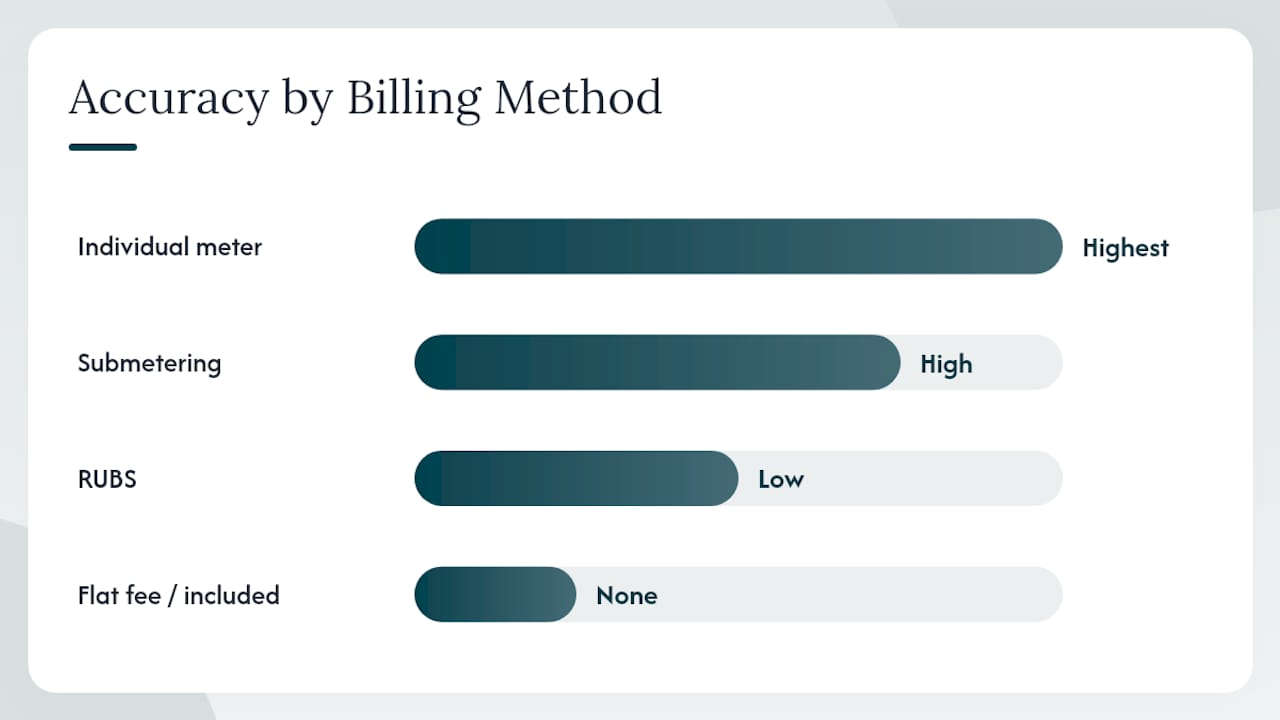
RUBS is common in older, master-metered buildings precisely because it avoids expensive retrofits. The trade-off: a low-usage renter in a RUBS building subsidizes high-usage neighbors, which is why some states have moved to restrict or regulate it.
Lease disclosure language and important U.S. state and city rules to check
Most states don’t prohibit RUBS, but several require landlords to disclose the billing method, the allocation formula, and sometimes the building’s total utility costs before a lease is signed. The rules vary enough that checking your state’s tenant-rights page is worth the five minutes.
State and city examples:
- California: Landlords using RUBS must disclose the billing method and formula in the lease. Submetering is permitted and regulated under the California Public Utilities Commission.
- Texas: No statewide cap on RUBS, but landlords must disclose utility billing arrangements in writing. The Texas Property Code requires that utility cutoff procedures follow specific notice requirements.
- Connecticut: State law requires landlords to disclose whether utilities are separately metered or master-metered before a tenant signs. Tenants have the right to request billing records.
- Seattle / Washington: The Seattle Tenants Union documents that landlords billing tenants for master-metered utilities must follow specific notice and billing requirements under Seattle Municipal Code. Tenants can dispute charges through the Office of Housing.
What to look for in a lease disclosure:
- A named billing method (individual meter, submetering, RUBS, flat fee)
- The specific formula or allocation factors used if RUBS applies
- Whether an admin or billing fee is added, and the maximum amount
- The utility company’s name and account contact if you’re setting up your own service
Sample lease language worth requesting: “Resident shall be billed for [water/sewer/trash] based on a ratio utility billing system using [occupancy/square footage/bedroom count] as the allocation factor. The property’s total monthly utility cost and each resident’s calculated share will be provided with each monthly statement.”
If your lease doesn’t include language like this for a RUBS building, ask for it in writing before signing.
How to budget for utilities and practical ways to reduce costs
The simplest budgeting formula: rent + estimated utilities = true monthly housing cost. Use the high end of the ranges for your unit size, not the median, because you want a buffer.
A rough starting point by unit size, using the ranges above:
- Studio: $100–$150/month for basic utilities (electricity, water, gas)
- 1-bedroom: $130–$226/month for basic utilities
- 2-bedroom: $180–$280/month for basic utilities
Add $40–$90 for internet and you have a realistic total. In a climate like South Florida, air conditioning pushes electricity toward the top of its range from May through October.
High-impact savings actions renters can take immediately:
- Set a programmable or smart thermostat schedule — cooling an empty apartment all day is the single biggest waste in warm climates.
- Replace any remaining incandescent bulbs with LEDs on move-in day.
- Plug electronics into smart power strips that cut standby power when devices are off.
- Run the dishwasher and laundry only on full loads, and use cold water for laundry.
- Check for leaks at faucets and the toilet flapper on move-in day and report them immediately through the maintenance request process.
- Ask your internet provider about autopay discounts or check whether the building has a bulk-rate deal.
Pro Tip: In a RUBS building, your personal conservation habits have limited impact on your bill because you’re sharing a pool. Focus your savings efforts on electricity, which is almost always individually metered.
What to do when a bill looks wrong
A bill that seems too high isn’t always an error, but it’s always worth checking. Work through these steps before assuming the worst.
- Pull your last 12 months of bills and compare the current charge to the same month last year. A spike in July is normal in a hot climate; a spike in March is a red flag.
- Request an itemized breakdown from your property manager or the utility company. For RUBS buildings, ask for the building’s total bill and the allocation formula used that month.
- Photograph your meter (or ask for a submeter reading in writing) and compare it to the reading on the bill. A discrepancy between the two is the clearest evidence of a billing error.
- Document every communication in writing. Follow up any phone call with an email summarizing what was discussed and agreed.
- Contact the utility company directly if you have your own account. Most utilities have a formal dispute process and will re-read a meter at no charge if you request it.
- Escalate to local tenant advocacy if the property manager doesn’t respond within a reasonable timeframe. The Seattle Tenants Union example above shows that city-level resources exist in many markets; search “[your city] tenant rights utility billing” for local equivalents.
Email template for requesting a breakdown:
“Hi [Property Manager Name], I’m writing to request an itemized breakdown of my utility charge for [month/year]. Specifically, I’d like to see the building’s total utility cost for that period, the allocation formula applied to my unit, and the resulting per-unit calculation. Please also confirm the meter read dates used. Thank you.”
Keep a copy of every response. If you escalate to a housing authority or tenant union, that paper trail is what makes your case.
What to expect when setting up, transferring, or closing utility service
Move-in and move-out are when billing surprises hit hardest. A little preparation prevents most of them.
At move-in:
- Contact utility providers at least two weeks before your move-in date to schedule service activation. Some providers require 5–7 business days.
- Expect a security deposit if you have no prior account history with that utility. Deposits typically range from one to two months of estimated usage.
- Your first bill may cover more than one month if the billing cycle doesn’t align with your move-in date. Plan for a larger first bill that may reflect 6–8 weeks of service.
- Photograph every meter on move-in day and email the readings to yourself. That timestamp is your baseline.
At move-out:
- Request a final meter read in writing at least a week before your move-out date.
- Provide a forwarding address to both the utility company and your property manager so final bills reach you.
- Keep your account open until the day after your lease ends, not the day before, to avoid any gap in responsibility.
- Reconnection fees (if service was ever interrupted) typically run $25–$100 depending on the provider. Late fees on utility bills are usually 1%–2% of the outstanding balance per month.
Documents and dates to record:
- Move-in meter readings (photographed and dated)
- Account numbers and customer service contacts for each utility
- The date service was activated and the first billing cycle end date
- Move-out meter readings (photographed and dated, ideally with the property manager present)
Questions to ask your property manager before signing
Print this list and bring it to your walkthrough or send it by email before you commit.
-
Which utilities are included in the rent, and which am I responsible for?
Expected answer: A specific list (e.g., “water, sewer, and trash are included; electricity, gas, and internet are tenant-paid”). -
Is billing based on individual metering, submetering, or RUBS?
Expected answer: One of those three methods, with a brief explanation. If RUBS, ask for the allocation formula. -
Can I see 12 months of utility bills for this specific unit?
Expected answer: Yes. If the manager hesitates or offers only a building average, that’s a signal to push harder or reconsider. -
Are there any admin or billing fees added to utility charges?
Expected answer: A flat dollar amount or percentage cap. Anything over $10–$15/month is worth negotiating. -
What utility company serves this building, and do I set up my own account?
Expected answer: The provider name and whether you call them directly or go through the property. -
Is there a utility cap on any included utilities, and what happens if I exceed it?
Expected answer: A specific dollar cap and a clear explanation of how overages are billed. -
How are utility disputes handled, and what’s the turnaround time for a billing question?
Expected answer: A named contact and a stated response window (24–48 hours is reasonable).
Pro Tip: If a manager can’t answer the billing-method question on the spot, that’s not necessarily a dealbreaker — but ask them to put the answer in writing before you sign. Verbal assurances about utility costs are worth nothing once the lease is executed.
What transparent properties actually do differently
The gap between a property that handles utility billing well and one that handles it poorly isn’t usually about which billing method they use. It’s about whether they treat billing information as something renters are entitled to or something they’d rather not discuss.
Properties that get this right share a few consistent habits. They provide 12 months of unit-level bills before signing, not after. They use itemized monthly statements that show the building total, the allocation formula, and the resulting per-unit charge, so a renter can verify the math independently. When submetering is feasible, they install it during renovations rather than defaulting to RUBS indefinitely. And their leases name the billing method explicitly, not in vague “utilities may be billed separately” language that leaves renters guessing.
The practical effect for renters is significant. When you can see the formula and the building total, a high bill becomes a math problem you can check rather than a black box you have to accept. Disputes drop because the information needed to resolve them is already in the tenant’s hands. Budgeting becomes more accurate because historical unit bills give a real baseline, not a national average that may not apply to your building’s age, insulation, or HVAC system.
The properties that resist sharing this information tend to be the ones where the numbers don’t hold up to scrutiny. That’s not a coincidence.
Transparent billing and leasing at Cynthiagardens
Cynthiagardens offers one-bedroom apartments in Boca Raton with pricing built around clarity, not fine print. For renters who’ve spent time untangling RUBS formulas and ambiguous lease language, the difference is immediate: no hidden fees, no surprise line items, and leasing tools that let you get answers before you commit.
- Virtual tours available anytime, so you can evaluate the unit and ask billing questions before setting foot on property
- Sample utility information available on request so you can budget your true monthly cost before signing
- Online lease documents with clearly labeled utility responsibilities
- AI chat and voice support to answer leasing and billing questions in real time
If you’re comparing one-bedroom options in Boca Raton and want to see exactly what’s included, browse available apartments and features or check the 1-bedroom apartments with utilities included page for current availability and pricing.
Sources
These are the most reliable places to verify utility cost averages, state rules, and tenant rights before you sign or dispute a bill.
- RUBS: Ratio Utility Billing System Explained for 2026 – National Center for Housing Management
- Eia
- How Much Are Utilities in an Apartment? | Zillow
- Average Utility Bills Per Month for an Apartment – Budget Seniors
- Seattle Utility Billing
Recommended
- Ultimate Guide to Utility Costs for Apartments in 2024 – Luxury Apartments for Rent in Boca Raton | Premium Boca Raton Apartments | Aapartments Boca Raton
- Understanding utilities in rent: A Boca Raton renter’s guide
- Find 2 Bedroom Apartments Utilities Included | Easy Budgeting – Luxury Apartments for Rent in Boca Raton | Premium Boca Raton Apartments | Aapartments Boca Raton