Table of Contents
- What Are Tri-Rail Accessible Apartments for Young Professionals?
- Transit-Oriented Development in South Florida: Why Location Matters
- Best Neighborhoods for Young Professionals Along Tri-Rail
- Commuter-Friendly Apartments South Florida: Cost Savings vs. Lifestyle
- Affordable Housing South Florida for Young Professionals
- Step-by-Step Guide to Renting a Tri-Rail Accessible Apartment
- Amenities and Lifestyle: What to Look for in Your New Community
- Accessibility Features and Station Area Infrastructure
Tri-Rail Accessible Apartments for Young Professionals
Last Updated: July 25, 2026
When young professionals relocate within South Florida, the decision hinges on balancing commute time against lifestyle quality and affordability. Transit-oriented development along the Tri-Rail corridor has fundamentally reshaped how a new generation of workers approaches housing, transforming neighborhoods into vibrant communities where walkability, accessibility, and convenience converge. This guide from Cynthia Gardens explores what makes Tri-Rail accessible apartments for young professionals the smartest choice for those entering the workforce or advancing their careers in the Miami metropolitan area.
Young professionals no longer accept the false choice between an affordable apartment far from work and an expensive unit close to it. Tri-Rail stations now anchor mixed-use neighborhoods that deliver both.
What Are Tri-Rail Accessible Apartments for Young Professionals?
Tri-Rail accessible apartments represent residential units located within walking distance of South Florida Regional Transportation Authority (SFRTA) stations. For young professionals, this proximity eliminates the car-dependent lifestyle that dominates much of Florida. You can walk to the station, ride 30-60 minutes to your job in Miami or downtown areas, and reclaim hours of commute time each week.
The term "accessible" carries multiple meanings. First, it describes physical accessibility, units designed to meet ADA standards and station infrastructure built to accommodate people with mobility needs. Second, it means financial accessibility: apartments near transit stations often cost less than comparable units in car-dependent neighborhoods because you’re not paying for premium parking or bearing fuel costs. Third, it signals lifestyle accessibility: you can reach your job, social venues, and daily necessities without a vehicle.
Tri-Rail serves three main corridors: the Main Line from Miami to West Palm Beach, the Airport Line connecting MIA to downtown, and the Coastal Link serving Miami Beach. Young professionals working in downtown Miami, Brickell, or the Miami International Airport area find the greatest time savings. A commuter living in Boca Raton near Tri-Rail can reach downtown Miami in under 45 minutes, far faster than driving during rush hour.
The real advantage isn’t just speed. It’s what you do during the commute. You can work, read, or sleep instead of gripping a steering wheel in traffic. Over a year, that’s 200+ hours of reclaimed time, equivalent to five full work weeks.
Transit-Oriented Development in South Florida: Why Location Matters
Transit-oriented development, or TOD, describes neighborhoods intentionally built around public transportation hubs. Unlike sprawling suburbs where you must own a car to function, TODs cluster residential, retail, dining, and office space within a 15-minute walk of a station, creating density without isolation.
South Florida’s Tri-Rail TOD projects represent a fundamental reimagining of regional development. For decades, South Florida grew outward through sprawl and car dependency. The transit-oriented approach grows upward and inward, creating walkable communities that reduce traffic, lower emissions, and make housing more affordable by eliminating parking as a major cost driver.
The infrastructure improvements supporting these developments are substantial. SFRTA [station area(/best-neighborhoods-in-boca-raton/) studies and master plans | sfrta.org] document public investment flowing into these neighborhoods: new sidewalks, bike lanes, street lighting, and public plazas. Private developers follow, knowing that station proximity commands premium rents and higher occupancy rates.
For young professionals, TODs offer lifestyle amenities that traditional apartment complexes don’t. You’re embedded in a neighborhood where you can walk to coffee shops, restaurants, gyms, and retail without a car. The 15-minute city concept, essential services reachable in 15 minutes, becomes reality in well-developed TODs.
The best TODs combine residential density with ground-floor retail and services. This creates vitality: people on the streets, businesses thriving, and neighborhoods that feel genuinely alive.
Best Neighborhoods for Young Professionals Along Tri-Rail
The Tri-Rail corridor spans multiple distinct neighborhoods, each with its own character, price point, and appeal for young professionals. Successful renters evaluate specific station areas based on their commute destination, lifestyle preferences, and budget.
Boca Raton Station Area
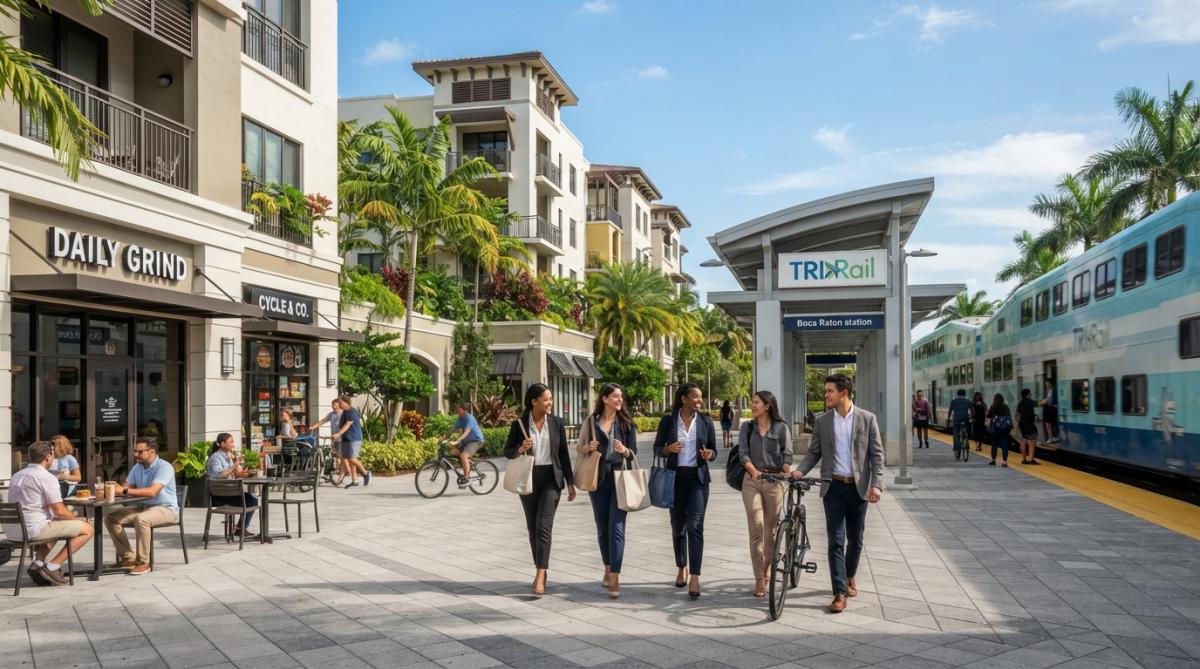
Boca Raton represents the northern anchor of the Tri-Rail Main Line, and its station area has undergone significant revitalization. The neighborhood attracts young professionals working in downtown Miami or Brickell because the 45-minute commute is offset by a genuinely walkable, upscale community with restaurants, fitness centers, and retail.
Cynthia Gardens exemplifies the modern apartment community thriving in this TOD context. Located minutes from the Boca Raton Tri-Rail station, the community offers one-bedroom apartments with high-end finishes, stainless steel appliances, quartz countertops, and modern layouts. Residents enjoy maintenance-free living in a garden-style setting with a resort-style pool and lush landscaping, all positioned within minutes of FAU and the beach. For young professionals seeking a serene, refined living environment without suburban sprawl isolation, Cynthia Gardens delivers the blend of accessibility and tranquility that defines successful TOD living.
The Boca Raton station area also benefits from proximity to Florida Atlantic University, which creates a young, educated demographic and supports diverse dining and entertainment options.
Hialeah and Miami Station Corridors
Hialeah represents a more affordable entry point for young professionals willing to accept a slightly longer commute in exchange for lower housing costs. The station area has attracted investment in recent years, with new residential projects and retail development transforming what was historically a car-dependent neighborhood. Young professionals working in Brickell or downtown Miami find that a 50-minute commute from Hialeah is often shorter than driving from a cheaper suburb, and the walkable station area offers significantly more lifestyle amenities.
Miami’s multiple stations, including Buena Vista, Allapattah, and the downtown Miami station, serve professionals working in the central business district. These locations offer the shortest commutes on the Tri-Rail system, sometimes under 20 minutes, though housing costs are correspondingly higher. The Miami stations also connect directly to Metrorail and bus networks, creating a true multimodal transportation hub.
The further north you go on the Tri-Rail line, the lower housing costs become, but commute times to downtown Miami increase proportionally. A $500/month savings in rent can evaporate if your commute time increases by 30 minutes daily. Calculate the true cost-benefit before assuming northern locations are automatically cheaper.
Commuter-Friendly Apartments South Florida: Cost Savings vs. Lifestyle
The financial case for transit-adjacent living is straightforward. Young professionals typically compare rent prices in isolation, missing the total cost-of-living picture that includes transportation.
A typical young professional earning $55,000-$75,000 annually might budget $1,200-$1,500 monthly for rent. If they choose a car-dependent neighborhood 20 miles from work, they add:
- Car payment or lease: $250-$400/month
- Insurance: $100-$150/month
- Fuel: $150-$200/month
- Maintenance and repairs: $100/month
- Parking at work (if applicable): $50-$200/month
That’s $650-$950 monthly, essentially doubling their housing cost. A Tri-Rail accessible apartment at $1,400/month becomes affordable when you eliminate the car entirely. You’re also recovering 8-10 hours weekly that you’d spend driving, allowing time for personal projects, additional work, or better mental health.
Young professionals living in walkable TODs report higher life satisfaction, more social connections, and better physical health. They walk more because daily errands don’t require a car and are embedded in neighborhoods with other young professionals, creating natural social networks.
Affordable Housing South Florida for Young Professionals
For young professionals earning $50,000-$80,000 annually, truly affordable apartments, those consuming 30% or less of gross income, are increasingly scarce in coastal areas. However, Tri-Rail accessible apartments offer the best path to affordability because they eliminate transportation costs.
Workforce housing initiatives have expanded along the Tri-Rail corridor in recent years. Florida Housing Finance Corporation programs and workforce housing definitions establish guidelines for developments that reserve units for workers earning 80-120% of area median income. Young professionals should investigate whether specific apartment communities participate in workforce housing programs, which often offer below-market rents in exchange for income verification.
Station area infrastructure improvements also reduce living costs indirectly. New sidewalks, bike lanes, and improved lighting make car-free living safer and more convenient. Some TODs now include bike-share programs and shuttle services to transit stations, further reducing transportation expenses.
Young professionals earning $50,000-$70,000 annually who work in downtown Miami, Brickell, or the airport area. Your commute time savings and eliminated car costs make Tri-Rail accessible apartments genuinely affordable, often cheaper than a comparable car-dependent location.
Step-by-Step Guide to Renting a Tri-Rail Accessible Apartment
Finding and securing an apartment near Tri-Rail requires a systematic approach optimizing for transit access, walkability, and commute time.
Evaluate Your Commute Needs and Budget
Start by mapping your actual commute. Open Google Maps and search "transit from [station area] to [your workplace]." Check travel times during peak hours (7-9 AM and 4-6 PM), not midday when trains run empty.
Calculate your total transportation budget. If you currently own a car, add up monthly payments, insurance, fuel, and maintenance. This number is what you can afford to spend on rent while maintaining your current standard of living.
Document your lifestyle priorities: gym access, pet-friendly housing, guest space, and other preferences. These should inform which neighborhoods and communities you target.
Research Station Areas and Walkability
Visit each station area in person, preferably during evening hours when you’d actually be using the neighborhood. Walk from the station to nearby apartments. How far is it really? Are sidewalks well-lit and maintained? Do you feel safe?
Use Walk Score (Walk Score walkability analysis tool) to evaluate specific addresses. Scores above 70 indicate "very walkable" neighborhoods where most errands can be accomplished on foot.
Research what retail and services exist within walking distance: grocery stores, coffee shops, restaurants, and gyms. Check whether the station area has bike infrastructure, which expands your practical range beyond walking distance.
Review Lease Terms and Move-In Costs
Understand exactly what you’re committing to before signing. Request a lease term of 12 months if possible; shorter leases often carry premium pricing. Ask about move-in specials or flexibility on deposits.
Clarify all move-in costs in writing: first month’s rent, last month’s rent, security deposit, application fees, and any community-specific charges. Ask about lease break policies and pet policies, including breed restrictions, weight limits, and monthly pet fees.
Amenities and Lifestyle: What to Look for in Your New Community
The apartment itself matters less than the community it’s embedded in. A beautiful unit in an isolated complex feels smaller and lonelier than a modest apartment in a vibrant neighborhood. Young professionals should prioritize community amenities and neighborhood context over individual unit features.
Essential amenities include fitness facilities, community spaces that encourage socializing, and proximity to food and entertainment. Cynthia Gardens exemplifies this approach: the resort-style pool and lush landscaping create gathering spaces where residents interact, and the garden-style layout maintains privacy while fostering community.
Consider whether the community offers services that reduce friction: package receiving, car-sharing programs, or shuttle services to transit stations. Evaluate the management company’s responsiveness by reading resident reviews about maintenance response times and accessibility.
Proximity to your actual lifestyle matters more than amenities you’ll never use. If you’re a fitness enthusiast, a community near excellent running trails is better than one with a pristine gym you never visit.
Visit a potential community at different times: weekday morning, weekday evening, and weekend. You’re assessing whether the neighborhood feels safe and vibrant during the times you’ll actually be there.
Accessibility Features and Station Area Infrastructure
Accessibility means different things to different people. For some, it’s physical accessibility with elevators and ADA-compliant units. For others, it’s proximity to transit and walkable streets. For most young professionals, both matter.
When evaluating apartments, confirm that the unit meets your accessibility needs. If you use mobility devices, verify accessible entrances, hallways, and bathrooms. Ask about accessible parking availability.
Station area infrastructure directly impacts daily accessibility. Tri-Rail stations vary in their amenities and accessibility features. SFRTA station facility information and accessibility features documents what each station offers. Sidewalk quality and pedestrian infrastructure matter significantly; newer TOD developments typically include complete street improvements with wide sidewalks, street trees, lighting, and traffic calming.
Bike infrastructure expands accessibility beyond walking distance. Protected bike lanes, bike parking, and bike-share programs make non-car transportation viable for a larger radius around stations.
The shift toward transit-oriented development represents a genuine opportunity for young professionals in South Florida. Rather than accepting the traditional choice between affordability and lifestyle, Tri-Rail accessible apartments deliver both. Cynthia Gardens exemplifies this opportunity: a refined, maintenance-free community positioned minutes from the Boca Raton Tri-Rail station, offering modern one-bedroom apartments with high-end finishes, a resort-style pool, and lush landscaping. For professionals seeking to eliminate the car-dependent lifestyle while maintaining a peaceful, serene living environment, Cynthia Gardens combines genuine accessibility with uncompromised quality. Schedule a tour today and experience how transit-oriented living transforms your relationship with work, time, and community.
Frequently Asked Questions
What are the main benefits of living in Tri-Rail accessible apartments for young professionals?
Tri-Rail accessible apartments offer significant commute time reduction, lower transportation costs compared to driving, and access to walkable neighborhoods with retail and dining options. Young professionals benefit from the ability to work in Miami or other employment hubs while living in more affordable, quieter areas. Transit-oriented development communities near Tri-Rail stations typically feature modern amenities, mixed-use environments, and proximity to local landmarks, making them ideal for those balancing career advancement with lifestyle quality.
How do commuter-friendly apartments in South Florida save money compared to traditional housing?
Commuter-friendly apartments near Tri-Rail eliminate or significantly reduce car ownership costs, including fuel, insurance, maintenance, and parking. Monthly SFRTA ridership passes cost considerably less than daily driving expenses. Additionally, many transit-adjacent properties offer competitive rental rates in emerging neighborhoods, offsetting any premium for proximity to stations. When you factor in time savings and reduced vehicle wear, residents often find their total cost of living decreases despite similar base rent to distant suburban options.
Which South Florida neighborhoods offer the best affordable housing options for young professionals near Tri-Rail?
Boca Raton, Hialeah, and Miami station areas are actively developing workforce housing and market-rate rental options targeting young professionals. These neighborhoods combine affordability with accessibility to employment centers, educational institutions like FAU, and lifestyle amenities. Station area studies and infrastructure improvements in these corridors indicate continued investment in residential units and mixed-use developments. Pricing and availability vary by specific location and project; contact local property managers or visit individual community websites for current options and move-in specials.
What accessibility features should I prioritize in a Tri-Rail accessible apartment?
Beyond Tri-Rail station proximity, evaluate walkability to the platform, elevator access, accessible parking, and station area infrastructure like sidewalks and crossings. Within the apartment community, check for accessible units if needed, responsive management for maintenance requests, pet policies if you have animals, and proximity to retail, dining, and services. Many transit-oriented developments now include universal design features. Visit communities in person or request detailed information about specific accessibility features, amenities, and management responsiveness before signing a lease.