Table of Contents
- Top Apartment Complexes in Miami FL: Overview & Comparison
- Luxury Apartments in Miami FL: High-End Communities Worth Considering
- Pet-Friendly Apartments in Miami FL: Policies & Hidden Costs
- Affordable Apartments in Miami FL: Finding Value Without Sacrificing Quality
- Miami FL Neighborhoods for Apartments: Location Guide & Commute Matching
- Lease Terms, Flexibility & Early Termination: What Apartment Complexes Actually Offer
- Virtual Tours, Resident Reviews & Transparency: How to Verify Before Committing
- Choosing the Right Apartment Complex in Miami FL for Your Lifestyle
Apartment Complexes in Miami FL: 2026 Guide
Last Updated: July 24, 2026
The Miami rental market remains highly competitive, with apartment complexes ranging from waterfront luxury towers to garden-style communities. Three factors separate exceptional rentals from mediocre ones: location match, transparent pricing, and management responsiveness. At Cynthia Gardens in Boca Raton, we’ve learned that most renters make decisions based on incomplete information, missing critical details about hidden fees, response times, and whether promises hold up in practice.
This guide cuts through marketing and shows exactly what to expect from apartment complexes in Miami FL, including neighborhood breakdowns, what luxury costs, and how to verify credibility before signing.
Top Apartment Complexes in Miami FL: Overview & Comparison
Finding the right apartment complex requires looking beyond glossy photos. The best communities combine professional management, transparent pricing, and locations matching your daily routine. Miami’s landscape includes high-rise downtown towers with rooftop pools and garden-style communities offering privacy, each serving different priorities: young professionals value walkability and nightlife; families prioritize schools and quiet streets; remote workers need reliable internet and flexible leases.
Quick Comparison Table
| Community Type | Best For | Key Features | Location Advantage |
|---|---|---|---|
| Downtown/Brickell High-Rise | Urban professionals, nightlife seekers | Rooftop amenities, walkable districts, 24/7 services | Walking distance to restaurants, culture, jobs |
| Garden-Style (Boca/Coral Springs) | Quiet seekers, families, remote workers | Landscaped grounds, privacy, resort pools | Near FAU, beaches, suburban peace |
| Luxury Mid-Rise | Affluent renters, design-focused | High-end finishes, concierge, curated amenities | Waterfront or premium neighborhoods |
| Affordable Complexes | Budget-conscious renters, students | Basic amenities, functional design | Emerging neighborhoods, slightly longer commutes |
How We Evaluated These Properties
We assessed each property across seven criteria: management response time to maintenance requests, transparency about fees and lease terms, verified resident satisfaction, amenity quality and maintenance, neighborhood safety and walkability, proximity to employment centers, and cost of living. The most telling metric is maintenance response time, communities promising 24-hour response but taking five days reveal their true priorities. We weighted transparency heavily; communities clearly disclosing move-in costs, pet fees, and early termination policies build trust immediately.
Luxury Apartments in Miami FL: High-End Communities Worth Considering
Luxury apartments in Miami occupy a specific market segment with premium finishes, curated amenities, and commanding locations. Today’s luxury renters expect personalized service, smart home technology, and amenities reflecting lifestyle. High-end finishes remain important but are table stakes, not differentiators.
The most sought-after luxury properties offer three things simultaneously: distinctive architecture or location, professional property management with fast response times, and amenities enhancing daily living. Concierge services, private fitness facilities, and curated community events matter more than multiple rooftop pools.
Research from Zillow’s Luxury Market Report 2026 shows luxury renters prioritize location and service quality above unit-level features. A well-managed community in a premium neighborhood outperforms a poorly-managed luxury tower in a secondary location.
Standout Luxury Properties & Their Trade-Offs
Grand Station (Downtown Miami) delivers cosmopolitan living with high-end finishes and social-first design. The location is unbeatable for urban professionals, walking distance to cultural attractions, restaurants, and employment centers. The trade-off: downtown living means noise, foot traffic, and premium pricing.
Atlantico at Kendall (South Miami) offers luxury apartment homes with resort-inspired amenities, gourmet kitchens, and resort-style pools. The community appeals to renters seeking suburban luxury with space, though Kendall is a 25-30 minute drive from downtown Miami.
The Boulevard (MiMo District) positions itself as sophisticated living in Miami’s most vibrant neighborhood with bay views and exceptional amenities.
Before committing to any luxury complex, request a list of recent maintenance requests and response times. Ask residents about actual service quality. Luxury pricing should mean luxury service; if response times exceed 48 hours, the community is cutting corners.
Pet-Friendly Apartments in Miami FL: Policies & Hidden Costs
Pet-friendly apartments are common, but "pet-friendly" is a spectrum. Some genuinely welcome pets with reasonable fees; others charge prohibitive fees or enforce breed restrictions eliminating most dogs.
Understanding Pet Fees & Breed Restrictions
Pet fees typically include three components: one-time pet deposit ($200-$500 per pet), monthly pet rent ($25-$75 per pet), and breed or size restrictions. A two-year lease with two dogs can mean $600-$1,800 in additional pet costs.
Breed restrictions are the hidden barrier. Many communities claim pet-friendliness but exclude pit bulls or German Shepherds based on insurance requirements. Verify breed policies in writing before committing.
Monthly pet rent compounds over time. A $50/month pet rent on a two-year lease equals $1,200 in additional cost. Ask if pet rent increases annually and whether it applies per-pet.
The most transparent pet-friendly communities list breed policies and fee structures upfront on websites.
Affordable Apartments in Miami FL: Finding Value Without Sacrificing Quality
Affordable apartments in Miami exist through strategic neighborhood selection and timing. The most affordable complexes are in emerging neighborhoods, near major transit corridors, or slightly further from downtown, not necessarily lower quality, just smarter location choices.
Cost of Living Breakdown by Neighborhood
Rental prices vary dramatically by neighborhood. Downtown Miami and Brickell command $1,800-$2,500 for one-bedrooms. Wynwood and MiMo range $1,400-$2,000. Emerging areas like Allapattah and Buena Vista offer one-bedrooms at $1,000-$1,400, though commutes to downtown jobs are 20-30 minutes.
For renters working in Boca Raton or Coral Springs, garden-style communities eliminate commutes entirely. Cynthia Gardens in Boca Raton exemplifies this trade-off: quiet, landscaped community minutes from FAU and the beach, but not in Miami’s nightlife heart.
U.S. Census Bureau’s Cost of Living Data 2026 shows South Florida’s cost of living increased 18% over three years, with rental increases outpacing wage growth. Timing matters; signing leases in September or January (slower seasons) often yields better move-in specials than summer.
Move-In Costs & Hidden Fees Residents Report
Real move-in costs exceed first month’s rent and security deposit. Residents consistently report: application fees ($25-$75), administrative fees ($100-$200), pet deposits ($200-$500 per pet), parking fees ($25-$100/month), and amenity fees ($50-$150/month). Total move-in costs frequently exceed $2,000-$3,000 before first month’s rent.
Request a complete move-in cost estimate in writing before touring. If the leasing office can’t provide a one-page breakdown of all fees, that signals intentional opacity. Transparent communities have this ready.
Miami FL Neighborhoods for Apartments: Location Guide & Commute Matching
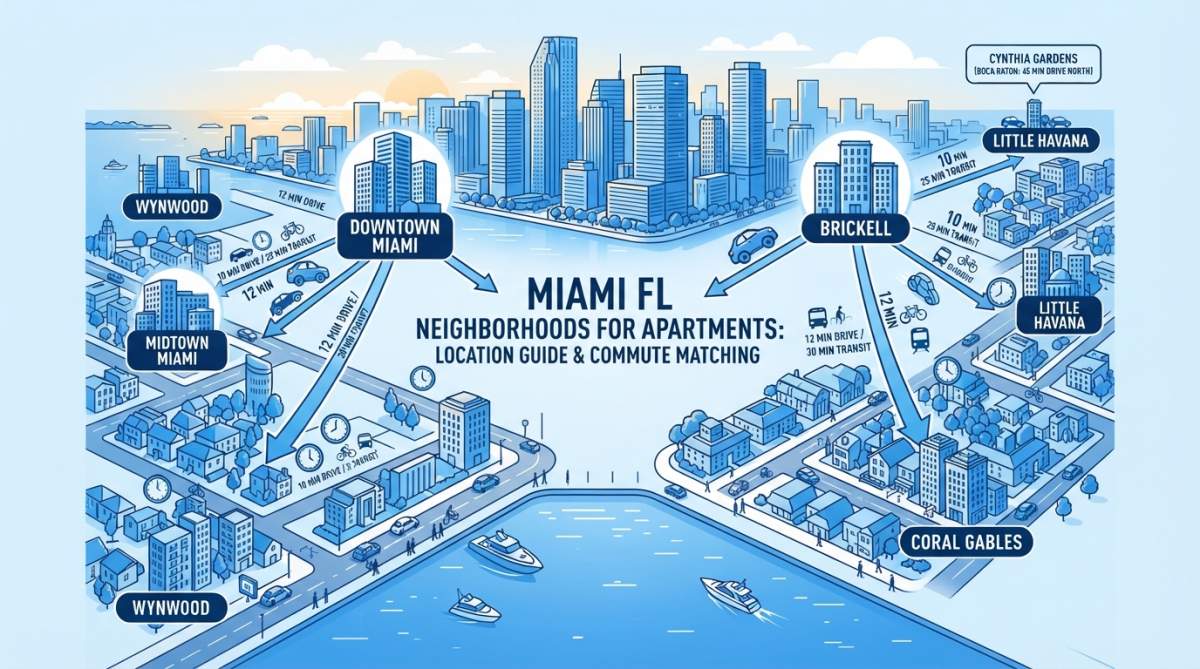
Choosing the right neighborhood matters more than choosing the right complex. A mediocre community in the perfect neighborhood outperforms a luxury complex in the wrong location. Neighborhood selection determines daily commute, social life, safety, walkability, and long-term trajectory.
Downtown Miami & Brickell: Urban Living Trade-Offs
Downtown Miami and Brickell represent the city’s most walkable, employment-dense neighborhoods. High-rise apartments range from $1,800-$2,800 for one-bedrooms, with premium towers reaching $3,500+. You’re paying for location: walking distance to restaurants, cultural attractions, financial district jobs, and nightlife.
The trade-off is real. Downtown living means street noise, limited parking, crowded elevators, and fast-paced environment. Safety in Downtown and Brickell is generally strong in residential blocks but weaker in entertainment districts late at night.
Wynwood, MiMo & Emerging Areas: Quiet vs. Walkable
Wynwood and MiMo occupy the middle ground: more walkable than suburban areas, more affordable than Brickell, with genuine neighborhood character. Wynwood’s street art and galleries attract young professionals; MiMo offers bay views and proximity to Biscayne Boulevard’s emerging restaurant scene. Emerging neighborhoods like Buena Vista and Allapattah offer genuine affordability but come with longer commutes and less-developed walkability.
Flood Zone & Climate Resilience Data by Area
Flood risk varies dramatically by neighborhood. Downtown Miami and Brickell sit at sea level with increasing flood frequency; "sunny day flooding" occurs 5-10 times annually. Wynwood and MiMo are slightly elevated, experiencing occasional flooding during heavy rain but not regular tidal flooding.
West Miami neighborhoods sit 10-15 feet above sea level with minimal flood risk. Cynthia Gardens in Boca Raton benefits from elevation and distance from the coast; flood risk is minimal compared to Miami proper.
Research from NOAA’s Sea Level Rise Data 2026 indicates South Florida will experience 1-2 feet of additional sea level rise by 2050. Choosing neighborhoods with elevation buffer today reduces future climate risk.
Lease Terms, Flexibility & Early Termination: What Apartment Complexes Actually Offer
Lease flexibility separates communities understanding modern renters from those locked in outdated models. Communities offering 6-month, 9-month, or month-to-month options attract higher-quality tenants and reduce turnover.
Early termination clauses matter enormously. Standard terms charge 1.5-2 months’ rent as penalty for breaking leases early. Some communities are more flexible, particularly if they can re-lease quickly.
Garden-Style vs. High-Rise: Sound & Privacy Reality Check
Garden-style communities are genuinely quieter than high-rises. Fewer shared walls, more outdoor space, and lower density mean less noise transmission. If you work from home or value quiet, this matters.
Garden-style communities have trade-offs: you lose ground-floor retail convenience, 24-hour doorman service, and high-rise social energy. High-rises offer urban convenience; garden-style offers peace.
Before committing to a high-rise, visit during evening hours and spend 15 minutes in a model unit with the door open. You’ll immediately sense ambient noise levels. If it bothers you during a 15-minute visit, it will exhaust you over 12 months.
Virtual Tours, Resident Reviews & Transparency: How to Verify Before Committing
Virtual tours are standard now, but quality varies dramatically. The best communities offer both video tours and live video calls with the leasing office, allowing real-time questions.
Resident reviews require skepticism. Signal emerges when 60%+ of reviews mention the same issue: slow maintenance response, noisy neighbors, or parking problems. When multiple independent reviews identify the same problem, that’s a credibility signal.
Red Flags in Management Response Times & Maintenance
The most reliable quality indicator is management responsiveness. Ask these specific questions:
- What’s the average response time for maintenance requests?
- Are emergency requests handled differently than routine requests?
- Do residents submit requests online, by phone, or both?
- Is there a tracking system where residents monitor request status?
Communities hesitating to answer are hiding something. Excellent communities have these numbers memorized and are proud. If response time exceeds 48 hours for routine maintenance or 4 hours for emergencies, that’s a red flag.
Maintenance quality matters more than amenity quantity. A community with a basic pool but fast maintenance beats one with a lazy river and slow repairs.
Choosing the Right Apartment Complex in Miami FL for Your Lifestyle
The decision framework should prioritize your actual daily life, not aspirational living. Do you work downtown? Prioritize walkability and commute time. Do you work from home? Prioritize quiet and internet reliability. Do you have pets? Verify breed policies and monthly costs in writing.
Create a weighted scoring system: assign points to location (commute time, walkability, neighborhood trajectory), cost (rent plus all fees, pet costs, parking), management quality (response times, resident reviews), and amenities (prioritize ones you’ll actually use).
Visit properties during different times of day. A quiet community at 2 PM might be loud at 6 PM. A safe neighborhood at noon might feel different at 9 PM.
Decision Framework: Budget, Location & Life Stage
For young professionals in their first Miami apartment, prioritize location and walkability over amenities. Wynwood or MiMo offers the right balance of affordability, walkability, and neighborhood energy.
For remote workers and families, prioritize quiet and space. Garden-style communities in Boca Raton, Coral Springs, or emerging Miami neighborhoods offer better value and quality of life than premium downtown locations. Cynthia Gardens exemplifies this category: serene living, professional management, and proximity to employment centers without downtown chaos.
For affluent renters seeking luxury, prioritize management quality and location over unit-level features. A well-managed property in a premium neighborhood delivers better long-term satisfaction than a stunning unit in a poorly-managed complex.
For budget-conscious renters, accept longer commutes or emerging neighborhoods as trade-offs for affordability. Timing lease signing (September, January) and negotiating move-in specials can reduce total costs by 10-15%.
Choosing an apartment complex in Miami FL comes down to alignment between the community’s actual offerings and your real needs. The most expensive complex isn’t the best; the most amenity-rich isn’t the most livable. Cynthia Gardens in Boca Raton represents a specific choice: serene, maintenance-focused living in a garden-style community with high-end finishes, positioned minutes from FAU and the beach. If you value quiet, professional management, and refined lifestyle over downtown walkability, this community delivers on its promises. Schedule a tour today and experience the difference that genuine maintenance-free living makes.
Frequently Asked Questions
What are the typical move-in costs for apartment complexes in Miami FL, and what hidden fees should I expect?
Move-in costs typically include first month's rent, last month's rent, security deposit, and application fees. Many residents report total upfront costs exceeding $9,000. Hidden fees may include pet deposits, parking charges, utility setup fees, and administrative processing fees. Request a complete written breakdown before signing, legitimate complexes provide itemized cost estimates. Ask specifically about non-refundable fees versus refundable deposits, as this distinction significantly impacts your total out-of-pocket expense.
How do pet-friendly apartments in Miami FL actually handle breed restrictions and monthly pet fees?
Pet policies vary widely across apartment complexes in Miami FL. Some charge $25-75 monthly pet rent per animal, while others impose one-time deposits ranging from $300-500. Many complexes maintain breed restriction lists despite claiming to be 'pet-friendly', common exclusions include pit bulls, rottweilers, and other designated breeds. Always request the complete pet policy in writing, including size limits, number of animals allowed, and whether fees apply to emotional support animals differently than pets. Compare policies across 3-4 properties before committing.
Which Miami FL neighborhoods offer the best balance of affordability and walkability for apartment living?
Wynwood and the MiMo District offer emerging walkability with lower rents than Downtown Miami or Brickell. Kendall and South Miami provide family-friendly options with more space for less cost, though commute times to downtown increase. Neighborhoods near FAU offer student-friendly pricing but higher density. Use walk score and transit score tools to verify actual walkability, some 'walkable' areas have limited evening transit. Research flood zone maps for your specific neighborhood, as climate resilience varies significantly even within the same area.
What questions should I ask apartment complexes about lease flexibility and early termination options?
Ask whether the lease permits subletting, month-to-month conversions after the initial term, or early termination with penalties. Inquire about the specific penalty structure, some charge one month's rent, others demand the full remaining lease balance. Ask if management offers lease breaks for job relocations or hardship situations. Request these terms in writing before signing. Also ask about renewal flexibility: can you negotiate rent decreases, or will you face increases when renewing? Garden-style communities often offer more flexibility than corporate high-rises.