Table of Contents
- Is It Expensive to Live in Boca Raton? The Short Answer
- Cost of Living Index: How Boca Raton Compares to National Average
- Median Home Values and Real Estate Market Trends in Boca Raton
- Average Salary in Boca Raton and Purchasing Power
- Monthly Expenses Breakdown: Housing, Utilities, and Groceries
- Hidden Costs of Coastal Living in Boca Raton
- Neighborhood-Specific Cost Tiers: Where to Find Value
- Pros and Cons of Living in Boca Raton
Is It Expensive to Live in Boca Raton? 2026 Cost Guide
Last Updated: July 16, 2026
Is It Expensive to Live in Boca Raton? The Short Answer
Yes, but with important nuance. Boca Raton consistently ranks above the national average for cost of living, yet neighborhoods vary significantly in price and lifestyle options. The real question isn’t whether Boca Raton is expensive in absolute terms, but whether it’s expensive for your specific situation. A remote worker earning six figures experiences the city very differently than a retiree on fixed income or a young professional starting their career.
Research from the U.S. Census Bureau’s American Community Survey shows median household income in Palm Beach County exceeds the national average, yet housing costs have risen faster than wages in recent years. This creates a compression effect: earning above-average income doesn’t necessarily mean housing feels affordable.
The biggest mistake when evaluating Boca Raton affordability is comparing only median home prices. A complete picture requires examining monthly expenses, property taxes, insurance, and your specific lifestyle choices.
Cost of Living Index: How Boca Raton Compares to National Average
Boca Raton‘s overall cost of living runs approximately 15-20% higher than the national average. Housing drives this premium, but utilities, groceries, and services also exceed U.S. benchmarks. According to Numbeo’s cost of living database, the city ranks in the top quartile for expensive places to live in Florida.
Housing represents the largest expense differential at roughly 25-35% above national average depending on neighborhood. Utilities run about 8-12% higher due to air conditioning demands. Groceries typically cost 5-8% more than the national median. Transportation expenses depend on vehicle ownership and commute distance but generally track slightly above national averages.
| Cost Category | Boca Raton vs National | Monthly Impact (Individual) | Notes |
|---|---|---|---|
| Housing (ownership) | +25-35% | Varies by property | Largest expense driver |
| Housing (rental) | +15-20% | $1,200-2,000+ | Depends on unit type |
| Utilities | +8-12% | $150-250 | Heavy AC usage year-round |
| Groceries | +5-8% | $300-400 | Store choice matters significantly |
| Transportation | +3-7% | $200-400 | Assumes car ownership |
| Healthcare | +5-10% | Varies | Retirees pay more attention here |
Median Home Values and Real Estate Market Trends in Boca Raton
Median single-family home values in Boca Raton range between $600,000 and $1.2 million, though waterfront and luxury properties command substantially higher prices. The real estate market has developed distinct tiers based on neighborhood, beach proximity, school quality, and amenities. Homes in the central core near downtown command premiums, while properties closer to the beach or in gated communities add another 20-40% to comparable inland homes.
The market has stabilized after rapid appreciation in 2021-2023, with prices showing modest growth but less volatility. Inventory remains tight, supporting prices but limiting buyer options. For renters, this dynamic is favorable, landlords increasingly offer competitive rates to fill units.
Property tax burden represents a critical cost consideration often overlooked. Florida’s property tax rate averages around 0.75-0.85% of assessed property value annually. A $750,000 home carries roughly $5,600-6,400 in annual property taxes. Add homeowners insurance (typically $1,200-2,000 annually) and HOA fees if applicable (ranging from $200-800 monthly), and the true monthly cost of ownership becomes clear.
The median home value reflects luxury real estate demand but doesn’t represent what most residents actually pay. Understanding neighborhood-specific pricing and the full cost of ownership, including taxes, insurance, and HOA fees, is essential before purchasing.
Average Salary in Boca Raton and Purchasing Power
The median household income in Boca Raton exceeds $70,000, higher than the national median but not dramatically so given the cost of living premium. This creates a purchasing power gap: earning above-average income doesn’t translate to above-average financial comfort.
Employment clusters around healthcare, professional services, retail, hospitality, and increasingly remote work. Many residents work in Miami or Fort Lauderdale and commute, adding transportation costs. Remote workers relocated to Boca Raton for lifestyle and weather often bring salaries from higher-cost metros like New York or California, experiencing Boca Raton as relatively affordable.
A household earning $100,000 annually has less discretionary income in Boca Raton than the same household would in most other U.S. metros. After housing, utilities, taxes, and basic living expenses, remaining disposable income is compressed. Professional salaries in healthcare, law, technology, and finance provide more comfortable positioning, while entry-level and service industry work often struggle against the cost of living.
Monthly Expenses Breakdown: Housing, Utilities, and Groceries
A realistic monthly expense breakdown for an individual typically shows housing consuming 35-45% of gross income for renters and 30-40% for owners. Utilities add $150-250 monthly. Groceries for a single person average $300-400 monthly. Car ownership runs $400-600 monthly if owned outright. Dining out and entertainment typically run $300-500 monthly for moderate lifestyles.
For families, budget $4,500-6,500 monthly for basic living expenses including housing, utilities, groceries, transportation, and insurance. Childcare in South Florida runs $1,200-2,500 monthly per child, becoming a dominant expense for working parents. Retirees should budget an additional $300-500 monthly for healthcare expenses beyond Medicare.
Housing Affordability and Property Taxes
A $700,000 home requires not just a mortgage payment but property taxes, homeowners insurance, HOA fees, and maintenance. Property taxes run roughly $5,000-8,000 annually depending on assessed value. Homeowners insurance for standard coverage runs $1,200-2,000 annually, with flood insurance adding $400-800 more in flood zones.
Many communities include HOA fees ranging from $200-400 monthly in modest communities to $800-1,500+ in luxury developments. Over a year, HOA fees add $2,400-18,000 to housing costs. The combination of mortgage, property tax, insurance, and HOA fees creates a true monthly housing cost often exceeding $3,000-5,000 for median-priced homes, which is why many residents choose to rent instead.
Boca Raton Utilities Cost and Insurance Premiums
Monthly electric bills typically range from $120-200 in moderate months to $250-400 during peak summer cooling season. Water and sewer services add $40-60 monthly. Internet and phone services run $80-150. Total monthly utility burden runs $250-350 for an average household.
Homeowners insurance premiums have increased substantially due to hurricane risk and rising construction costs, now running $1,200-2,000 annually. Properties in flood zones require additional flood insurance costing $400-1,200+ annually. Umbrella liability policies add another $150-300 annually.
Auto insurance in Florida runs higher than most states due to no-fault insurance requirements, with standard coverage costing $1,200-1,800 annually.
Many relocating residents underestimate insurance costs when evaluating Boca Raton affordability. Homeowners and auto insurance premiums are substantially higher than national averages, and flood insurance is mandatory in many areas. Budget an additional $200-300 monthly for comprehensive insurance coverage.
Hidden Costs of Coastal Living in Boca Raton
Coastal living carries expenses inland residents don’t face. Flood insurance is mandatory in flood zones and adds $400-1,200 annually. Hurricane preparedness requires emergency supplies and home reinforcement. A complete hurricane shutter system costs $3,000-8,000 installed. Impact-resistant windows run $5,000-15,000 but provide better long-term value and insurance discounts.
Salt air corrosion affects vehicles, air conditioning units, and exterior fixtures, adding $500-1,500 annually in maintenance costs. Erosion and sea-level rise concerns are beginning to affect property values and insurance availability in vulnerable areas. Lifestyle costs also increase in coastal communities, as proximity to beaches encourages spending on water activities and beach clubs.
Neighborhood-Specific Cost Tiers: Where to Find Value
The downtown core and areas immediately west of Federal Highway represent the most expensive tier, with median single-family home prices of $850,000-1.5 million. Rental apartments run $1,800-3,000+ monthly for two-bedroom units.
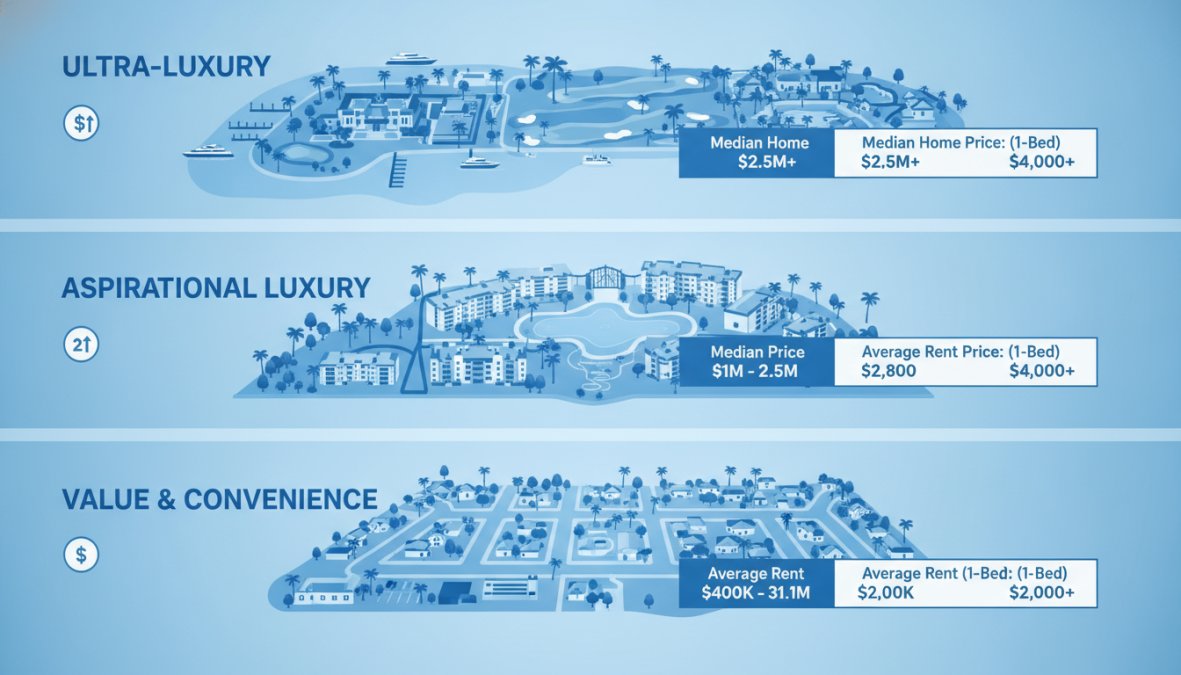
Mid-tier neighborhoods west of downtown offer better value. Areas like Boca Pointe, Tiburon, and communities along Glades Road provide established neighborhoods with good schools at median prices of $500,000-800,000. East of Federal Highway near the beach, prices escalate significantly, with beachfront homes commanding $1.2 million to $3+ million.
The value tier exists in neighborhoods slightly south and west of the main commercial core, offering homes in the $450,000-650,000 range. Rental options across all neighborhoods have become more competitive in 2026, with one-bedroom apartments ranging from $1,200-1,800 in less desirable areas to $2,000-2,800 in premium locations. Two-bedroom apartments run $1,600-2,400 in standard areas to $2,800-4,000+ in luxury buildings.
Cynthia Gardens offers modern one-bedroom apartments with high-end finishes in a garden-style community, appealing to professionals seeking maintenance-free living without the capital commitment of home purchase.
Pros and Cons of Living in Boca Raton
Pros: Year-round warm climate, excellent healthcare facilities, top-ranked public schools, beach access, cultural amenities, established community feel, strong professional networks, no state income tax, and good safety and security.
Cons: Real cost of living premium, housing prices appreciating faster than incomes, hurricane risk and insurance costs, summer heat limiting outdoor activity, traffic congestion, limited public transportation requiring car ownership, demographic skew toward older residents, seasonal tourism crowding, limited job market compared to major metros, and higher service costs.
Whether Boca Raton is expensive ultimately depends on your income, lifestyle preferences, and comparison point. For remote workers earning metro-level salaries, it offers reasonable value. For local wage earners, the cost of living premium creates genuine financial pressure. The real opportunity lies in understanding neighborhood-specific pricing, choosing between ownership and rental strategically, and recognizing that Boca Raton offers diverse living options at different price points. Cynthia Gardens provides modern, maintenance-free apartment living in a serene garden community with convenient beach and FAU access, offering an alternative to traditional home ownership while delivering refined living without the full premium of single-family home ownership.
Frequently Asked Questions
What is a good salary to live comfortably in Boca Raton?
Comfort depends on lifestyle and family size, but most financial advisors suggest a household income that allows 25-30% allocation to housing costs. Given median home values and rental prices in the area, a household income of $75,000-$100,000+ annually provides reasonable flexibility for a single individual or couple. Remote workers and retirees should assess their fixed income against local cost-of-living expenses, including property taxes, insurance, and utilities.
Are property taxes high in Boca Raton compared to other Florida cities?
Florida has no state income tax, which is a major advantage. However, property taxes in Palm Beach County, where Boca Raton is located, are moderate to moderately high relative to other Florida counties. Tax rates depend on property value and local assessments. Homeowners should factor property taxes into their affordability calculations, as they represent a significant portion of annual housing costs alongside homeowners insurance and HOA fees.
What are the hidden costs of coastal living in Boca Raton?
Coastal living brings expenses beyond rent or mortgage: higher homeowners insurance premiums due to hurricane risk, flood insurance requirements in certain zones, more frequent maintenance from salt air and humidity exposure, and potential special assessments for coastal infrastructure. Additionally, lifestyle inflation near the beach, dining, entertainment, and recreation, can exceed budgets. Utility costs also tend to run higher due to air conditioning needs in Florida's climate.
Is Boca Raton a good place to retire on a budget?
Boca Raton offers retiree-friendly benefits: no state income tax, abundant healthcare facilities, and active lifestyle amenities. However, it is not a budget-friendly retirement destination compared to inland Florida cities. Retirees should prioritize neighborhoods with lower median home values, consider renting instead of buying, and budget carefully for property taxes and insurance. Fixed-income retirees may find better value in nearby communities while maintaining access to Boca Raton's amenities.