
Table of Contents
- What Are Alternatives to Traditional Apartment Security Deposits?
- Types of Security Deposit Alternatives Explained
- Security Deposit Insurance Cost: Comparing Monthly Fees vs. Lump Sum
- Pros and Cons of Lease Insurance and Deposit Alternatives
- How to Ask Your Landlord to Waive Security Deposit or Use Alternatives
- Exit Strategy, Credit Impact, and State-Specific Regulations
- Finding the Right Alternative for Your Situation
- Conclusion
Alternatives to Traditional Apartment Security Deposits
Last Updated: July 3, 2026
Finding the right housing option often means navigating the financial hurdles that come with moving. One of the biggest obstacles renters face is the security deposit, typically one to two months’ rent due upfront before you can even get your keys. Alternatives to traditional apartment security deposits have emerged as effective financial products that let renters move in with less cash on hand. These alternatives range from surety bonds to lease insurance products to credit-based systems, each offering different trade-offs between upfront costs, monthly fees, and long-term financial impact. Understanding what’s available, how each option works, and which one fits your situation is essential before signing a lease.
What Are Alternatives to Traditional Apartment Security Deposits?
Security deposit alternatives are financial products designed to replace the traditional lump-sum cash deposit that landlords have historically required. Instead of tying up hundreds or thousands of dollars in an escrow account, renters can use these products to satisfy the landlord’s need for financial protection against damages or unpaid rent.
The core appeal is straightforward: preserve your cash for moving expenses, furniture, or your emergency fund. Rather than paying $2,000 upfront for a deposit, you might pay a monthly fee of $30-50 or a one-time bond fee of $100-300. For many renters, especially those early in their careers or managing tight budgets, this shift from lump-sum to monthly or minimal upfront costs makes the difference between affording a move and waiting another year.
How Security Deposit Alternatives Work
These products operate through a straightforward mechanism: a third-party provider steps between you and your landlord, offering the landlord financial protection while you pay a fraction of the traditional deposit amount.
You apply with a provider like Rhino, a security deposit insurance provider, which runs a credit check and income verification. If approved, the provider issues either an insurance policy or surety bond that covers the landlord for damages and unpaid rent. You pay a monthly premium, a one-time fee, or both, depending on the product. If you move out without damage and pay all rent on time, you owe nothing further. If damage occurs or rent goes unpaid, the provider pays the claim, and you may owe a deductible or face other consequences.
The key difference from traditional deposits: you’re not getting money back. These are insurance premiums or bond fees, not refundable deposits.
Types of Security Deposit Alternatives Explained
The market has fragmented into several distinct product categories, each with different mechanics and cost structures.
Surety Bonds
A surety bond is a three-party agreement: you (the renter), the landlord (the obligee), and the surety company (the guarantor). The surety company issues a bond that guarantees the landlord will be compensated if you damage the property or fail to pay rent.
SureDeposit, a long-standing surety bond provider uses this model to help renters reduce move-in costs while protecting landlords. You pay a one-time fee (typically 10-15% of the traditional deposit amount) and the surety company backs the landlord. If a claim is filed, the surety investigates and pays out if valid. You may owe a deductible or be required to reimburse the surety company for claims paid on your behalf.
Pros for renters: Lower upfront cost than a traditional deposit, straightforward process, widely understood by property managers.
Cons for renters: The fee is non-refundable, and you could face collection efforts if the surety pays a claim and seeks reimbursement from you.
Lease Insurance Products
Lease insurance is a newer category that operates more like traditional insurance than a surety bond. The insurance company directly covers the landlord’s losses without requiring the tenant to reimburse the provider for claims.
LeaseLock, a lease insurance provider for multifamily operators exemplifies this model. Claims are typically paid within 7 days, and there’s no on-site adjuster needed for smaller claims.
Pros for renters: No reimbursement liability if a claim is paid, faster claims processing, designed specifically for the rental market.
Cons for renters: Monthly fees are non-refundable, typically only available through large property operators, less widely available than surety bonds.
Credit-Based Alternatives
Some providers use financial technology and credit authorization rather than insurance or bonds. Obligo’s deposit-free rental solution uses bank-issued lines of credit to replace deposits. The provider verifies your creditworthiness and income, then authorizes a line of credit that the landlord can draw from if needed. You pay a monthly service fee, typically much lower than insurance premiums, starting at $7.90 per month for qualified renters.
Pros for renters: Lowest monthly cost, no cash deposit required, simple digital qualification process.
Cons for renters: Requires credit and bank account verification, fees are non-refundable, not available everywhere.
Lease Guarantor Services
Lease guarantor services like TheGuarantors act as a co-signer or guarantor for your lease, backing your ability to pay rent and maintain the property. This product targets renters with non-traditional income (freelancers, gig workers), inconsistent employment history, or limited credit.
Pros for renters: Helps renters who don’t qualify for traditional deposits or other alternatives, supports non-traditional income verification.
Cons for renters: Premiums can be higher than other alternatives depending on your risk profile, still requires underwriting approval.
Security Deposit Insurance Cost: Comparing Monthly Fees vs. Lump Sum
The financial comparison between monthly fees and one-time bond fees depends on how long you stay in your apartment.
Monthly Premium Models
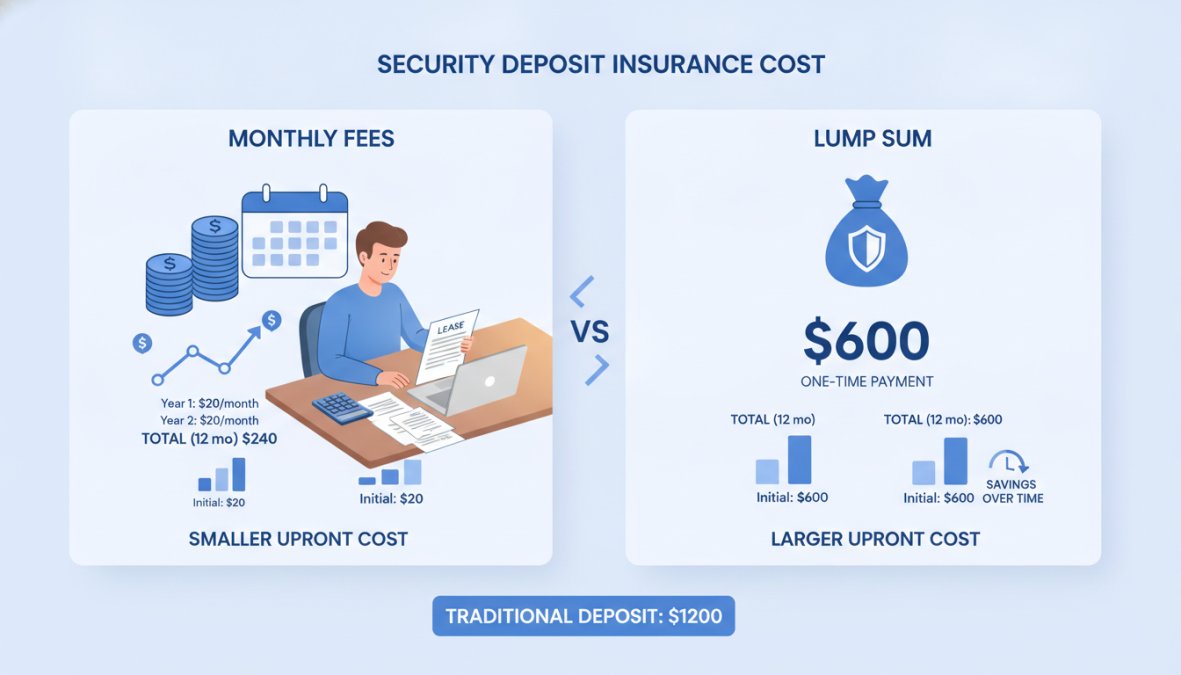
Monthly premium models spread costs over time. A typical monthly fee ranges from $7.90 to $49, depending on the provider and your risk profile. If you stay for 12 months, a $30/month premium totals $360, significantly less than a traditional $1,500-2,000 deposit. But if you stay for 3 years, that same premium becomes $1,080, which approaches or exceeds what a traditional deposit would have cost.
The math favors monthly premiums if you plan to move within 12-18 months. Beyond that, the cumulative cost catches up to traditional deposits.
Calculate your break-even point before choosing a monthly premium model. If you know you’ll stay 3+ years, a one-time bond fee may be more cost-effective.
One-Time Bond Fees
Surety bond providers typically charge a one-time fee of 10-15% of the deposit amount. A $2,000 deposit translates to a $200-300 bond fee, paid upfront and never again. This model favors renters planning to stay longer, with no ongoing cost and a known total expense.
Hidden Fees and Fine Print
Beyond the advertised monthly or one-time fee, several hidden costs can emerge: cancellation fees if you break your lease early, deductibles of $250-500 before insurance kicks in, and application or credit check fees of $25-75.
Request a full fee schedule in writing before applying, and ask specifically about cancellation policies, deductibles, and claims handling fees.
Pros and Cons of Lease Insurance and Deposit Alternatives
The decision to use a deposit alternative involves trade-offs between flexibility, cost structure, and long-term impact on your financial profile.
Advantages for Renters
The primary advantage is cash preservation. Moving is expensive, deposits, first month’s rent, transportation, utility deposits, and furniture all add up. Reducing the upfront deposit burden by $1,500-2,000 frees capital for these other costs.
Monthly premium models allow you to spread costs over time rather than saving a lump sum. Speed matters too, deposit alternatives often approve instantly or within 24 hours, letting you move in faster than traditional deposit verification processes.
For renters with limited credit history or non-traditional income, these products open doors that would otherwise be closed.
Disadvantages and Long-Term Costs
The non-refundable nature of these products is the biggest disadvantage. You’re paying for insurance or a guarantee, not a deposit you’ll get back. Over a 3-year tenancy, monthly premiums can total more than a traditional deposit.
Cancellation policies can trap you, some providers charge a cancellation fee plus remaining monthly premiums if you break your lease early. Limited availability remains an issue, as many products aren’t available in all states or for all property types.
Benefits for Property Managers and Landlords
From the landlord’s perspective, deposit alternatives eliminate the administrative burden of managing escrow accounts, calculating interest, and processing returns. Lease insurance guarantees coverage for damages and unpaid rent, with claims paid quickly, reducing bad debt and vacancy risk.
How to Ask Your Landlord to Waive Security Deposit or Use Alternatives
Not all landlords are familiar with deposit alternatives. You may need to educate them and make a case for why accepting an alternative benefits both parties.
Building Your Case
Research which providers operate in your state and offer coverage matching your landlord’s property type. Bring specific information: the provider’s website, coverage details, claims process, and pricing. Frame it as a win-win, the alternative eliminates their administrative burden, guarantees coverage for damages and unpaid rent, and often processes claims faster than traditional disputes.
Offer to cover any provider fees. Provide references highlighting your solid rental history, credit score, or employment stability.
Timing and Approach
Bring up deposit alternatives early in the leasing process, ideally before the lease is drafted. Approach the conversation respectfully: "I’d like to explore using a deposit alternative like Rhino, which provides you with the same coverage as a traditional deposit but with faster claims processing. Would you be open to that?"
Be prepared to walk away. If a landlord refuses and you can’t afford the traditional deposit, don’t stretch yourself financially.
Exit Strategy, Credit Impact, and State-Specific Regulations
Before committing to a deposit alternative, understand the exit implications and regulatory landscape in your state.
Cancellation and Exit Options
Most deposit alternatives allow you to cancel if you move out, but terms vary widely. Some charge a cancellation fee equal to one month’s premium. Others pro-rate the remaining balance. Read the cancellation policy before signing.
Breaking your lease complicates things. The provider may continue charging premiums until the lease ends or charge a cancellation fee on top, creating unexpected costs if your circumstances change.
Impact on Credit Scores
Credit-based alternatives like Obligo perform a hard credit pull during application, which temporarily lowers your score by a few points. Insurance products like Rhino and LeaseLock typically use soft pulls, which don’t affect your score.
If a claim is filed and you’re required to reimburse the provider, non-payment could be reported to credit bureaus and damage your score.
Check whether your chosen provider uses hard or soft credit pulls, and ask explicitly what happens to your credit if a claim is filed and you can’t pay immediately.
State-Specific Rules and Availability
Deposit alternatives are not available everywhere. Rhino, for example, operates in 48 states but not Hawaii, Montana, North Dakota, or Wyoming. State law also governs how deposits are handled. Some states require landlords to pay interest on deposits or return them within 30 days of move-out. These protections don’t apply to deposit alternatives.
Check your state’s rental housing authority or attorney general’s office for guidance on what’s legal in your jurisdiction.
Finding the Right Alternative for Your Situation
The best deposit alternative depends on your specific circumstances: how long you plan to stay, your credit profile, your upfront cash availability, and your state’s regulations.
Key Factors to Consider
Tenure: If you plan to stay under 18 months, a monthly premium model saves money. If it’s 3+ years, a one-time bond fee or traditional deposit likely costs less.
Cash on hand: If you can’t afford the upfront cost, a monthly premium model is essential. If you have savings, a one-time fee might be more economical long-term.
Credit profile: If your credit is strong, credit-based alternatives offer the lowest monthly cost. If credit is weaker, a lease guarantor service might be your only option.
Risk tolerance: Are you comfortable with non-refundable fees? If you value getting money back, traditional deposits are still the most familiar option.
Landlord flexibility: Will your landlord accept alternatives? If they’re traditional and unfamiliar with these products, you may need to educate them or look for a different property.
| Factor | Best Choice | Why |
|---|---|---|
| Staying under 18 months | Monthly premium (Rhino, LeaseLock) | Lower total cost than one-time fees |
| Staying 3+ years | One-time bond fee (SureDeposit) | Lowest total cost over long tenure |
| Limited upfront cash | Monthly premium model | Spreads cost over time |
| Strong credit | Credit-based alternative (Obligo) | Lowest monthly fees available |
| Non-traditional income | Lease guarantor (TheGuarantors) | Designed for variable income |
| Landlord unfamiliar with alternatives | Education + provider resources | Provide landlord with coverage details |
Navigating the move-in process is stressful enough without financial barriers blocking your path to a new home. Alternatives to traditional apartment security deposits have made it possible for millions of renters to move with less upfront burden. Whether you choose a monthly premium model, a one-time bond fee, or a credit-based alternative depends on your timeline, cash position, and local rental market. At Cynthia Gardens in Boca Raton, we recognize that renters deserve flexible, transparent options that work with their financial reality. If you’re ready to explore a community that values your financial flexibility, schedule a tour today and discover how our refined, welcoming apartments can fit your lifestyle without the traditional deposit stress.
Frequently Asked Questions
What is a security deposit alternative?
A security deposit alternative is a financial product that replaces the traditional upfront cash deposit required by landlords. Instead of paying a lump sum (typically one month's rent), renters can use options like surety bonds, lease insurance, or credit-based services. These alternatives reduce move-in costs while still protecting property owners against damages or unpaid rent. Products like Rhino, LeaseLock, and Obligo operate as third-party providers handling the coverage and claims process.
How much does security deposit insurance cost compared to a traditional deposit?
Security deposit insurance typically costs between $8-$30 per month, depending on the provider and renter profile. Traditional deposits require a lump sum upfront, usually equal to one month's rent ($1,500-$3,000+). Over a 12-month lease, insurance premiums total $96-$360, making them cheaper initially. However, premiums are non-refundable, so over longer leases, total costs can approach or exceed a traditional deposit. Always compare the total cost over your lease term.
What are the pros and cons of lease insurance versus traditional security deposits?
Pros of lease insurance include lower upfront move-in costs, easier qualification for renters with limited credit, and reduced financial burden. Cons include non-refundable premiums, potential long-term costs exceeding a traditional deposit, and limited availability in some states. Traditional deposits tie up cash but are refundable if no damages occur. Lease insurance works best for renters with tight budgets; traditional deposits suit those with savings and longer lease terms.
Can a security deposit alternative affect my credit score?
Most security deposit alternatives do not directly impact credit scores because they don't create debt or appear on credit reports. However, some credit-based alternatives like Obligo use billing authorization, which may require a soft credit inquiry that doesn't affect your score. If you fail to pay premiums or breach the lease, claims could indirectly affect creditworthiness. Always ask providers about credit implications before enrolling to understand any potential impact on your financial profile.
Are security deposit alternatives available in all states?
No, availability varies by state. Providers like Rhino operate in 48 states but exclude Hawaii, Montana, North Dakota, and Wyoming. Some alternatives are restricted to specific regions or require partnerships with large property management companies. Before signing a lease, confirm that your chosen alternative is available in your state and accepted by your landlord. State regulations differ on deposit replacement products, so check local rental laws to ensure compliance.