TL;DR:
- The ideal apartment layout for cats features corner units with dual windows, high ceilings, and dead-end quiet zones to support their natural behaviors. Vertical enrichment through shelves and cat trees or superhighways enhances space utilization and reduces stress for both single and multiple cats. Thoughtful design, such as integrated furniture and deliberate zone creation, ensures a harmonious environment for feline psychological health and owner satisfaction.
The best types of apartment floor plans for cats are defined by how well they support vertical enrichment, dedicated quiet zones, and unobstructed natural light. Floor plan architecture directly shapes a cat’s psychological health, territorial confidence, and daily activity levels. The right layout turns even a modest one-bedroom into a feline-friendly environment where your cat can climb, observe, and retreat safely. This guide breaks down seven key floor plan features and layout types, backed by expert design insights, so you can choose or adapt a space that genuinely works for both you and your cat.
1. Types of apartment floor plans for cats: corner units lead the list
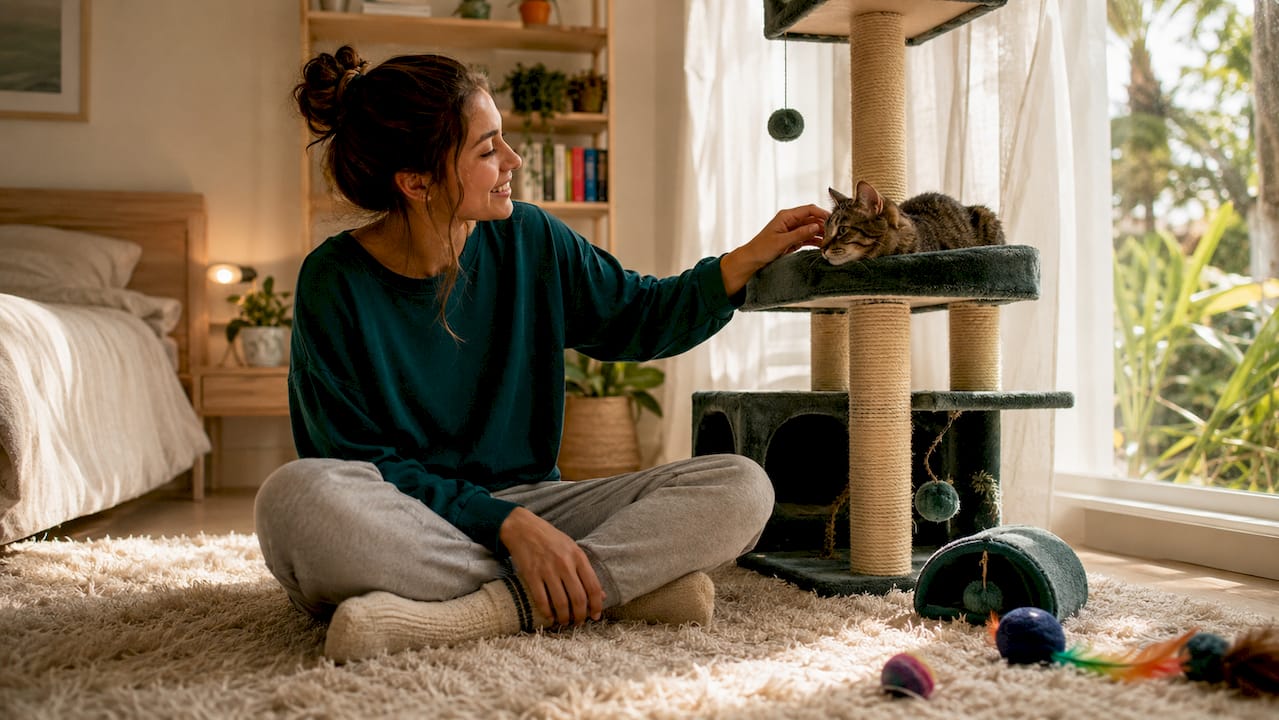
Corner apartment units consistently rank as the best floor plan type for cat owners. The reason is architectural: dual-exposure window walls provide multiple vantage points and light sources that cats instinctively seek for surveillance and warmth. Two window walls also mean you can position a cat tree in a corner without blocking any primary walking path.
From a practical standpoint, corner units allow the necessary 32-inch clear walkways for human traffic while still accommodating a 24-inch base cat tree against the window. That combination is harder to achieve in interior units with a single window wall. For cat owners at Cynthiagardens or any Boca Raton community, requesting a corner unit is one of the highest-impact decisions you can make before signing a lease.
Pro Tip: When touring a corner unit, stand in the corner where two windows meet and check the floor space. If you can draw a 24-inch square without overlapping a door swing or main walkway, that corner is your cat tree location.
- Dual windows create two separate sun-bathing spots throughout the day
- Corner placement keeps cat furniture out of primary traffic lanes
- Multiple light angles reduce the need for artificial lighting near cat zones
2. Dead-end dens and alcoves as quiet cat sanctuaries
A dead-end den or alcove is one of the most underrated features in cat-friendly floor plans. Unlike a walkthrough room, a dead-end space sits off the main traffic flow, which means your cat can retreat there without being disturbed by human movement. Dead-end dens around 5 by 7 feet provide enough room for a cat tree, a bed, and a litter cabinet without crowding the space.
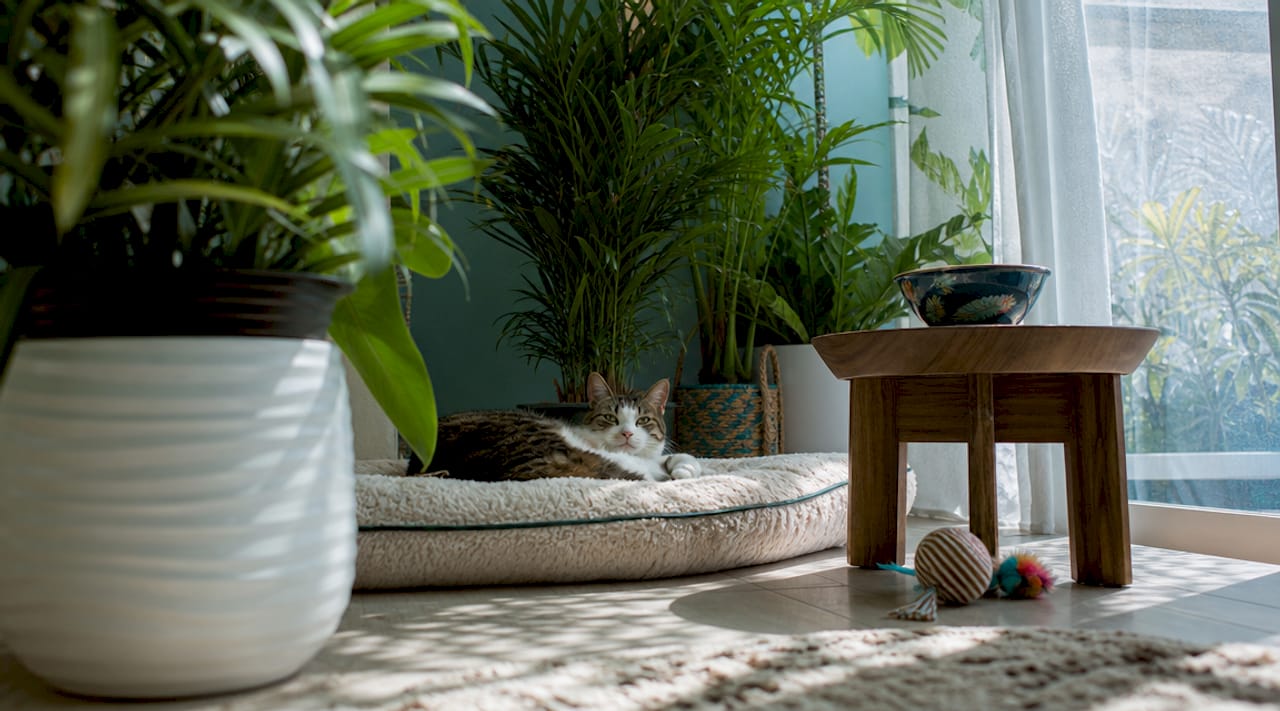
The psychological benefit here is real. Cats are territorial animals that need at least one zone where they control access. A dead-end den functions as that zone. Positioning it near the apartment’s perimeter rather than its center keeps it quieter and more stable throughout the day.
Pro Tip: If your apartment has a small den or nook, place a litter cabinet and a low perch inside before adding any human furniture. Cats claim spaces faster when they find their resources already in place.
- Avoid walkthrough dens, which create safety hazards and disrupt the cat’s sense of ownership
- Peripheral placement near an exterior wall reduces noise exposure
- A 5-by-7-foot space comfortably holds a 72-inch cat tree plus a feeding station
3. Ceiling height and vertical territory: why 9-foot ceilings matter
Ceiling height is a specification most renters overlook, but for cat owners it is a structural constraint that determines how much vertical territory your cat can actually use. A minimum 9-foot ceiling provides roughly 24 inches of clearance above a standard 72-inch cat tree, keeping the top perch away from HVAC bulkheads, sprinkler heads, and light fixtures.
Ceiling fixtures like HVAC bulkheads and sprinkler heads critically restrict viable cat furniture placement in lower-ceiling apartments. An 8-foot ceiling with a 6-inch bulkhead leaves only 18 inches of clearance, which is not enough for a cat to sit upright on the top perch. That forces you to buy shorter trees, which reduces the vertical territory your cat can claim.
| Ceiling height | Usable clearance above 72-inch tree | Feline comfort rating |
|---|---|---|
| 8 feet | 24 inches (if no fixtures) | Marginal |
| 8 feet with bulkhead | 18 inches or less | Poor |
| 9 feet | 36 inches | Good |
| 10 feet or more | 48 inches or more | Excellent |
Pro Tip: During an apartment tour, bring a tape measure and check the ceiling height in the corner where you plan to place a cat tree. Measure from floor to the lowest fixture, not just to the ceiling itself.
4. Cat superhighways and integrated wall shelves
A cat superhighway is a connected vertical path made of shelves, cat trees, and perches that allows cats to move continuously above ground level throughout the apartment. This concept is particularly powerful in small floor plans where floor square footage is limited. A well-designed superhighway can turn a 400-square-foot studio into a multi-level territory that satisfies a cat’s need to patrol, climb, and observe.
For renters, the most practical approach uses modular wall grids and bookshelf extensions that mount without permanent damage. IKEA LACK shelves, floating brackets rated for 30 pounds, and corner-mounted cat bridges create interconnected routes without requiring landlord approval for structural changes. The key design rule is to include multiple exit routes at each elevated point so your cat never feels trapped on a perch.
| Superhighway element | Renter-friendly option | Key requirement |
|---|---|---|
| Climbing entry | Freestanding cat tree | Stable base, 24-inch minimum |
| Mid-level perch | Floating shelf with bracket | 30-pound load rating |
| Horizontal bridge | Corner-mounted cat bridge | Two anchor points |
| Exit route | Second freestanding tree | Placed within jumping distance |
- Safe landing zones below each perch prevent injury from misjudged jumps
- Multiple exit routes reduce anxiety and territorial standoffs in multi-cat homes
- Modular systems allow you to reconfigure the layout as your cat’s preferences change
5. Comparing open concept, galley, and square layouts for feline comfort
Not all apartment layouts serve cats equally. Open concept apartments offer spacious flow but often lack the defined zones cats need for psychological security. A single large room with no walls means no natural separation between active and quiet areas, which forces you to create those zones artificially with furniture placement.
Galley layouts, which are long and narrow with rooms arranged in a line, restrict where you can place cat furniture without creating traffic bottlenecks. A cat tree in a galley hallway blocks human movement and puts your cat in a high-traffic zone, which is the opposite of what feline comfort requires. Square or near-square layouts distribute usable wall space more evenly, giving you more options for corner placement and wall-mounted shelving across multiple walls.
The practical takeaway: if you are choosing between a galley one-bedroom and a square one-bedroom at the same price point, the square layout offers meaningfully better floor plans for feline comfort. Open concept works well only when you deliberately design a quiet cat zone using room dividers, tall bookshelves, or a dedicated alcove.
6. Integrated furniture for cat-friendly apartment designs
Integrated furniture like litter cabinets and floating shelves provides stylish, multifunctional options that support cats without cluttering the apartment. These designs are also renter-friendly because they do not require permanent modifications. A litter cabinet that doubles as a side table keeps the litter box concealed while freeing floor space. Floating shelves that serve as both book storage and cat perches eliminate the need for a separate cat tree in rooms where floor space is tight.
The design principle behind integrated furniture is that integrating cat spaces into architecture rather than treating them as add-ons creates the best cat-friendly apartments. When your cat’s resources are built into the room’s design logic, the space feels cohesive for humans and functional for cats. Interior design firms like Yonda Interiors have documented this approach as space optimization as art, where every surface serves multiple purposes without visual clutter.
7. Situational recommendations by apartment size and number of cats
The right strategy for adapting a floor plan depends on two variables: square footage and how many cats share the space. Here is a practical breakdown:
-
Studio apartments (400 to 500 square feet, one cat): Prioritize a vertical superhighway over any horizontal furniture. A 400-square-foot studio with vertical enrichment offers more usable territory than a 1,200-square-foot apartment limited to floor space. One tall cat tree by the window plus two wall-mounted shelves at staggered heights is the minimum viable setup.
-
One-bedroom apartments (550 to 750 square feet, one cat): Use the bedroom as the cat’s primary quiet zone. Place the litter box and a low perch in the bedroom, and the main cat tree by the living room window. This creates two distinct micro-territories that mirror how cats naturally divide space.
-
One-bedroom apartments with two cats: Apply the N+1 resource rule, which means more litter boxes than cats, plus duplicate elevated perches. Two cats need two high perches at the same elevation so neither cat monopolizes the top position. Duplicating elevated perches reduces territorial compression better than adding litter boxes alone.
-
Multi-cat studios: Create visual separation using tall bookshelves or room dividers to establish micro-territories. Predictable feeding, rest, and play zones support psychological safety in multi-cat households and reduce conflict more reliably than space alone.
Pro Tip: If you have two cats in a one-bedroom, place one feeding station in the kitchen and one in the bedroom. Cats that do not have to share a feeding area show measurably lower stress behaviors like guarding and avoidance.
Key takeaways
The most effective apartment floor plan for cats combines corner placement for window access, a dead-end quiet zone, and at least 9-foot ceilings to support vertical enrichment.
| Point | Details |
|---|---|
| Corner units are the top choice | Dual window walls allow cat tree placement without blocking human walkways. |
| Dead-end dens reduce stress | A 5-by-7-foot alcove off main traffic flow gives cats a controlled retreat zone. |
| Ceiling height determines vertical space | A minimum of 9 feet is required to safely use a standard 72-inch cat tree. |
| Vertical superhighways beat floor space | A connected shelf system creates more usable territory than extra square footage. |
| N+1 rule governs multi-cat homes | More litter boxes than cats, plus duplicate perches, prevents territorial conflict. |
What I’ve learned from designing spaces for cats and humans at once
I used to think the square footage number on a listing was the most important factor for cat owners. After years of watching how cats actually use apartments, I know that is wrong. A cat does not care about your total square footage. It cares about whether it can get from the floor to a high perch without touching the ground, whether it has one space that is genuinely its own, and whether it can see outside from a stable, comfortable position.
The mistake I see most often is treating cat furniture as an afterthought. People sign a lease, move in their human furniture, and then try to fit a cat tree wherever there is leftover space. That leftover space is almost always in a corner with low traffic, poor light, and no window view. The cat uses it reluctantly. The owner wonders why the cat keeps jumping on the kitchen counter instead.
The better approach is to decide where the cat tree and the quiet zone will go before you place any human furniture. That one shift changes everything. It forces you to find cat-friendly housing that actually has the architectural features to support it, rather than hoping a standard layout will work out. Corner units, dead-end dens, and 9-foot ceilings are not luxury preferences. They are functional requirements if you want a cat that is calm, active, and behaviorally healthy.
— Ayman
Find a cat-friendly apartment at Cynthiagardens in Boca Raton
Cynthiagardens offers one-bedroom apartments in Boca Raton designed with the features that matter most to cat owners: corner units with dual window exposure, generous ceiling heights, and alcove spaces that work perfectly as dedicated cat zones.
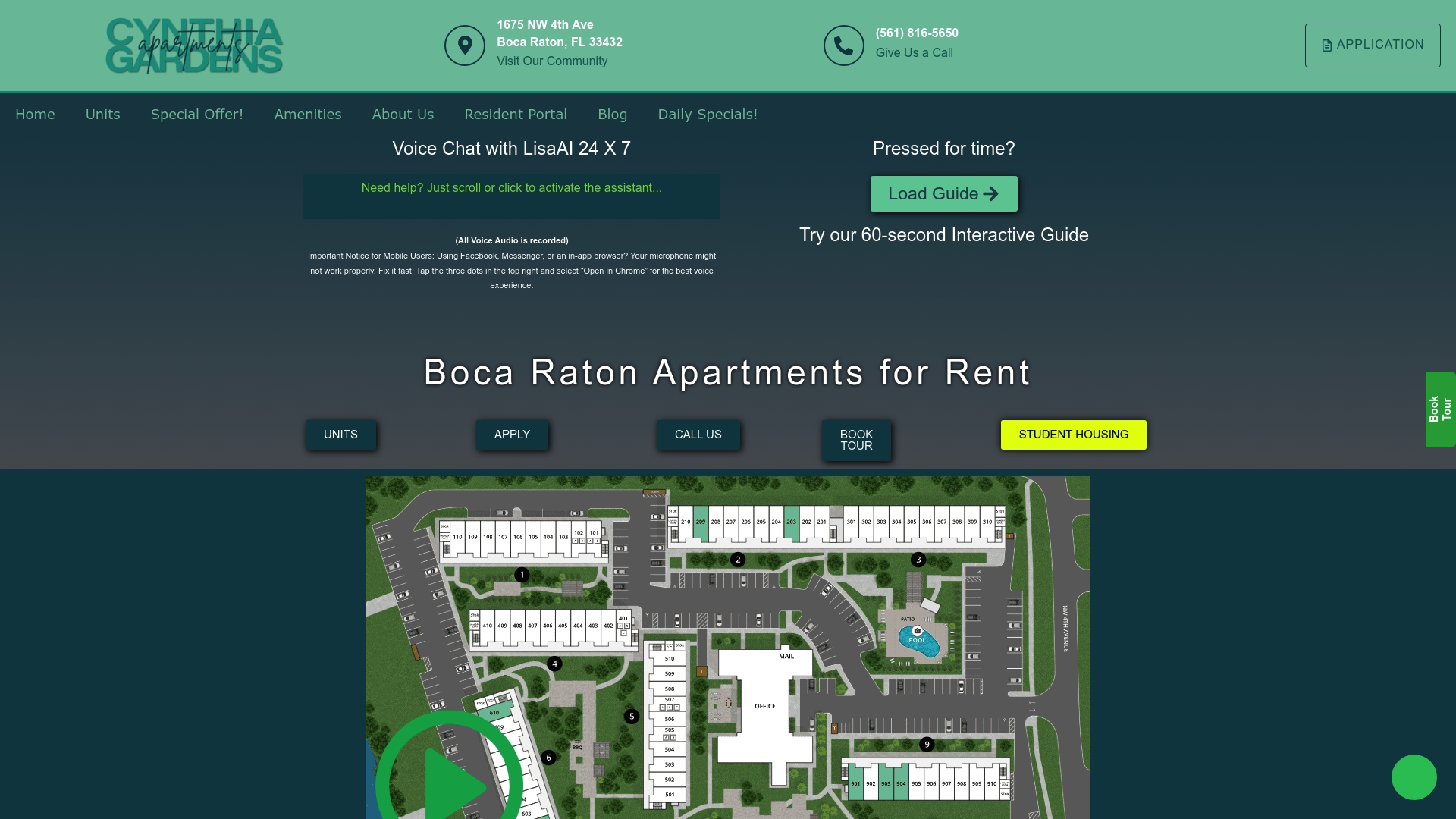
If you are searching for pet-friendly apartments in Boca Raton that go beyond a basic pet deposit, Cynthiagardens gives you transparent pricing, virtual tours, and an interactive property map so you can evaluate layouts before you visit. You can also explore one-bedroom options in Boca Raton that include the corner placement and ceiling clearance your cat needs. No hidden fees, no guesswork. Just a space that works for both of you.
FAQ
What floor plan type is best for a single cat in a small apartment?
A corner unit with dual window exposure is the best floor plan for a single cat in a small apartment. It allows stable cat tree placement with natural light while keeping the tree out of human traffic paths.
How many litter boxes does a two-cat apartment need?
The N+1 rule requires at least three litter boxes for two cats. Placing them in separate locations, such as one in the bathroom and one in the bedroom, reduces territorial guarding.
Do open concept apartments work for cats?
Open concept apartments can work for cats, but they require deliberate zone creation using tall bookshelves or room dividers. Without defined quiet zones, cats in open layouts often show higher stress behaviors.
What ceiling height do I need for a full-size cat tree?
A minimum ceiling height of 9 feet is recommended to safely accommodate a standard 72-inch cat tree. This provides at least 24 inches of clearance above the top perch, keeping it away from HVAC fixtures and sprinkler heads.
Can a studio apartment support two cats comfortably?
A studio apartment can support two cats if it includes a vertical superhighway, duplicate elevated perches, and separate feeding stations. Apartment size matters less than the availability of distinct micro-territories for each cat.