
TL;DR:
- Voice assistance is transforming apartment searches into quick, hands-free, locally targeted queries.
- It allows renters to filter options instantly through natural language, saving time and reducing fatigue.
- Limitations include incomplete listing data and potential misinterpretations, so verify details manually.
Finding an affordable, pet-friendly one-bedroom apartment near Florida Atlantic University is genuinely hard work. You’re juggling class schedules, work shifts, or a demanding job while trying to sort through dozens of listings that may or may not allow your dog. Here’s the part most renters miss: voice search now accounts for about 40% of all online searches, and a growing share of those queries are people asking their phones where to live. This guide breaks down exactly how voice assistance works for apartment hunting, what it does well, where it falls short, and how you can use it right now to find your next place faster.
Table of Contents
- Why voice assistance is set to revolutionize apartment searching
- How voice assistants work for apartment searches
- Benefits and smart strategies for voice-based apartment hunting
- Limitations and real-world tips for renters using voice search
- Why voice will keep shaping how Boca renters search beyond 2026
- Ready to find your perfect Boca Raton apartment?
- Frequently asked questions
Key Takeaways
| Point | Details |
|---|---|
| Voice search saves time | Using voice queries can help you skip multiple manual filters and find apartments faster. |
| Perfect for busy renters | Hands-free voice assistance makes searching easy for students, professionals, and pet owners on the go. |
| Be specific for best results | Detailed voice commands give you more relevant apartment matches than generic searches. |
| Check listings carefully | Even with voice search, verify all details and amenities before deciding. |
| Voice tech keeps advancing | Future apartment searches will become even more conversational and user-friendly with AI growth. |
Why voice assistance is set to revolutionize apartment searching
Not long ago, searching for an apartment meant opening a laptop, typing keywords into a search bar, and manually adjusting a dozen filters. Price range. Pet policy. Distance from campus. Number of bedrooms. It was slow, repetitive, and easy to miss something important. Voice assistance flips that process on its head.
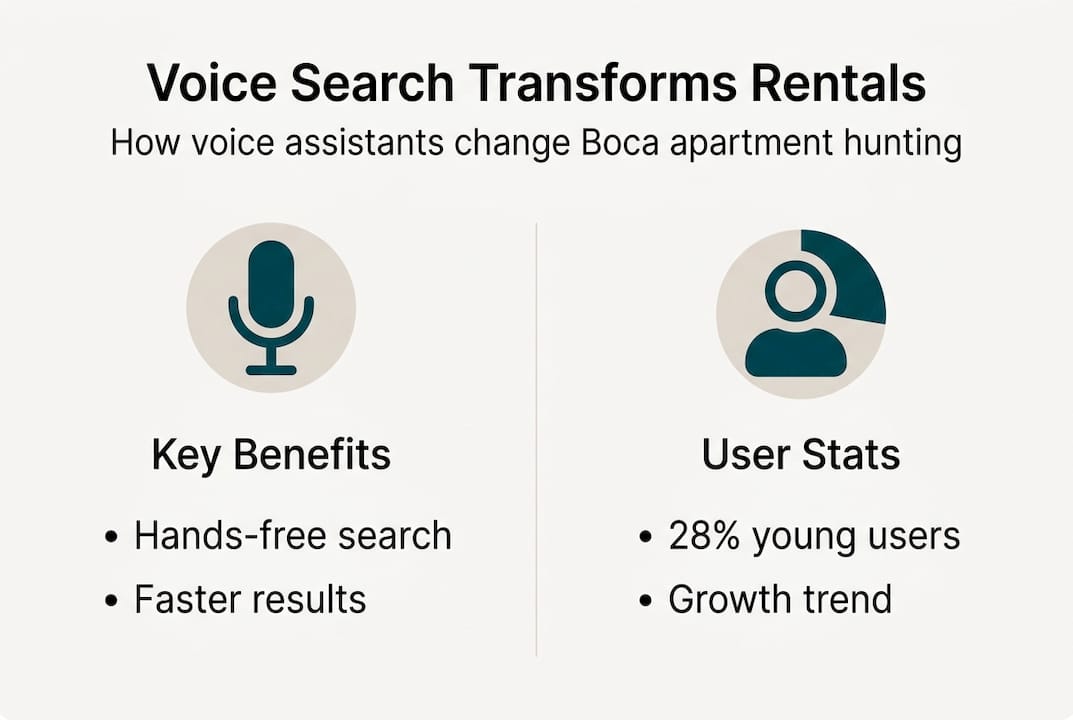
The adoption numbers tell a clear story. 28-34% of young professionals and students regularly use voice assistants today, and 65% of adults aged 25 to 49 use them daily. That’s not a niche behavior anymore. That’s the majority of the exact demographic trying to rent apartments in Boca Raton.
What makes voice search particularly powerful for local apartment hunting is its built-in local intent. Voice searches are three times more likely to carry local intent compared to typed searches. When someone says “affordable pet-friendly one-bedroom near FAU,” they aren’t browsing casually. They want an address, a price, and a move-in date.
Here’s why voice assistance fits the lifestyle of young renters so well:
- Hands-free searching while commuting, cooking, or walking between classes
- Faster query building by speaking naturally instead of clicking through dropdown menus
- Instant local filtering that pulls results near a specific location or landmark
- Reduced screen fatigue from endless scrolling through irrelevant listings
- Conversational follow-ups that let you refine results without starting over
Think about a typical Tuesday for a FAU student working part-time. You have 10 minutes between classes. You’re not sitting at a desk. But you can absolutely say, “Hey Google, show me one-bedroom apartments under $1,500 near FAU that allow cats,” and get filtered results before you reach your next building. That’s the real value here.
For a broader overview of how to approach your search from the start, the renter’s guide to apartment finding covers the top platforms worth your time. And if you want to see how interactive tools like maps are speeding up the leasing process, faster leasing with apartment map shows exactly how visual search tools complement voice queries.
How voice assistants work for apartment searches
Understanding the mechanics helps you use the tools more effectively. Voice assistants don’t just transcribe what you say and run a keyword search. They use natural language processing (NLP), which means they interpret the intent behind your words, not just the words themselves.
Here’s a simple step-by-step of how a voice-based apartment search works:
- Activate your assistant. Say “Hey Siri,” “OK Google,” or “Alexa” to wake the device.
- Speak your full query. Be specific: “Find pet-friendly one-bedroom apartments in Boca Raton under $1,600 near Florida Atlantic University.”
- Review filtered results. The assistant pulls listings that match your stated criteria and presents them visually or reads key details aloud.
- Refine with follow-ups. Say “Show me only ones that allow large dogs” or “Which of these have in-unit laundry?” to narrow further.
- Save or share a listing. Most platforms let you bookmark results directly from the voice interface.
The three major platforms for this are Google Assistant, Apple’s Siri, and Amazon’s Alexa. Each connects to different data sources, so results can vary. Google Assistant tends to pull the most current local listings because it integrates directly with Google Maps and Google Search. Siri works well if you’re already in the Apple ecosystem. Alexa is catching up fast on rental-specific queries.
On the platform side, Apartments.com launched Smart Search, a voice-activated AI specifically built for rental queries. You can speak a natural sentence and the system filters listings in real time without you touching a single dropdown.
Here’s a quick comparison of voice search versus traditional search to put the difference in perspective:
| Feature | Voice search | Traditional search |
|---|---|---|
| Query input | Spoken, natural language | Typed keywords |
| Filter setup | Single spoken sentence | Multiple manual clicks |
| Local intent | Built-in, highly accurate | Requires manual location input |
| Speed | Faster for mobile users | Faster for desktop power users |
| Best for | On-the-go, specific queries | Detailed comparison browsing |
Pro Tip: When using voice search on a mobile device, always include a landmark or neighborhood name in your query. Saying “near FAU” or “in Boca Raton” dramatically improves the accuracy of your results compared to relying on your device’s GPS alone.
For a full breakdown of which platforms perform best for renters, the guide to best apartment finding sites compares the top options side by side.
Benefits and smart strategies for voice-based apartment hunting
Voice search isn’t just convenient. When used correctly, it genuinely cuts down the time you spend hunting and increases the quality of the results you see. Here’s why that matters for renters in Boca Raton.

Voice assistance streamlines apartment search for students, young professionals, and pet owners by allowing hands-free, natural queries and instant filtering. Instead of spending 45 minutes adjusting filters across three different websites, you can get targeted results in under two minutes with one well-phrased query.
The high local intent in voice searches also means you’re less likely to waste time on listings that are technically in “Boca Raton” but are actually 20 minutes from campus or your office. Voice queries naturally anchor to your location and your stated preferences simultaneously.
Key benefits worth knowing:
- Bundle multiple filters in one query. Say “pet-friendly, one-bedroom, under $1,500, near FAU, with parking” and get results that match all five criteria at once.
- Search while mobile. No laptop needed. Your commute, lunch break, or walk to class becomes productive search time.
- Reduce decision fatigue. Fewer irrelevant results means less time comparing options that don’t fit your needs.
- Follow-up queries refine fast. You can keep the conversation going with your assistant to drill down without starting over.
Smart strategies to get better results:
Be specific from the start. Vague queries return vague results. “Apartments in Boca” is far less useful than “one-bedroom apartments in Boca Raton under $1,600 that allow dogs.”
Use real landmarks. “Near FAU,” “close to Mizner Park,” or “off Glades Road” helps the assistant anchor your search geographically.
Follow up immediately. If the first results aren’t quite right, refine on the spot. “Show me only ones with in-unit laundry” takes two seconds.
Pro Tip: Save your most-used voice queries as shortcuts on your phone. On iPhone, you can create a Siri shortcut that runs your full apartment search query with one tap. It sounds small, but when you’re checking listings three times a day, it adds up.
If you have a pet and want to know what to look for beyond just a “yes” on the pet policy, the pet-friendly apartment guide walks through breed restrictions, deposit structures, and what questions to ask. For renters watching their budget, affordable pet-friendly housing tips covers how to find places that won’t charge excessive pet fees.
Limitations and real-world tips for renters using voice search
Voice search is genuinely useful, but it isn’t perfect. Understanding where it struggles helps you avoid frustration and get better results overall.
The first limitation is platform coverage. Not every apartment listing site supports voice commands. Many smaller or local listing sites have no voice integration at all. If you rely solely on voice search, you may miss properties that are only listed on sites without that capability.
The second issue is misinterpretation. Natural language processing has improved dramatically, but voice assistants still mishear words or misread intent. Saying “Boca Raton” clearly is usually fine, but complex queries with multiple conditions can sometimes get garbled. You may need to repeat or rephrase.
Third, benchmarks show rapid growth in mobile voice queries, but rental-specific data and listings haven’t fully caught up. Some voice results pull from outdated listing databases, which means a unit that shows up as available may already be leased.
Common pitfalls to watch for:
- Outdated listings appearing in voice results because the platform’s data isn’t refreshed in real time
- Misheard amenity terms like “in-unit laundry” being interpreted as “on-site laundry”
- Missing niche filters such as specific breed restrictions or exact square footage
- Limited follow-up depth on some platforms that don’t support multi-turn voice conversations
The smartest approach is to use voice search as your first pass and traditional filtering as your verification step. Let voice search surface the top candidates quickly, then open each listing manually to confirm the details that matter most to you.
Pro Tip: Never rely on voice search alone to confirm a pet policy. Always read the lease addendum or ask the leasing office directly. “Pet-friendly” in a listing can mean anything from “cats only” to “any pet under 25 pounds.” Verify before you apply.
For renters specifically looking for one-bedroom options in Boca Raton that welcome pets, one-bedroom pet-friendly options lists verified properties with clear pet policies. And if budget is your main concern, affordable pet-owner listings focuses on options with reasonable pet fees.
Why voice will keep shaping how Boca renters search beyond 2026
Here’s a take you won’t hear often: voice search isn’t just a convenience feature. It’s quietly becoming an equity tool.
Not every renter has time to sit at a desktop and spend an hour comparing listings. Many FAU students work multiple jobs. Young professionals in Boca are commuting, networking, and managing packed schedules. Voice search gives those renters the same access to quality filtered results that someone with more free time gets from a long desktop session. That’s a meaningful shift.
20.5% of global online users use voice search, and 51% use it specifically for researching products and services, including housing. As that number climbs, platforms that don’t offer voice integration will lose users to those that do.
The real breakthrough coming in the next few years isn’t just voice recognition. It’s voice combined with AI that remembers your preferences, tracks your search history, and proactively surfaces new listings that match what you’ve been asking for. Imagine your assistant saying, “A new one-bedroom just listed near FAU that fits your criteria” before you even ask. That’s where this is heading.
For renters in Boca Raton, the practical advice is simple: start using voice search now. Even if the results aren’t perfect yet, you’re building the habit and the query vocabulary that will serve you well as the technology matures. Tools like faster leasing with interactive maps already show how combining multiple tech tools shortens the path from search to signed lease.
Ready to find your perfect Boca Raton apartment?
Voice search is a powerful starting point, but the fastest path to a signed lease is landing on a site where the listings are accurate, the pet policies are clearly stated, and you can take a virtual tour without playing phone tag.
At Cynthia Gardens, we’ve built our leasing experience around exactly that. No hidden fees, no vague pet policies, and no waiting three days for a callback. You can explore pet-friendly amenities to see exactly what we offer for residents with pets, browse our available one-bedroom apartments in Boca, or go straight to our pet-friendly one-bedroom listings if that’s your specific need. Use voice search to find us, then let our tools do the rest.
Frequently asked questions
Which voice assistants work best for apartment hunting?
Alexa, Google Assistant, and Siri are the top platforms supporting natural language apartment searches, with Google Assistant generally returning the most current local listings due to its deep integration with Google Search.
How do I search for pet-friendly apartments using voice commands?
Speak your full set of requirements in one sentence, such as “Find pet-friendly one-bedroom apartments near FAU under $1,600,” and the assistant will filter results accordingly. Platforms like Apartments.com Smart Search are built specifically for this type of query.
Does voice search work on all apartment listing websites?
No. Apartments.com launched the first dedicated voice-activated rental search tool, but many smaller listing sites still don’t support voice commands, so always verify results manually.
Is voice search faster than using filters?
For mobile users, yes. Voice search lets you bundle multiple filters into a single spoken sentence, which is significantly faster than clicking through dropdown menus one at a time on a small screen.
Do young renters really use voice assistants for apartment searches?
28-34% of Gen Z and Millennials use voice assistants regularly, and 56-57% use them occasionally, making voice search a mainstream behavior among exactly the renters looking for apartments near FAU.